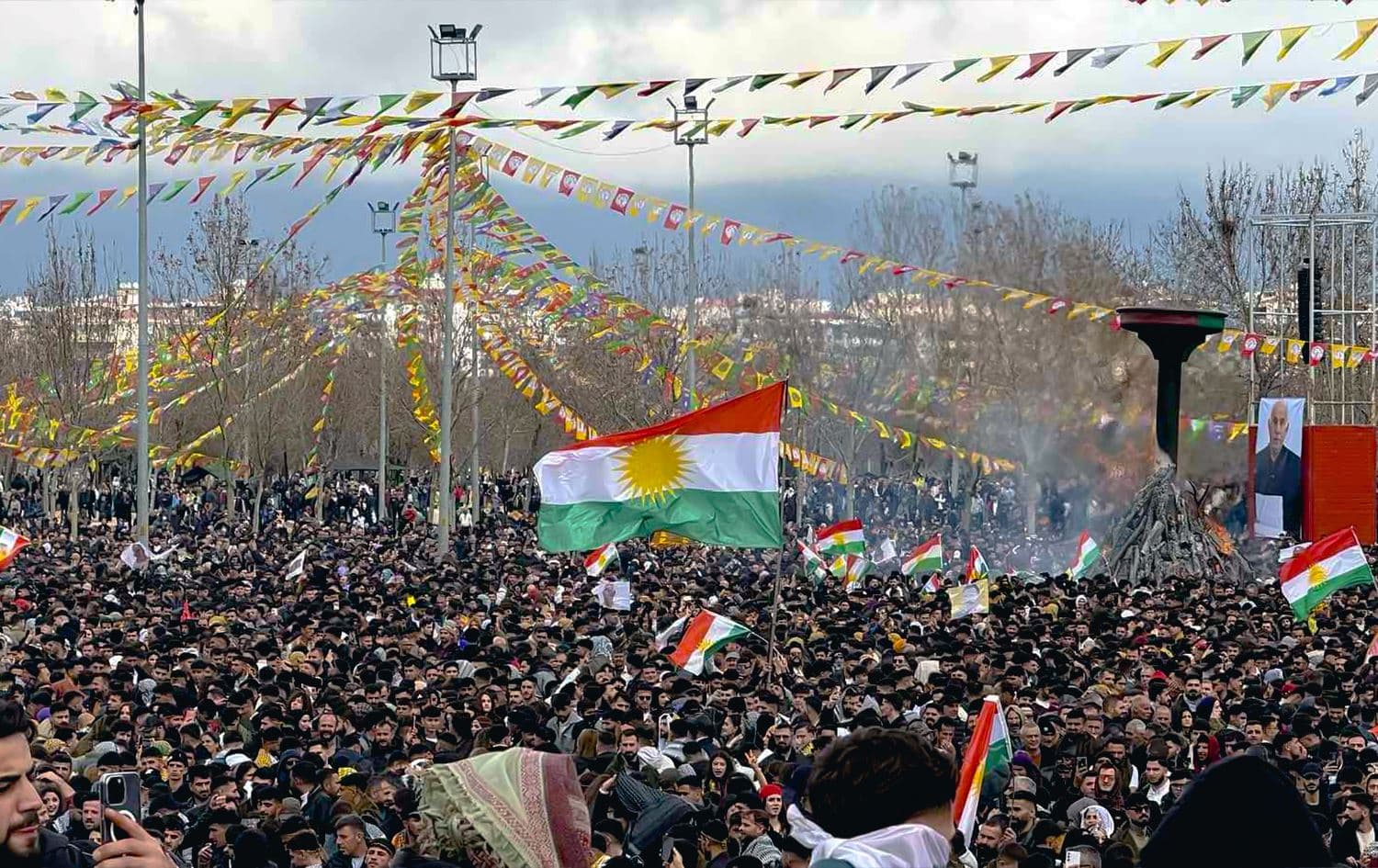
Diyarbakir, Turkiye — Kurdish leaders reiterated their support for the ongoing peace process in Turkiye during Newroz celebrations in the city of Diyarbakir, calling on all sides to recognize that peace is the only viable path forward for Turkiye and the wider region.
Tens of thousands of people gathered in Diyarbakir — known as Amed in Kurdish — to celebrate the festival marking the beginning of the Kurdish New Year, which has become a symbol of unity, renewal, and hopes for peace.
“In the Kurdistan Region, we reaffirm our full support for the success of peace and look forward to the end of conflicts and the consolidation of stability,” Kurdistan Region President Nechirvan Barzani said in a written message referring to the peace process that began between the Turkish government and the Kurdistan Workers’ Party (PKK) in February 2025.
“Let us work together so that, at a time when the region is passing through difficult wars and tensions, peace becomes a lasting reality,” he added.
The peace process began after imprisoned PKK leader Abdullah Öcalan called on his fighters to lay down their arms and pursue a new form of struggle for Kurdish rights within Turkiye. His call was followed by messages of support from Turkish leaders, including President Recep Tayyip Erdoğan and nationalist leader Devlet Bahçeli.
“The process we initiated on 27 February 2025 aims to revive the foundations of unity in keeping with the spirit of Newroz,” Öcalan said in a written message read out at the event. He stressed the need to believe in coexistence among different cultures and faiths and to move beyond narrow nationalist ideologies toward democratic integration.
President Barzani and other leaders from the Kurdistan Region have for years encouraged both Kurdish political actors and the PKK in Turkiye and the Turkish government to resolve their differences through dialogue and negotiations.
President Masoud Barzani also reiterated his support for the peace process in Türkiye and said that he hoped that the result would serve all sides. “The message of the people of Kurdistan has always been peace and stability. Our efforts have been for the people of Kurdistan not to be drawn into this tension and rivalry,” President Masoud Barzani said. “I reiterate our support for the peace process in Türkiye and we hope that it will reach a good outcome that serves all sides.”
Since the collapse of the previous peace process in July 2015, at least 7,270 people have been killed in clashes between PKK fighters and Turkish government forces, according to data compiled by the International Crisis Group. Overall, the conflict — which began in the early 1980s — has claimed more than 40,000 lives.
“For us, Newroz is a special celebration; it is a symbol of renewal and the will to live, as well as an expression of the hopes of a people who have always longed for freedom and coexistence,” Barzani said. “I hope this celebration becomes a source of goodness and peace for everyone.”
Öcalan has previously praised the role of Turkish leaders in pursuing peace and reiterated that democratic politics must replace armed struggle.
“Our call … is a declaration that where democratic politics comes to life, weapons lose their meaning,” he said in a message read out on February 27 in Ankara by lawmakers Pervin Buldan and Tülay Hatimoğulları of the pro-Kurdish Peoples’ Equality and Democracy Party (DEM Party).
In his Newroz message, Öcalan addressed the wider regional conflict currently raging between Iran and its proxies on the one hand, and the United States, Israel, and their allies on the other. He argued that this conflict undermines centuries of coexistence.
“The religious, sectarian, and cultural wars that have been waged in the Middle East for a thousand years are the greatest blow to the culture of coexistence among its peoples,” Ocalan said in his written message. “Today’s insistence on continuing outdated policies in the region has brought disaster …But we can enable cultures and beliefs to coexist once again. It is within our power to transform the war and chaos that is being created in the Middle East into a spring of freedom for the people.”
.jpeg&w=3840&q=75)