
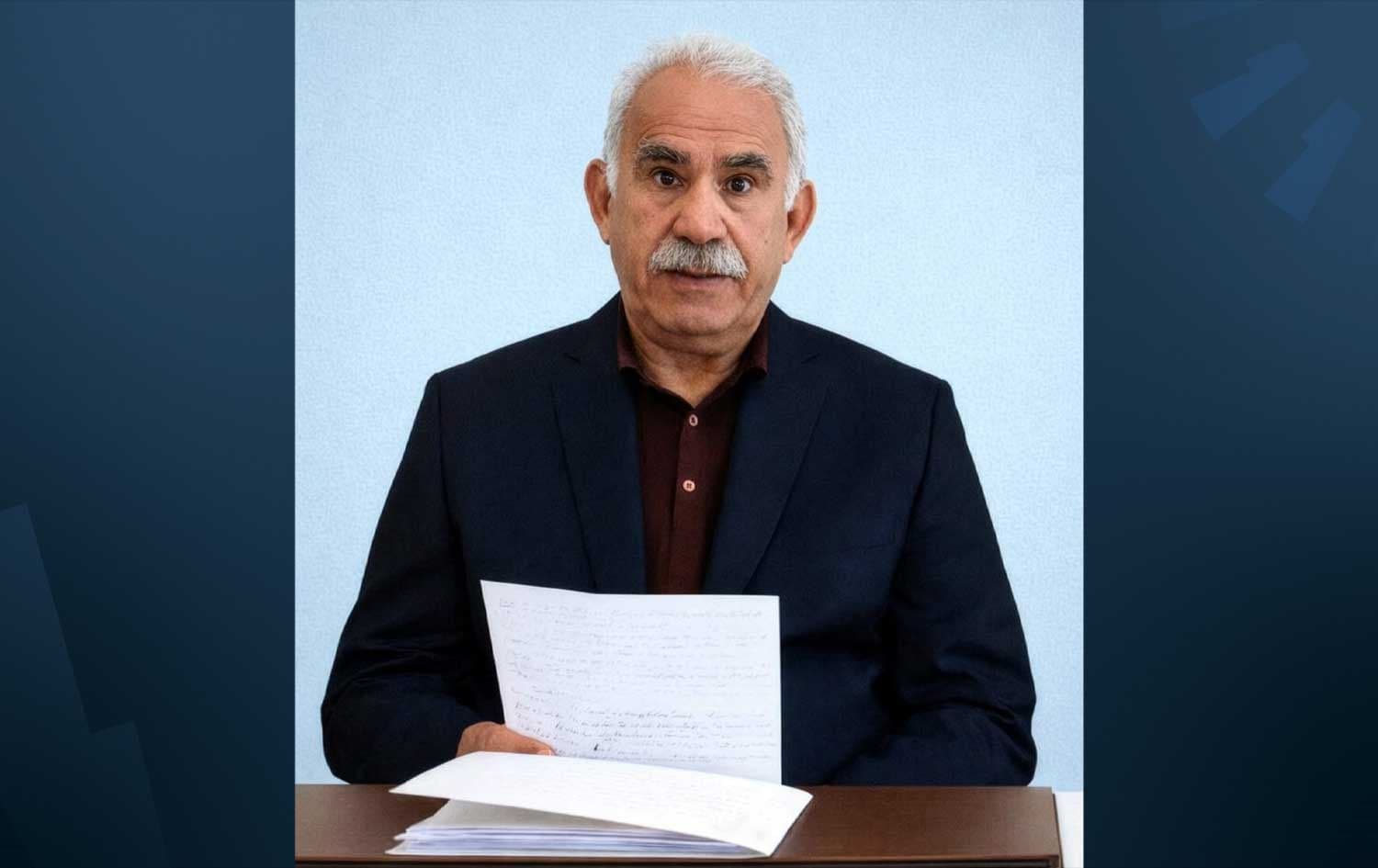

ERBIL, Kurdistan Region - Jailed Kurdistan Workers’ Party (PKK) leader Abdullah Ocalan said democratic politics must replace armed struggle and praised the roles of Turkey’s political leaders in the country's peace process, marking the one-year anniversary of his appeal to end armed struggle in a landmark message on Friday.
The message was read out in Ankara by Turkey’s pro-Kurdish Peoples' Equality and Democracy Party (DEM Party), which has been mediating the peace talks, during a ceremony commemorating Ocalan’s February 27, 2025 Call for Peace and Democratic Society. A new photograph of Ocalan was also shared during the event.
“Our call… is a declaration that where democratic politics comes to life, weapons lose their meaning; it is a proclamation that the choice has been clearly made in favor of politics, representing an integrity of principles,” Ocalan said in his remarks read out by DEM Party co-chairs Pervin Buldan and Tulay Hatimogullari.
Ocalan in February 2025 called on the PKK to lay down its arms and dissolve itself as a prelude to finding a political solution to the decades-long conflict with the Turkish state, which has claimed nearly 40,000 lives.
In May, the group officially declared its dissolution and an end to its armed campaign, rebranding itself as the Kurdistan Freedom Movement. In October, it announced the withdrawal of all its fighters from Turkey as part of its push for peace with Ankara.
Ocalan conveyed his latest message to a DEM Party delegation during a visit on February 16 to Imrali Island, where he has been imprisoned since 1999. Despite his incarceration, Ocalan remains a central figure in Kurdish politics and peace efforts and has continued to receive visits from political delegations and family members as part of ongoing dialogue aimed at ending decades of violence.
The DEM Party has played a key mediating role in recent peace efforts, visiting Ocalan multiple times to relay messages between him and political actors.
“We have essentially managed to overcome the negative period of rebellion through a unilateral will and practice,” Ocalan said in the message, adding that “the organization's [PKK] decisions to dissolve and put an end to the armed struggle strategy have demonstrated a purification from violence and a preference for politics not only officially and practically, but also mentally.”
Turning to Kurdish-Turkish relations, Ocalan said, “There can be no Turk without a Kurd, and no Kurd without a Turk,” adding that “the dialectic of this relationship has a historical uniqueness.”
“We are removing the obstacles before the brotherhood that has been sought to be reversed over the last two hundred years, and we are fulfilling the requirements of the law of fraternity. We want to discuss how to come together and how to live together,” he said, adding, “We invite all segments of society to create opportunities and take responsibility in this direction.”
Ocalan also outlined his vision for citizenship in Turkey.
“The citizenship relationship should be founded not on belonging to a nation, but on the bond with the state,” he said, adding, “A constitutional citizenship relationship, based on democratic boundaries and the integrity of the state, encompasses the right to freely express religious, ideological, the identity, and national existence, and the right to organize.”
“Today, no system of thought can survive without basing itself on democracy,” he said.
In the message, Ocalan also praised Turkey’s political leadership, saying that “I have found the will” of President Recep Tayyip Erdogan, “the call” of Devlet Bahceli, leader of the Nationalist Movement Party (MHP), “the contribution” of Ozgur Ozel, leader of the Republican People’s Party (CHP), and “the efforts of all other political, social, and civil individuals and institutions who have made positive contributions to the Process in Turkey highly valuable.”
In October 2024, Bahceli, a key ally of Erdogan, suggested that Ocalan could be eligible for the “right to hope,” - a legal principle allowing for the possibility of conditional release for life prisoners - calling on him to declare the dissolution of the PKK, a move that helped kickstart the renewed peace efforts between Ankara and the group.
Ozel expressed support for Bahceli’s call, saying, “I also offer Kurds a state,” and adding, “I propose that Kurds who do not feel fully belonging to the state, to become the rightful owners of the Republic of Turkey. Let’s create a country where no one feels like an outsider.”
For its part, Ankara in August established a parliamentary commission tasked with creating a legal framework for the peace process between the Turkish state and the PKK.
The 50-member committee last week voted overwhelmingly in favor of a report that lays the groundwork for PKK fighters who reject violence to rejoin Turkish society, though it stops short of granting amnesty. Erdogan described the report as a “roadmap” and an “important achievement” that will “accelerate the process.”
Beyond Turkey, PKK members remain scattered across the region, with a base in the Kurdistan Region’s rugged Qandil mountains.
.webp&w=3840&q=75)
.png&w=3840&q=75)