


Turkey


Turkey has donated medical supplies to the UK, Italy, Spain and others during the COVID-19 pandemic. Photo: AP
ISTANBUL—In a crowded metropolis of 16 million people, coronavirus could be hiding anywhere. Despite the toll of infections rising past 47,000 as of Friday, life goes on in Turkey’s economic nucleus. While a curfew in the city has not been imposed, many cafes, restaurants and shopping malls have closed, other workplaces remain open. Citizens, therefore, need to protect themselves when they go outside.
During the day, streets are still somewhat busy as the neighborhood markets are still doing business. Even as they are supposed to be socially distancing, long queues can easily form at the grocery store, in front of banks, or anywhere people are shopping and forced into close proximity as they wait in line to stock up on supplies.
In this tense atmosphere, the now-ubiquitous business of selling face masks and gloves is booming — some of them taking advantage of the public’s fears, and making specious claims on their ability to protect consumers from COVID-19.
Black polyester masks which have been labeled as approved by Turkey’s Health Ministry and deceptively advertised as protective against coronavirus have flooded markets in Turkey's largest cities, posing a major health risk amid the already dangerous pandemic.
Products marketed under the name “nano masks” tout that they are washable, reusable, and certified — in reality, they are nothing more than re-purposed common polyester fabric, and laboratory tests indicate that they do not meet the standards of a proper face mask.
An investigation by journalist Altan Sancar for the news portal Gazete Karınca revealed that these black cloth masks have few safety benefits, and thus can be potentially hazardous if users at risk of coronavirus are tricked by their dubious claims.
As millions of people continue to go to work in Istanbul – city trash collectors, delivery drivers, restaurant and retail employees, healthcare workers, bank tellers, street vendors, scrap metal collectors, and paper recyclers to name a few. Without access to basic protective equipment such as masks and latex gloves, they are at risk of not only contracting, but spreading the highly-contagious coronavirus.
A health ministry official confirmed to Sancar that a brand’s claims that its products were certified by the Ministry of Health were false. The journalist also spoke to healthcare workers who said that the masks essentially become a medical hazard the moment they are used, while a dermatologist said that the low quality paint from the fabric could cause irritation or allergic reaction.
One online seller contacted through social media admitted that they were not approved by the Ministry of Health but that customers were happy with the masks, while another falsely claimed that they were officially certified by the ministry.
A video posted on social networks shows the black fabric masks being hastily packaged from the floor of a living room rug by a group of young men. Some are barefoot as they load the mass-produced masks into plastic sleeves.
Dozens of online retailers have begun selling these types of mask in different parts of the country, indicating that a number of opportunists have emerged who aim to earn a quick profit from the fear surrounding coronavirus.
“Within the past week, I’ve started to see them being sold by street vendors, markets and pharmacies in Kızılay, the center of Ankara. The other day in Kızılay three out of ten people were using them,” Sancar said.
“Advertisements regarding these products began to appear on social media a week before Turkey announced that the virus had arrived. The usage of the products on the streets rose [along with] advertisements amid the daily announcements of cases from the Ministry of Health,” Sancar told Rudaw English.
On a sunny early afternoon on April 9, the streets of Kurtuluş were far from empty. Within ten minutes of walking, dozens of people could be observed wearing the black nano masks, about equal in number to those donning typical surgical masks.
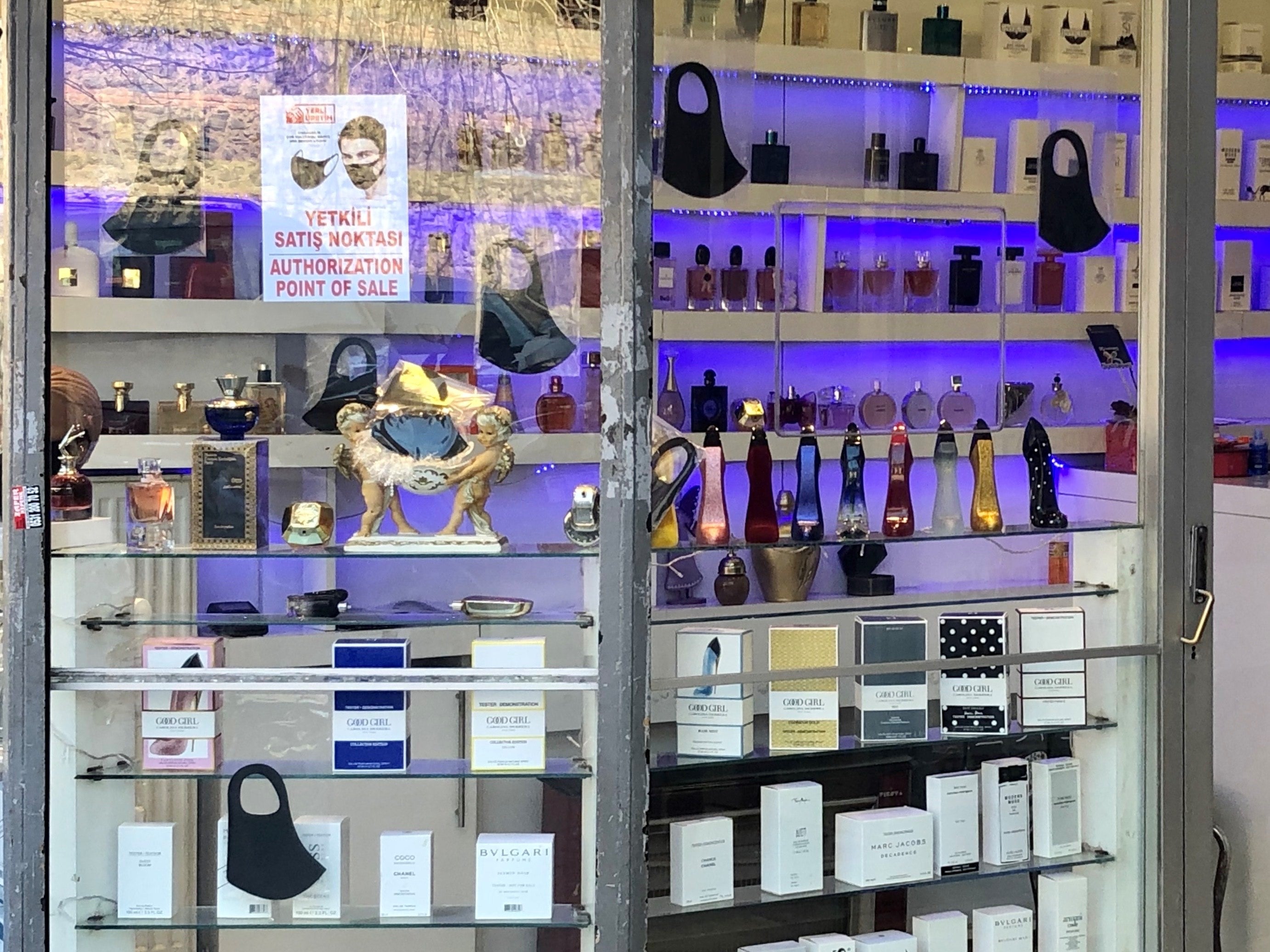
A small shop selling perfume advertised in its window that the masks in question were for sale.
Though the masks appear to have become fashionable in Istanbul and Ankara, the city municipalities say they are not able to intervene in their sale or production.
“Mask sales and product quality does not fall under the jurisdiction of the Istanbul Metropolitan Municipality (IBB), therefore the IBB has no authority to sanction stores or sellers based on consumer product fraud. The matter should be addressed by the Ministry of Health and/or Trade,” an Istanbul municipality spokesperson told Rudaw English in an email.
“The Istanbul Governorship and District Governorates should be in charge to address cases of sales fraud. The only way the IBB can intervene is through municipal police, however the municipal police only have the power to sanction cases of overpricing of goods and services.”
The Turkish government has taken steps to ensure manufacturers are not hoarding masks, but has not regulated what types of masks are safe to protect against COVID-19.
Prior to his report, Sancar tweeted about the masks on March 31, in a comprehensive thread that was shared widely and picked up by television broadcasts. One user responded on April 1 with a screenshot showing that “nano masks” were the top seller in the medical products section of HepsiBurada, a popular online corporate retailer essentially Turkey’s equivalent to Amazon.
Though the masks don’t necessarily cause harm on their own, occupational safety expert Yasemin Oymez advises against their use. “Most of these 'washable masks' [only] protect against pollen or air pollution,” Oymez said in an interview with the DHA news agency.
“Most of these masks do not have the CE symbol [indicating EU certification] and for this reason they are not suitable for sale in Turkey. People who wear these masks have difficulty breathing and sweat heavily. This situation strips away our purpose for using a mask,” she said.


Comments
Rudaw moderates all comments submitted on our website. We welcome comments which are relevant to the article and encourage further discussion about the issues that matter to you. We also welcome constructive criticism about Rudaw.
To be approved for publication, however, your comments must meet our community guidelines.
We will not tolerate the following: profanity, threats, personal attacks, vulgarity, abuse (such as sexism, racism, homophobia or xenophobia), or commercial or personal promotion.
Comments that do not meet our guidelines will be rejected. Comments are not edited – they are either approved or rejected.
Post a comment