


World

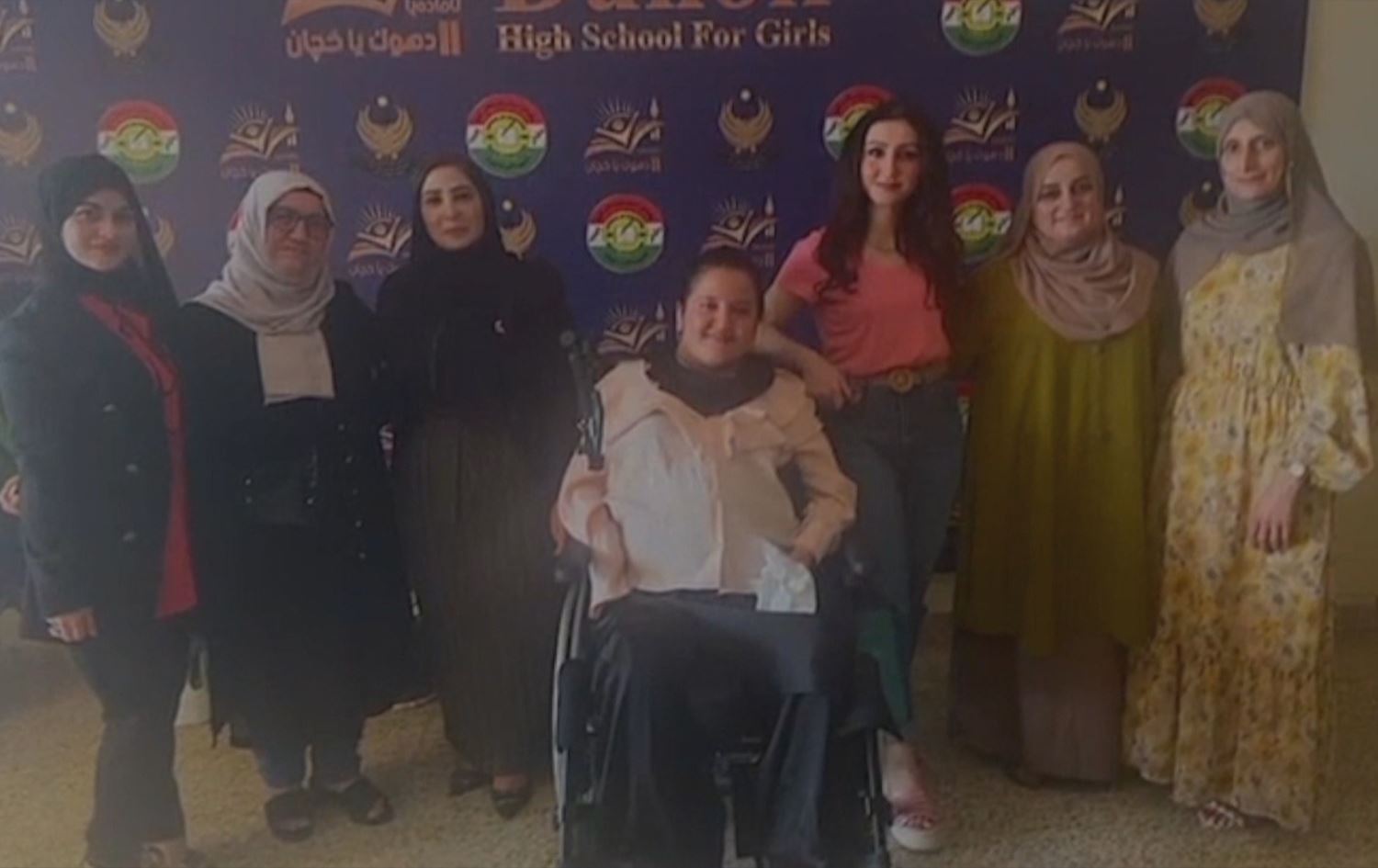
Undated picture of Arwa Abdulhameed during a visit to a girls' high school in the Kurdistan Region. Photo: Rudaw
ERBIL, Kurdistan Region - A Kurdish student at a German university drew from her own experiences in a wheelchair for her research into how the education systems in Iraq and the Kurdistan Region accommodate people with special needs.
Arwa Abdulhameed is paraplegic and spends her life in a wheelchair. In her bachelor’s thesis for her social work degree at Cologne’s University of Applied Science, she showed that in Germany 10 percent of people have special needs while in Iraq that number is 11 percent and that there is a big difference in how they are treated.
Her research found that two out of five students with special needs in Iraq cannot go to school because, as the schools have said themselves, they lack the necessary resources.
She pointed to a lack of proper transport as an example, something she observed while visiting the Kurdistan Region, where she was born.
“There I had to rent a car and find a ramp to use when getting in and out. This problem exists in Iraq and Kurdistan,” she told Rudaw’s Diaspora program that aired on Friday. “It's very important and necessary to help with transportation by providing buses or special cars.”
Abdulhameed noted that the Kurdistan Region is taking steps in the right direction with an effort to provide support for special needs students in 25 percent of the schools.
“Rebaz School had opened a special class for those students and said: 'We accept them and help them to complete their education,' but they also indicated that their problem is that the government doesn't help them,” Abdulhameed said.
“The difference appears here in Germany too. Without government help, things are difficult, but here that help is provided,” she added.
Abdulhameed is a new graduate and is looking to begin a career in social work. At the moment, she stays busy doing volunteer work, visiting hospitals and talking to people who have recently been paralyzed about what to do once they go back home.
“People with special needs are those who have alternative abilities, meaning each of them has a characteristic and can provide a service to their surroundings in a different field,” she said.
While some progress is being made in Iraq and the Kurdistan Region for supporting and including people with special needs, the journey requires continued government support, increased funding, robust policy implementation, and a fundamental shift in societal attitudes.
Arwa Abdulhameed is paraplegic and spends her life in a wheelchair. In her bachelor’s thesis for her social work degree at Cologne’s University of Applied Science, she showed that in Germany 10 percent of people have special needs while in Iraq that number is 11 percent and that there is a big difference in how they are treated.
Her research found that two out of five students with special needs in Iraq cannot go to school because, as the schools have said themselves, they lack the necessary resources.
She pointed to a lack of proper transport as an example, something she observed while visiting the Kurdistan Region, where she was born.
“There I had to rent a car and find a ramp to use when getting in and out. This problem exists in Iraq and Kurdistan,” she told Rudaw’s Diaspora program that aired on Friday. “It's very important and necessary to help with transportation by providing buses or special cars.”
Abdulhameed noted that the Kurdistan Region is taking steps in the right direction with an effort to provide support for special needs students in 25 percent of the schools.
“Rebaz School had opened a special class for those students and said: 'We accept them and help them to complete their education,' but they also indicated that their problem is that the government doesn't help them,” Abdulhameed said.
“The difference appears here in Germany too. Without government help, things are difficult, but here that help is provided,” she added.
Abdulhameed is a new graduate and is looking to begin a career in social work. At the moment, she stays busy doing volunteer work, visiting hospitals and talking to people who have recently been paralyzed about what to do once they go back home.
“People with special needs are those who have alternative abilities, meaning each of them has a characteristic and can provide a service to their surroundings in a different field,” she said.
While some progress is being made in Iraq and the Kurdistan Region for supporting and including people with special needs, the journey requires continued government support, increased funding, robust policy implementation, and a fundamental shift in societal attitudes.


Comments
Rudaw moderates all comments submitted on our website. We welcome comments which are relevant to the article and encourage further discussion about the issues that matter to you. We also welcome constructive criticism about Rudaw.
To be approved for publication, however, your comments must meet our community guidelines.
We will not tolerate the following: profanity, threats, personal attacks, vulgarity, abuse (such as sexism, racism, homophobia or xenophobia), or commercial or personal promotion.
Comments that do not meet our guidelines will be rejected. Comments are not edited – they are either approved or rejected.
Post a comment