


Newly elected German Chancellor Friedrich Merz attends a handover ceremony at the Chancellery in Berlin on May 6, 2025. Photo: Odd Andersen/AFP
BERLIN - Germany’s legislature, the Bundestag, on Tuesday elected Friedrich Merz, leader of the Christian Democratic Union (CDU), as the country’s next chancellor, following a second round of voting in which he secured a parliamentary majority.
Merz’s initial attempt to secure the chancellorship fell short by six votes despite his coalition - comprising the CDU, its Bavarian sister party the Christian Social Union (CSU), and the center-left Social Democrats (SPD) - holding a majority of 328 seats.
After further negotiations, Merz was confirmed in a second vote with 325 votes in favor. His appointment will be formalized by President Frank-Walter Steinmeier.
The incoming government is expected to be formed by the CDU/CSU and SPF coalition.
Serdar Yuksel, a Kurdish-born SPD lawmaker, told Rudaw on Tuesday that “72 days after the federal elections, we are hopeful [that the coalition] will deliver positive outcomes under Chancellor Merz.”
Yuksel also warned that democracy in Germany is under threat due to the rise of the radical, far-right party, emphasizing the coalition's responsibility to uphold democratic values.
The Kurdish-born lawmaker additionally highlighted the importance of “establishing a bridge between Germany and Kurdistan.”
“The people of Kurdistan should know they are not alone,” Yuksel said, emphasizing that “they have a strong voice in the [German] federal parliament. The SPD will stand shoulder-to-shoulder with the Kurds of Northern Iraq.”
Meanwhile, opposition leaders from the far-right Alternative for Germany (AfD) voiced skepticism about the new government’s direction.
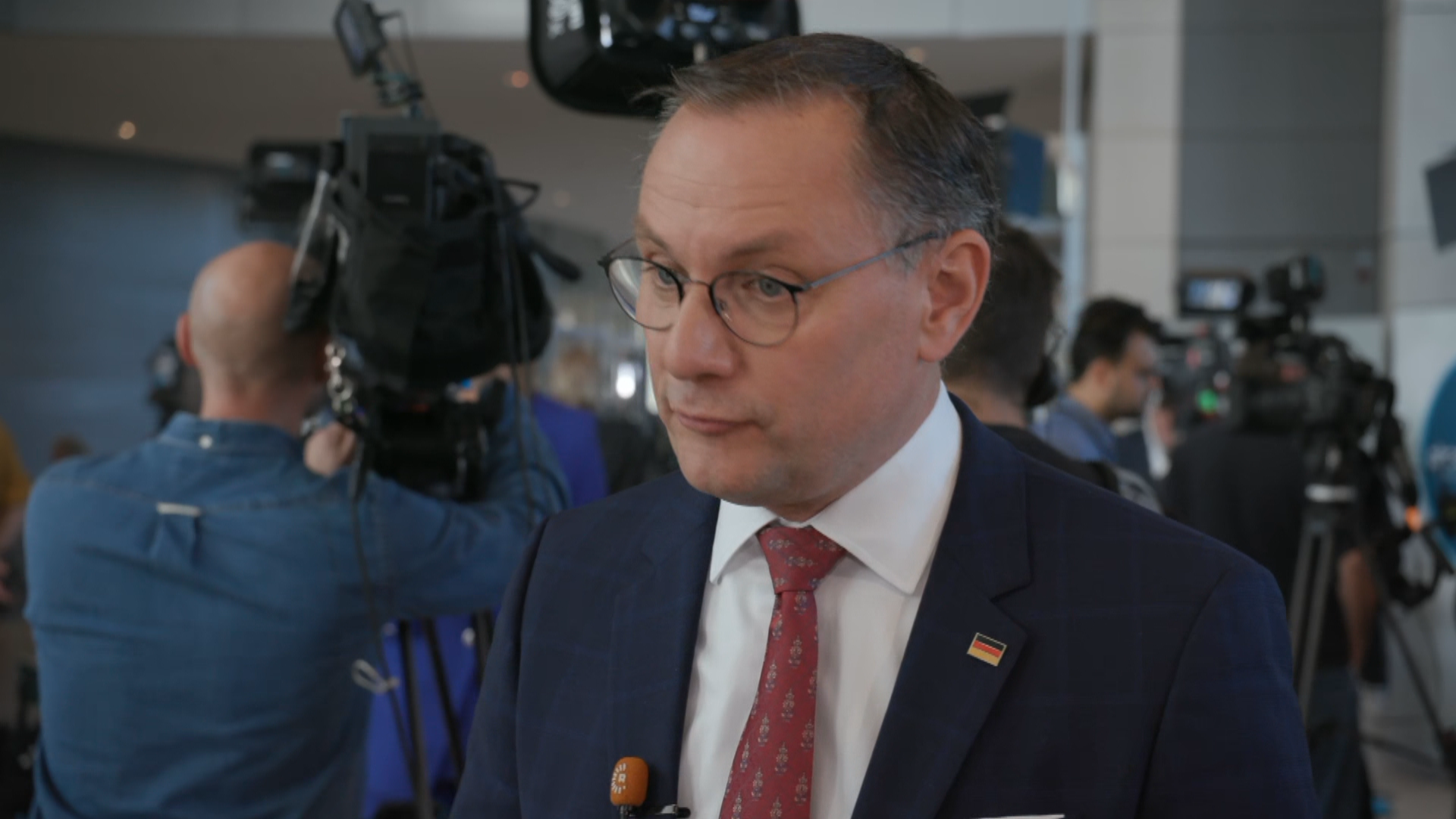
AfD Co-chair Tino Chrupalla told Rudaw on Tuesday that “Merz has yet to deliver on campaign promises, including easing fiscal restrictions and enacting substantive policy shifts.”
“We will closely monitor whether real change occurs. After all that is the opposition’s duty,” Chrupalla said.
He further expressed doubts that the new government under Chancellor Merz will bring significant changes to immigration, economic, or European peace policies, urging a political shift and stricter immigration policies.
“The CDU has changed some policies, such as implementing deportations in regions under their authority. We'll see if they will actually make changes, which they had copied from us, or if it was just voter deception. We will look at it critically,” Chrupalla said.
AfD lawmaker Kay Gottschalk echoed these concerns, lamenting what he described as a weakened economy and overstretched public services.

“German industry is faltering, schools and housing are overwhelmed, and our social systems are at capacity,” Gottschalk said, arguing that Berlin has tried having open borders while also being a welfare state.
“We’ve tried to juggle both and it's tearing us apart. So there’s no shame in saying: we need to repatriate people,” the AfD lawmaker said.
The federal parliamentary elections, held in February, saw all 630 Bundestag seats contested by over 59 million eligible voters.
The CDU/CSU bloc emerged as the largest faction with 28.5 percent of the votes, followed by the AfD at 20.5 percent and the SPD at 16.4 percent.
Key issues in the campaign included immigration, economic stability, and public trust in democratic institutions.
In late January, the German federal parliament passed a motion aimed at tightening illegal immigration enforcement. The proposal was backed by the CDU, CSU, and the AfD - an unusual cross-party alignment that drew criticism from civil society groups and some members of the SPD.


Comments
Rudaw moderates all comments submitted on our website. We welcome comments which are relevant to the article and encourage further discussion about the issues that matter to you. We also welcome constructive criticism about Rudaw.
To be approved for publication, however, your comments must meet our community guidelines.
We will not tolerate the following: profanity, threats, personal attacks, vulgarity, abuse (such as sexism, racism, homophobia or xenophobia), or commercial or personal promotion.
Comments that do not meet our guidelines will be rejected. Comments are not edited – they are either approved or rejected.
Post a comment