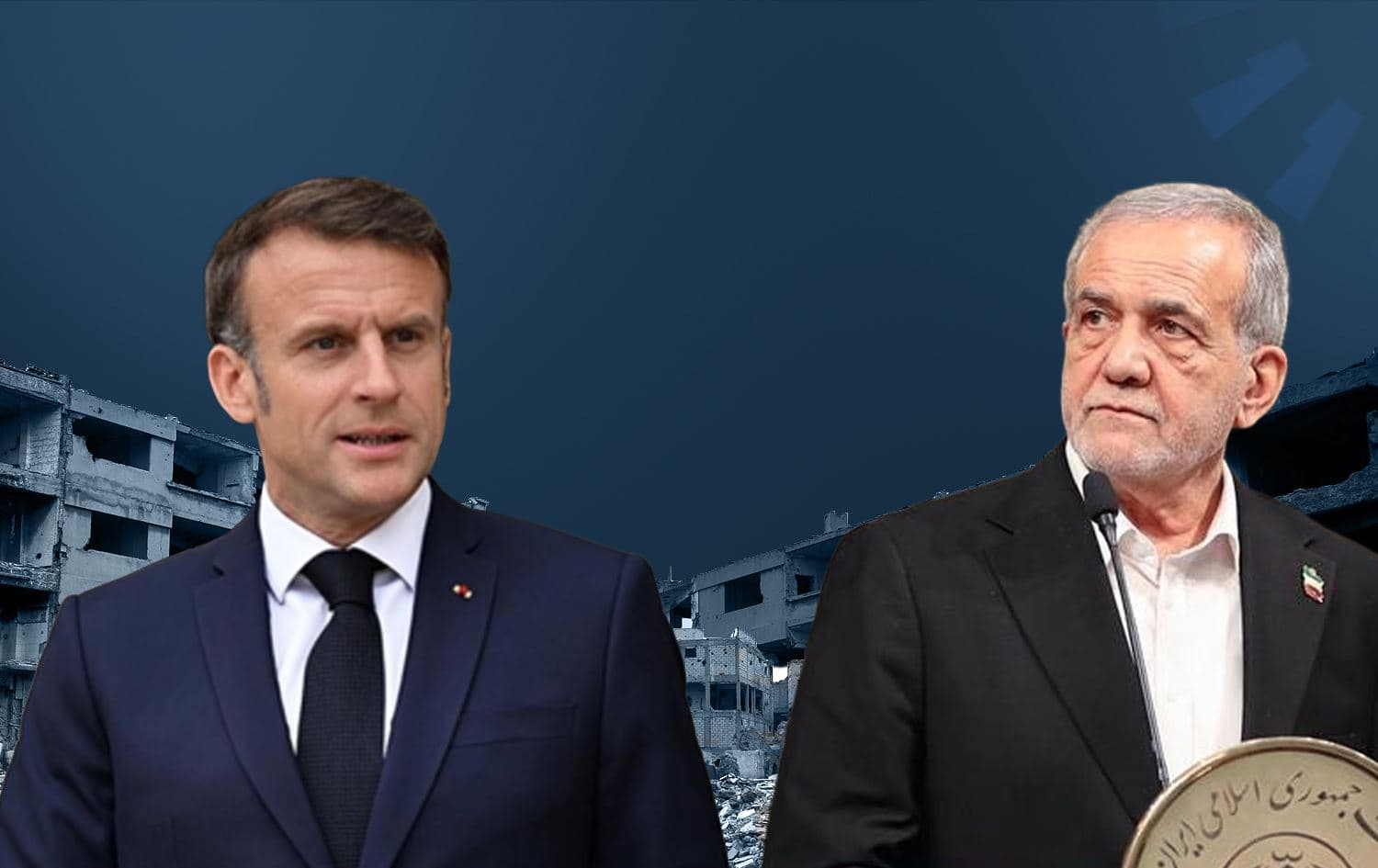
ERBIL, Kurdistan Region - French President Emmanuel Macron on Sunday held a phone call with his Iranian counterpart Masoud Pezeshkian urging an immediate cease to Tehran’s strikes on alleged US targets in the region. The call, which marks the first such engagement by a European leader with the Iranian president since the Iran-Israel-US war began last week, comes a day before Macron is set to arrive in Cyprus for talks on regional maritime security.
In a statement on X, Macron said he stressed to Pezeshkian “the need for Iran to immediately cease its strikes against countries in the region,” adding that Tehran “must also guarantee freedom of navigation by putting an end to the de facto closure of the Strait of Hormuz.”
Macron conveyed Paris’ “deep concern over the development of Iran’s nuclear and ballistic programs and over all of its destabilizing activities in the region, which are at the origin of the current crisis.”
The French leader further emphasized that “a diplomatic solution is more necessary than ever to address these crucial challenges, put an end to the escalation, and preserve peace.”
“We agreed to remain in contact,” Macron notably declared.
For its part, the Iranian presidency did not provide details about the notable call.
The backdrop
The Macron-Pezeshkian engagement marked the first by a European leader with the Iranian president since the outbreak of the Iran-Israel-US war late last week.
The US and Israel on February 28 launched a joint aerial campaign against Iran, killing several of the country’s top leaders and commanders, including long-time supreme leader Ayatollah Ali Khamenei.
The Iran-Israel-US war entered its second week on Saturday, with the US Central Command declaring on Saturday that its forces have struck over 3,000 targets in its campaign dubbed Operation Epic Fury. The Command added that approximately 43 Iranian ships were also damaged or destroyed.
For its part, Iran said Friday that it had launched more than 2,000 drones and over 600 missiles targeting US and Israeli positions as part of its multi‑front response titled Operation True Promise 4.
Meanwhile, the Strait of Hormuz remains effectively closed to commercial traffic after the Iranian Revolutionary Guard Corps (IRGC) recently declared it a restricted war zone, warning it would “set ablaze” any ship attempting passage.
Notably, Iranian Foreign Minister Abbas Araghchi in a Thursday interview with NBC denied that his country has closed the key waterway, instead arguing that ships and tankers are avoiding passage due to fear of being caught in the crosshairs of the fighting.
It also comes days after the French president on Tuesday declared that he ordered Paris’ “aircraft carrier Charles de Gaulle, along with its air assets and frigate escort, to set course for the Mediterranean.”
“We have economic interests to protect, and with oil prices, gas prices, and international trade deeply disrupted by this war, we are taking the initiative to build a coalition,” Macron then said. “This coalition will bring together the necessary resources - including military ones - to restore and secure traffic through these maritime routes, which are essential to the global economy.”
Engagement intensified
Macron on Sunday also spoke with the president of Azerbaijan and Egypt, as well as the Emirs of Kuwait and Qatar, to express “full solidarity” and stress “the importance of securing energy supplies, which requires that oil tankers be able to sail in the Red Sea and the Strait of Hormuz.”
The intensified diplomatic engagement comes as the French president is set to visit Cyprus on Monday, to discuss “strengthening security around Cyprus and in the eastern Mediterranean,” the Elysee reported Sunday.
Cyprus on Monday was targeted by Iranian-made drones, which prompted Macron to dispatch the Charles de Gaulle aircraft carrier to the Mediterranean, a frigate and air defense units to Cyprus.
“This trip is intended to demonstrate France's solidarity with Cyprus, a member state of the European Union with which we have a strategic partnership" and which was recently hit "by several drones and missile strikes,” the Elysee said.
On Sunday as well, the French president spoke to his American counterpart, Donald Trump. Details on the conversation were not provided by neither the Elysee nor the White House.
Eyes on Kurdistan
The Iranian response to the US-Israeli campaign has also included a series of ongoing strikes by shadowy armed groups attacks against alleged US targets in Iraq, including in the Kurdistan Region.
Kurdistan Region President Nechirvan Barzani and French President Emmanuel Macron on Saturday discussed the ongoing regional war and its potential consequences, expressing concern over the risk of further escalation and stressing the need for stronger international efforts to restore peace and stability.
Both leaders expressed “serious concern about the risk of further escalation and agreed on the urgent need to strengthen international efforts to prevent any additional deterioration of the conflict while restoring peace and security across the region,” according to a statement from the Kurdistan Region Presidency.
Macron said in a statement in Kurdish that during his phone call with President Barzani, he "reaffirmed France’s commitment to the security and stability" of Iraq and Kurdistan Region.
"We agreed to continue our efforts to prevent the proliferation of weapons in the area. To this end, I thanked him for their commitment to that cause," he added.