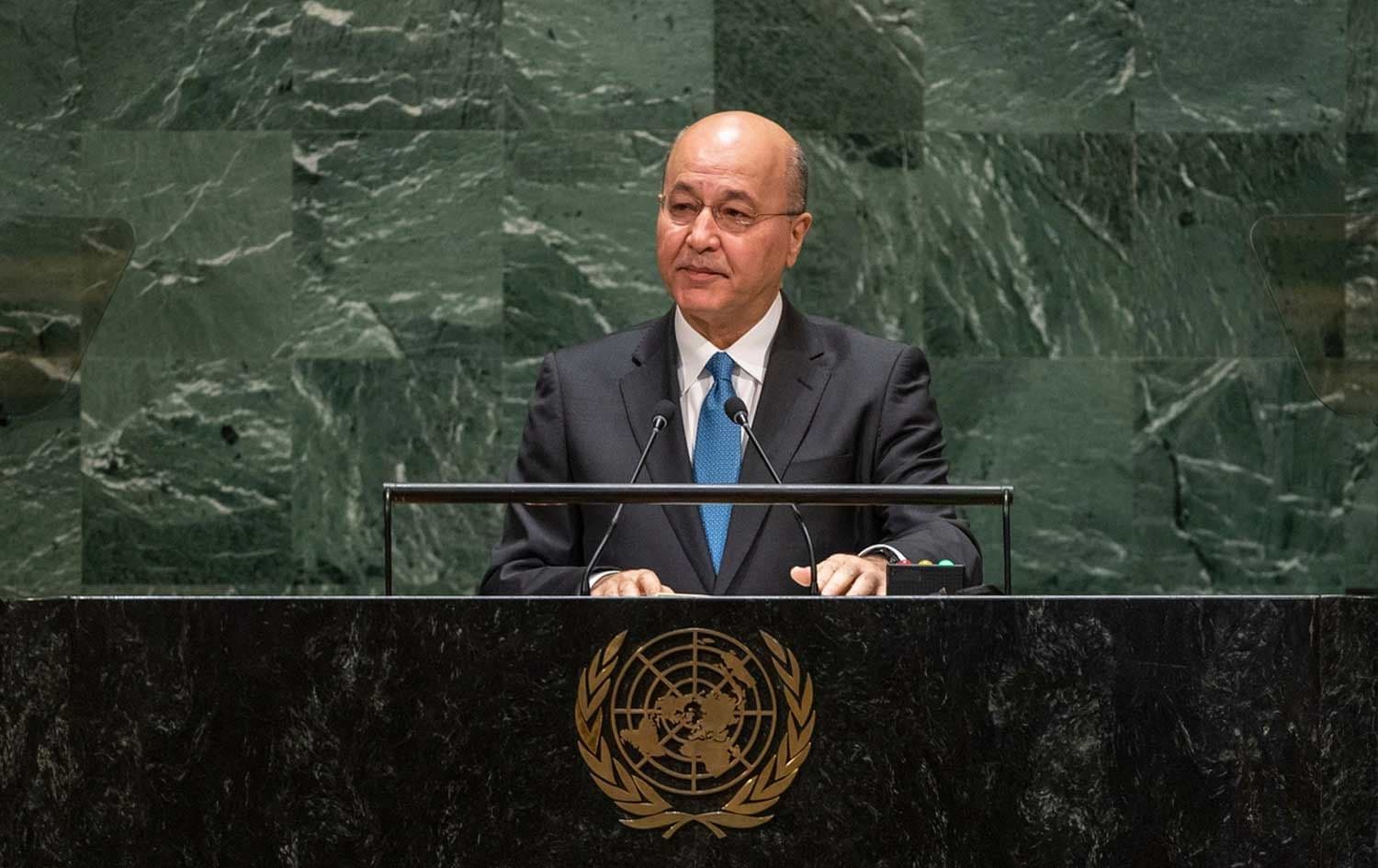

ERBIL, Kurdistan Region - The United Nations General Assembly on Thursday approved former Iraqi President Barham Salih as the next head of the UN refugee agency, making the Kurdish politician the first leader from the Middle East to hold the post since the late 1970s.
Salih, 65, was elected by consensus by the 193-member General Assembly to succeed longtime UN High Commissioner for Refugees Filippo Grandi, whose second term ends on December 31. Salih will begin his five-year term on January 1, 2026.
“I am honoured to have been elected as the incoming United Nations High Commissioner for Refugees,” Salih said in a post on X. “As a former refugee, I know first-hand how protection and opportunity can change the course of a life.”
According to UNHCR, Salih was selected through a competitive process in New York that drew candidates from multiple countries.
At the age of 19, Salih was arrested twice by Saddam Hussein’s Baath Party for his links to the Kurdish national movement, spending 43 days in detention before completing high school. He later fled to the United Kingdom to avoid further persecution.
“That experience will inform a leadership approach grounded in empathy, pragmatism, and a principled commitment to international law,” Salih said.
UN Secretary-General Antonio Guterres, who recommended Salih for the position, welcomed the General Assembly’s decision, saying on X: “I welcome the election by the General Assembly of @BarhamSalih of Iraq as the next @UN High Commissioner for @Refugees.” Guterres also thanked Grandi for “his leadership and tireless efforts in protecting refugees, displaced persons and stateless people.”
Salih will take the helm of the Geneva-based UNHCR following a challenging year for the agency and other UN bodies, marked by spending cuts and thousands of job losses after sharp reductions in foreign aid from the United States and other Western donors.
“Despite deep cuts in humanitarian funding this year, UNHCR remains present in 128 countries, with nearly 90 percent of its more than 14,600 staff working in the field,” the agency said on Thursday, noting that this month marks 75 years of protecting people forced to flee.
“At a time of record displacement and severe pressure on humanitarian resources, delivering on UNHCR’s mandate requires a renewed focus on impact, accountability, and efficiency,” Salih said. He added that he would work “with member states and partners across the public, private, and philanthropic sectors to mobilize the capacity, resources, and collective will needed to reach those most in need.”
Biography
Salih was born on September 12, 1960, in Sulaimani. During his youth, he was arrested twice by Iraq’s former Baath regime.
He earned a bachelor’s degree in civil engineering and architecture from Cardiff University in 1983 and later obtained a PhD in statistics and computer applications in engineering from the United Kingdom.
Salih joined the Patriotic Union of Kurdistan (PUK) in 1976, initially working in Europe before becoming head of the party’s UK relations. He served as a representative of the first Kurdistan Regional Government (KRG) cabinet in 1992 and later as head of foreign relations in the United States.
From 2001 to 2004, Salih served as prime minister of the KRG’s Sulaimani administration, and later again as prime minister in the sixth KRG cabinet for two years.
Following the fall of Saddam Hussein, he became deputy prime minister of the Iraqi Interim Government in 2004 and later served as minister of planning in the Iraqi Transitional Government. From 2006 to 2009, he was deputy prime minister under the elected Iraqi government led by Nouri al-Maliki.
Salih is the founder of the American University of Iraq, Sulaimani (AUIS), and was elected the eighth President of Iraq on October 2, 2018.