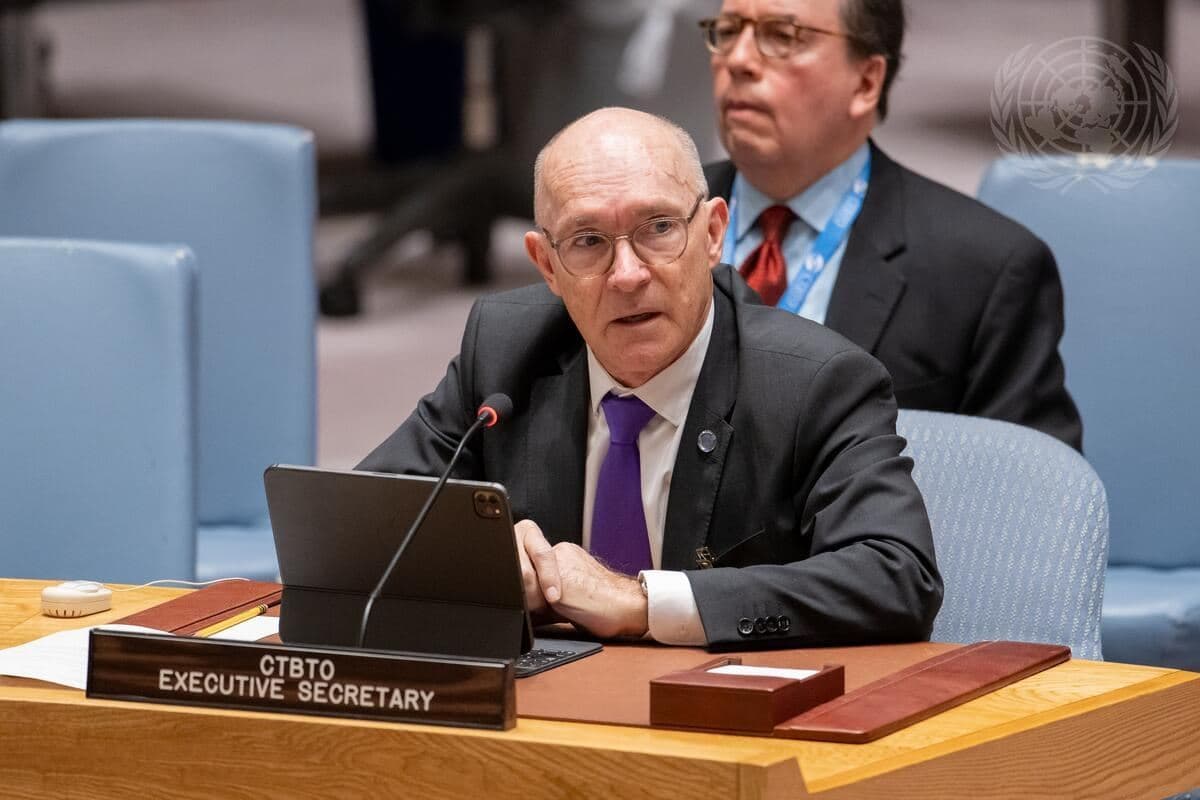

NEW YORK - The head of the global nuclear test ban watchdog acknowledged on Wednesday that his organization cannot reliably detect low-yield nuclear explosions, conceding a gap in the international monitoring system at a moment when fears of a clandestine Iranian test - and a wider return to nuclear weapons testing - are running high.
Robert Floyd, executive secretary of the Comprehensive Nuclear-Test-Ban Treaty Organization (CTBTO), said the network of 307 monitoring stations he oversees would detect any nuclear blast at or above 500 tonnes of TNT equivalent - roughly 2 to 3 percent of the yield of the bomb dropped on Hiroshima - but that confidence drops sharply below that threshold.
“We are way less confident below that threshold of 500 tonnes and down to anything which is yield-producing zero plus,” Floyd told reporters at the United Nations headquarters in New York, in response to a question from Rudaw about the system’s reliability amid the ongoing crisis with Iran.
“That is the area where I think we need to do more work to build confidence in the international community that any test would be detected,” he added.
The admission carries particular weight for the Middle East, where Israel and the United States struck Iran’s nuclear facilities on February 28, marking the start of a six-week war that was followed by a Pakistan-mediated ceasefire on April 8, though a final resolution remains pending.
Iran is one of nine holdout states that have never ratified the test ban treaty, and Western officials have long worried that Tehran could move toward a weapons test if it concluded the war had left its nuclear infrastructure salvageable.
Floyd said the CTBTO’s International Monitoring System is now more than 90 percent complete and has detected all six of North Korea’s nuclear tests, including the smallest in 2006. He also pushed back on persistent social media claims that two seismic events in northern Iran in late 2024 were covert nuclear tests.
“The analysis done by my colleagues showed that those events were entirely consistent with natural seismic events - earthquakes in northern Iran,” Floyd said. “The countries of the world breathed a sigh of relief when we made that known.”
A ‘spiral’ the world may not be able to stop
Floyd’s appearance came on the sidelines of the Eleventh Review Conference of the Nuclear Non-Proliferation Treaty (NPT), which opened at the UN headquarters on Monday and runs until May 22. The treaty review is taking place amid what arms-control specialists describe as the most dangerous nuclear environment in decades.
US President Donald Trump in late October directed the Pentagon to begin testing nuclear weapons “on an equal basis” with Russia and China, claiming, without evidence, that Moscow and Beijing had conducted very low-yield underground tests. Russia has said it would respond “in a mirror manner” if Washington tested first. No nuclear-armed state other than North Korea has detonated a nuclear device since the late 1990s.
Floyd warned that if any major power resumed testing, others would likely follow.
“If one state tests, others would, and even more would potentially then go into a spiral of expanded testing,” he said. “That is a spiral that we do not want to see start, because it may never be able to be stopped.”
He disclosed that he had recently travelled to Moscow and raised the issue directly with Russian Foreign Minister Sergei Lavrov, but said he had been unable to secure a meeting with US Secretary of State Marco Rubio.
“I have not had the opportunity to meet with the Secretary of State. I would greatly welcome that,” Floyd said, adding that he had met with State Department officials.
Nine holdouts, including Iran
The Comprehensive Nuclear-Test-Ban Treaty, opened for signature in 1996, has been signed by 187 states and ratified by 178, but it cannot enter into force until nine specific countries - the US, China, Egypt, India, Iran, Israel, North Korea, Pakistan, and Russia - ratify it. Russia withdrew its ratification in 2023.
Until that happens, three of the treaty’s four verification mechanisms - consultation and clarification, confidence-building measures, and on-site inspections - remain dormant. Only the International Monitoring System is operational.
Floyd said he saw no realistic prospect of any single holdout moving alone, arguing that progress would require Washington, Moscow, and Beijing to act in concert.
“It is, I think, quite unlikely that any one of them would move on that. Moving together, that would certainly be a powerful step forward,” he said. “I don’t have good news to report to you on that matter.”
.jpg&w=3840&q=75)