


Analysis

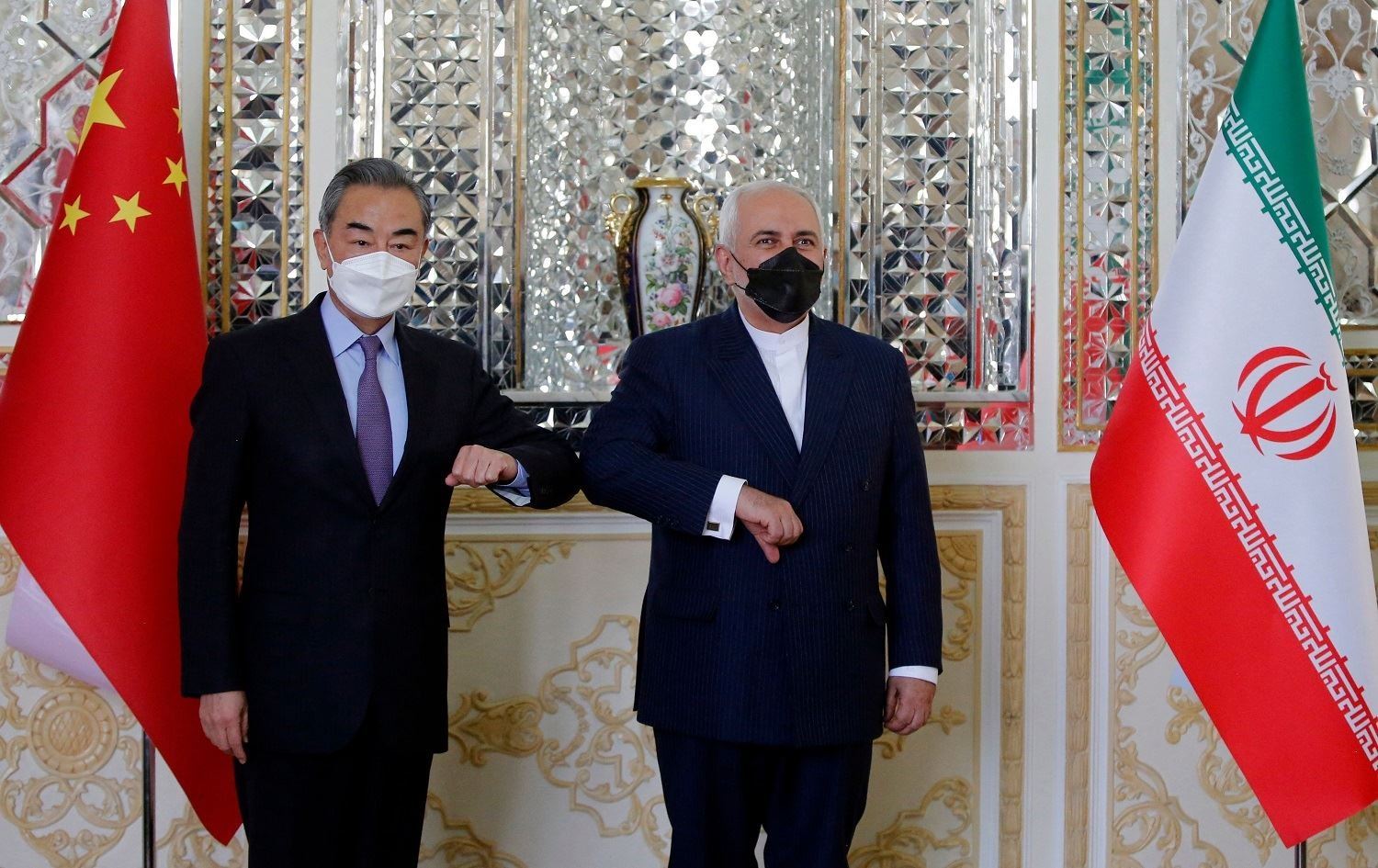
Iranian FM Mohammad Javad Zarif (R) greets his Chinese counterpart Wang Yi in Tehran on March 27, 2021. Photo: AFP
Iran and China signed a long-awaited strategic deal in Tehran on March 27, stirring up huge controversy with regard to China's ambitions in the Middle East and Iran's decisiveness in a diplomatic crossroads between East and West.
The deal pours $400 billion into Iran's suffocated economy over 25 years, in return for heavily discounted hydrocarbon supply to China within the same period. The specifics of the agreement remain ambivalent, but, according to some information leaked from a 2020 draft of the deal, both countries will engage in joint military ventures, including weapon development, intelligence sharing, joint exercises, and the establishment of Chinese military bases on Iranian soil, therefore crossing the threshold of a purely economic settlement and potentially challenging US dominance in the region as fresh indirect talks between United States and Iran hang in the balance.
The China-Iran deal solidifies and strengthens Iran's position in the Middle East, and strengthens China's link to the Middle East, rendering Russia and the United States vulnerable. Raghida Dergham, the Founder and Executive Chairman of Beirut Institute and columnist, believes that the China-Iran deal "will leave Tehran with an annual windfall of up to $20 billion. This will encourage the regime to pursue its domestic and regional projects with even more vigour, including strategic operations inside Syria, Iraq, Lebanon and Yemen."
China has sought, in the last decade. to expand its influence westward, furnishing a modern Silk Road and bringing periphery states such as Bangladesh, Sri Lanka, Myanmar, and Turkmenistan, among others, under its yoke by signing strategic accords. Iran is a different creature altogether because of its military power, geopolitical privilege, and hostilities with its neighbors. Hence, aside from its utility for the modern economic Silk Road, China might seek to use Iran to deepen its political impact in the Middle East, for which it has to find itself in front of the US, dagger drawn.
Farnaz Fassihi and Steven Lee Myers, op-ed columnists in The New York Times, wrote that "the deal could deepen China's influence in the Middle East and undercut American efforts to keep Iran isolated." Moreover, China possibly perceives this agreement as a part of a growing narrative. The week before the agreement was signed was incredibly momentous. The Chinese Minister of Defense Wei Fenghe conducted visits to North Macedonia, Greece, Hungary, and Serbia to discuss military cooperation. Chinese Foreign Minister Wang Yi visited Ankara prior to Tehran, and displayed intentions to continue his diplomatic tour across some other Middle Eastern states. These were quickly followed by US Secretary of State Antony J. Blinken's visit to the NATO headquarters in Brussels and Russian Foreign Minister Serge Lavrov's visit to China.
The EU, US, UK, and Canada's new sanctions on Chinese officials in Xinjiang for human rights abuses against the Uighur minority has possibly triggered the timing of the accord with Iran, given that it has been in the works since 2016. Although China reiterated that it had abandoned Cold War politics, it is trying to convey to the US that it also capable of forming alliances and tip the balance of power in its
favor in regions where the US has the upper hand.
Nevertheless, Iran can serve as a corridor for China to enter the region, thus gaining a probability to access vast hydrocarbon supplies to fuel its growing economy while igniting an inevitable rivalry against the US. China will perhaps start with mending the trust deficits between Iran and its neighbors, or, at least, convince the Arab states and Israel that the arrangement with Iran will not pose a threat to their security.
As with Iran, the deal will most probably give the country breathing room against the pressures still exercised by the US under the Biden Administration, also affording Iran some leverage this week's talks on the nuclear deal in Vienna.
Domestically, the agreement was met with a frosty reception across the press and social media, labelling the deal as a "colonial agreement" that will undermine the 'revolutionary' principles of the Islamic Republic and violate the constitution, which stipulates that no foreign military base must be established on Iranian territory. The secretive deal will nonetheless be submitted to the Iranian parliament for ratification, and the content will conceivably be disclosed soon. The agreement, however, has the support of the Iranian Supreme Leader Ali Khamenei, whose economic advisor stated in the Iranian media that Iran needs Chinese investments to increase its oil export to 8.5 million barrels a day in order to maintain a foothold in the energy market.
The Biden administration has already demonstrated willingness to return to the nuclear deal, which will remove some fetters on the Iranian economy. The Vienna meetings will be a starting point. Nevertheless, this potential appeasement will certainly be pertinent to nuclear development, hence the sanctions imposed on the ground of spreading terrorism across the region will remain in force. Moreover, President Biden seeks more concessions from Iran, whereas FM Zarif has asserted that they won't renegotiate any part of the deal.
Zarif told Iran's Tasnim News Agency that as the world's influence shifts away from the West and toward Asia, Iran must work collaborate with China and Russia. His statement indicates that Iran wants to pressure the Biden administration into lifting sanctions and go back to the nuclear agreement. However, even if United States goes back to the nuclear deal and lifts all sanctions, international companies and banks will not be willing to invest in Iran.
The Sino-Persian agreement will undoubtedly help Iran to loosen-up the shackles on its isolation, but it will backfire badly if the country abandons the West and hinges its destiny on China's expansive economic policies, probably relegating its unquenchable regional ambitions to mere economic endeavors coordinated by Beijing. Meanwhile, China must offset the balance by considering the outrage of the Arab states and Israel that a resurrected Iran may endanger their security.
Mohammed Kamaran holds a BA in International Studies from the American University of Iraq-Sulaimani, and is a researcher and communications officer at the Office of the KRG's Coordinator for International Advocacy.


Comments
Rudaw moderates all comments submitted on our website. We welcome comments which are relevant to the article and encourage further discussion about the issues that matter to you. We also welcome constructive criticism about Rudaw.
To be approved for publication, however, your comments must meet our community guidelines.
We will not tolerate the following: profanity, threats, personal attacks, vulgarity, abuse (such as sexism, racism, homophobia or xenophobia), or commercial or personal promotion.
Comments that do not meet our guidelines will be rejected. Comments are not edited – they are either approved or rejected.
Post a comment