


Analysis

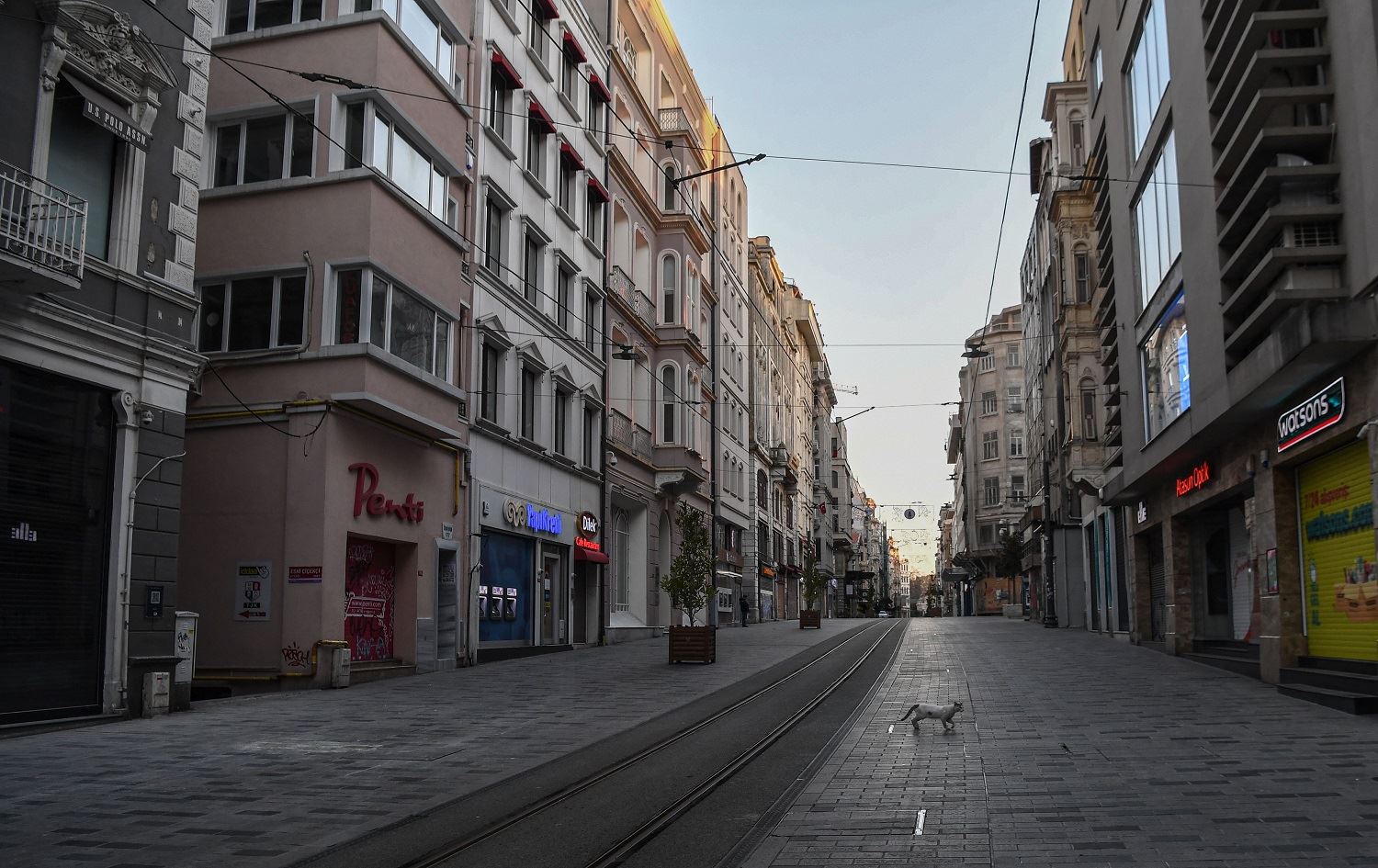
A deserted Istiklal street in Istanbul's Taksim district during a two-day curfew to prevent the spread of COVID-19 on on April 12, 2020. Photo: Ozan Kose/ AFP
ERBIL, Kurdistan Region — Just as Turkey seemed to be nearing a corner in its response to the COVID-19 pandemic, its economy risks entering a second recession in less than two years.
After the currency sunk to an 18-year low, trading at just under seven lira to the dollar, banks announced constraints that effectively limit Turkish banks' ability to lend lira overseas, concentrating their cash flow domestically.
While the coronavirus death toll has so far increased, the growth rate of new cases appeared to be leveling off as had been brought under control and is now “on a stable trajectory,” Health Minister Fahrettin Koca wrote on Wednesday.
The health ministry announced 4,353 new cases and 126 deaths on Friday, taking the death toll to 1,769 and infections past 78,000.
Streets lie quiet as a partial lockdown shut businesses, closed borders, and halted much intercity travel. Ankara has shied away from imposing a full stay-at-home order in an effort to shield the economy, though those aged 65 and above and most people under 20 are under lockdown.
Economic worries may have something to do with it. Turkey has not imposed a full lockdown over the new coronavirus pandemic because of its possible cost to the country's economy, according to presidential spokesperson İbrahim Kalın.
"A decision of a long-term quarantine would have a much heavier cost to the economy. The cost to social life and human psychology would be very, very different," he said in an interview with broadcaster NTV on April 16.
However, researched published by five Turkish economists this week suggested an immediate "full lockdown" would better insulate the economy and limit the drop in economic output this year of about 7.8%, by concentrating and shortening the period of pain.
"When the full lockdown is delayed, it becomes harder to contain the pandemic, and thus the duration of the lockdown and hence the economic costs increase," said economists from Koc University in Istanbul and the University of Maryland.
The study estimated that Turkey could sharply limit damage to its economy if it were to impose a nationwide stay-at-home order to curb the spread of the coronavirus, and faces a contraction of up to 17% if it maintains its current course.
Then again, politics may also have something to do with it. Mayors of Turkey’s three largest cities called for total lockdown to be imposed to limit the spread of the virus.
“We again highlight the need for action before more time is lost," said the statement, signed by eleven opposition mayors.
Their plea has drawn attention to the increasingly politicized nature of Turkey’s pandemic response.
The authority to impose a city-wide lockdown rests not with the mayor but with the provincial government, which is controlled by the ruling AKP of President Recep Tayyip Erdogan.
The political fallout from Turkey's COVID-19 response has exposed tensions at the highest echelons of the AKP.
A botched lockdown last weekend which caused a panic when the announcement came two hours before it was set to take effect prompted Inter Suleyman Soylu to offer his resignation. Soylu apologized for the mishandling of the lockdown announcement, which caused chaotic scenes as crowds of people rushed out to shops to stock up on supplies.
His resignation statement prompted a wave of support on social media for Soylu, who is known for his hawkish stance on security and is popular with party supporters, and Erdogan swiftly announced that the minister would stay in place.
Since being appointed interior minister four years ago, Soylu, 50, has led a crackdown in which tens of thousands of people have been detained on suspicion of links to a network accused of being behind a failed 2016 military coup.
After the wave of praise, all seemed forgotten, and Erdogan announced well in advance that the following weekend would also see a lockdown.
As a prominent member of Erdogan's cabinet, Soylu is seen by some party members as a potential rival to the president's influential son-in-law, Finance Minister Berat Albayrak, and consider the feigned resignation as a potential power play.
"It is no secret now that there has been a struggle and some issues between Albayrak and Soylu for some time," one AK Party official told Reuters, speaking on condition of anonymity.
"Soylu's ... resignation was an explosion from all this build-up."
By offering to take individual blame - even though the lockdown was approved by Erdogan - and then winning a public endorsement from the president, Soylu has strengthened his own position, the official said.
The government has played down suggestions of division.
"Our president has rejected our interior minister's resignation ... Nobody can axe our unity and solidarity," Kalin said on Monday.
But economic woes are far from over. A sharp drop in the price of fruits and vegetables could force Turkish farmers to trim output this spring as the coronavirus pandemic slows exports and reduces the needs of restaurants and shops, food industry executives say.
Turkey’s own domestic production is expected to take a hit from the slowdown in daily life which has impacted demand. Turkey is also one of the world's top exporters of fresh produce such as tomatoes, apricots, tangerines, eggplants and peppers. According to Reuters market data, the demand for imports in neighboring Europe has plummeted as measures to curb the pandemic have disrupted cross-border supply chains, and restricted social movement is keeping buyers indoors and tightening their belts.
"Export markets are shutting down due to the coronavirus pandemic (and) it poses a big risk for production. When prices go down too much, farmers do not want to plant," Ozgur Tort, chief executive of Turkish supermarket chain Migros, told Reuters.
"April and May are critical planting months for many farmers. If they have price concerns, many of them might decide not to plant this year," Tort said on a press call Tuesday.


Comments
Rudaw moderates all comments submitted on our website. We welcome comments which are relevant to the article and encourage further discussion about the issues that matter to you. We also welcome constructive criticism about Rudaw.
To be approved for publication, however, your comments must meet our community guidelines.
We will not tolerate the following: profanity, threats, personal attacks, vulgarity, abuse (such as sexism, racism, homophobia or xenophobia), or commercial or personal promotion.
Comments that do not meet our guidelines will be rejected. Comments are not edited – they are either approved or rejected.
Post a comment