


Analysis

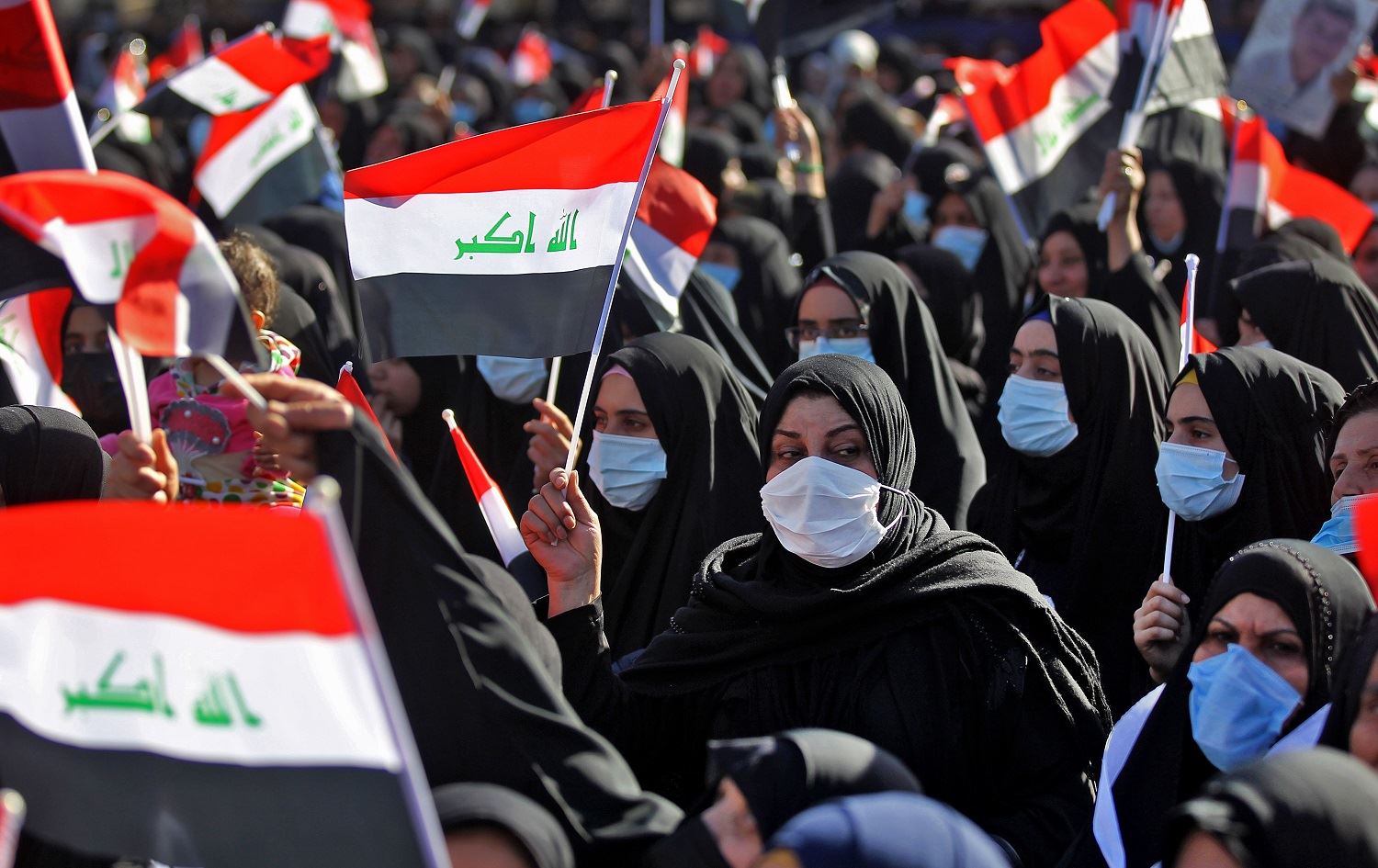
Iraqis wave national flags at a gathering in central Baghdad on February 12, 2021. Photo: Ahmad al-Rubaye/AFP
The Special Representative of UN Secretary-General to Iraq, Jeanine Hennis-Plasschaert, announced in a briefing of the Security Council on February 16 that “a request from the Government of Iraq for electoral observation is currently before this Council,” and demanded “clarity” and a “decision.”
This request comes after months of debate in political circles on the subject of early elections and international supervision. The early vote got a stamp of approval by Grand Ayatollah Ali al-Sistani, who, in a statement on September 13, 2020, called for a free and fair election conducted under "supervision and monitoring in coordination with the relevant departments of the United Nations mission."
Sistani also called for early elections; however, elections on their own are not a goal, but rather the means for correcting the political process.
Iraq’s political forces are divided on the issue of international oversight. Some call for full-fledged supervision. Others reject it and demand simple observation, saying supervision interferes with Iraq’s sovereign affairs.
UN supervision or observation?
Iraqi leaders are used to issuing support statements whenever Sistani voices his opinion about any social or political matter and this time was no exception. However, they only go as far as issuing a statement. As soon as it becomes clear that it is not in their interest, the politicians start to manoeuvre away and use a myriad of tactics to deviate and delay action.
After Sistani's call for "supervision," President Barham Salih said in a statement on August 4, 2020, "holding early, free and fair elections requires international cooperation with the Independent High Electoral Commission (IHEC), as well as supervision by international observers." On October 1, 2020, Prime Minister Mustafa al-Kadhimi stressed that "there should be free and fair elections that are far from the authority of armed parties and militias and under international supervision." Parliament Speaker Mohammad al-Halbousi, after meeting the US ambassador on December 9, 2021, declared "the need for the United Nations and organizations concerned with electoral affairs for the elections to be accepted by the people, politicians, and internationally."
The position of political leaders differed between supporters and opponents. The head of the Iraqiyoon Coalition, Ammar al-Hakim, supported international supervision on the condition that Iraq's sovereignty is not violated. As for the Sadrist movement leader, Muqtada al-Sadr, he said on February 10, 2021, "I request the intervention of the United Nations to supervise it....UN supervision of early elections is desirable."
Meanwhile, the leader of State of Law, Nouri al-Maliki, chose to oppose international supervision "categorically" and said he considers it "very dangerous" because it "represents a breach of national sovereignty." In general, the al-Fatah Alliance is opposed. The leader of Asa'ib Ahl al-Haq, Qais Khazali, on December 19, 2020 warned “against supervision and interference in the upcoming parliamentary elections… monitoring is acceptable..... As for supervision, it is a dangerous issue." This is consistent with Iran's position expressed by the advisor to the Supreme Leader, Ali Akbar Velayati, after he met the UN’s Jeanine Hennis-Plasschaert in Tehran on January 31, 2021. He considers the upcoming elections in Iraq fateful and called for "non-interference by foreigners and foreign countries in Iraq’s affairs."
Political parties and presidencies give in
The political leaders held several meetings in which the three presidencies (president, prime minister, and parliament speaker), IHEC, and the UN mission in Iraq (UNAMI), participated. The matter of international supervision was discussed at length and proposals were made, including that supervision should be done by a special mission independent of UNAMI. For this to happen, a resolution would have to be passed by the UN Security Council, as well the allocation of some $40 million to fund it. The Iraqi government met with the ambassadors of the Security Council's permanent members to discuss this request and search for a mechanism by which funds could be allocated.
Opposition to international supervision continued to grow and forced the government to back down and choose a more flexible international observation through UNAMI. This means reducing the role of the international observer to merely observation on election day, with foreign observers conducting field visits to electoral centers in several governorates and then preparing a report that supports the integrity of the elections and pointing out irregularities they may encounter during their field visits.
The role of UNAMI will be more than simple observation, according to an informed source. It will closely accompany the work of the IHEC and exchange views and ideas during various stages of the elections. They will support technically and logistically, especially with respect to overcoming obstacles and negotiating with companies and contractors to implement the electoral system, equip counting and sorting machines, choose the verification company, and other means of technical and logistical support.
There is no doubt that the political forces do not want the upcoming elections to have international supervision and real monitoring, because they know that the elections will not be fully free and fair. It is likely that the vote will be tainted by violations and breaches, as happened in the past. So they insist on rejecting any international monitoring authorized to investigate. The political parties just want a stamp on the final results to say it was a free and fair election.
It is noteworthy that the current government, which was formed to meet the demands of protestors and has promoted holding a free and fair election under full international supervision, is now harmonious with the will of the ruling political parties. The government chose to go with a much watered-down version of international observation.
It is also important to note here that while international supervision is important to monitor the vote, change is achieved by broad participation, especially by the youth who were reluctant to participate in previous polls. The turnout level will be a significant factor and could be sufficient to loosen the ruling parties' grip and bring about the desired transformation of Iraq’s political scene.
Farhad Alaaldin is the Chairman of the Iraqi Advisory Council. He was the political adviser to former Iraqi President Fuad Masum, the former chief of staff to the Kurdistan Region prime minister from 2009 to 2011, and former senior adviser to the Kurdistan Region prime minister from 2011 to 2012.
The views expressed in this article are those of the author and do not necessarily reflect the position of Rudaw.
This request comes after months of debate in political circles on the subject of early elections and international supervision. The early vote got a stamp of approval by Grand Ayatollah Ali al-Sistani, who, in a statement on September 13, 2020, called for a free and fair election conducted under "supervision and monitoring in coordination with the relevant departments of the United Nations mission."
Sistani also called for early elections; however, elections on their own are not a goal, but rather the means for correcting the political process.
Iraq’s political forces are divided on the issue of international oversight. Some call for full-fledged supervision. Others reject it and demand simple observation, saying supervision interferes with Iraq’s sovereign affairs.
UN supervision or observation?
Iraqi leaders are used to issuing support statements whenever Sistani voices his opinion about any social or political matter and this time was no exception. However, they only go as far as issuing a statement. As soon as it becomes clear that it is not in their interest, the politicians start to manoeuvre away and use a myriad of tactics to deviate and delay action.
After Sistani's call for "supervision," President Barham Salih said in a statement on August 4, 2020, "holding early, free and fair elections requires international cooperation with the Independent High Electoral Commission (IHEC), as well as supervision by international observers." On October 1, 2020, Prime Minister Mustafa al-Kadhimi stressed that "there should be free and fair elections that are far from the authority of armed parties and militias and under international supervision." Parliament Speaker Mohammad al-Halbousi, after meeting the US ambassador on December 9, 2021, declared "the need for the United Nations and organizations concerned with electoral affairs for the elections to be accepted by the people, politicians, and internationally."
The position of political leaders differed between supporters and opponents. The head of the Iraqiyoon Coalition, Ammar al-Hakim, supported international supervision on the condition that Iraq's sovereignty is not violated. As for the Sadrist movement leader, Muqtada al-Sadr, he said on February 10, 2021, "I request the intervention of the United Nations to supervise it....UN supervision of early elections is desirable."
Meanwhile, the leader of State of Law, Nouri al-Maliki, chose to oppose international supervision "categorically" and said he considers it "very dangerous" because it "represents a breach of national sovereignty." In general, the al-Fatah Alliance is opposed. The leader of Asa'ib Ahl al-Haq, Qais Khazali, on December 19, 2020 warned “against supervision and interference in the upcoming parliamentary elections… monitoring is acceptable..... As for supervision, it is a dangerous issue." This is consistent with Iran's position expressed by the advisor to the Supreme Leader, Ali Akbar Velayati, after he met the UN’s Jeanine Hennis-Plasschaert in Tehran on January 31, 2021. He considers the upcoming elections in Iraq fateful and called for "non-interference by foreigners and foreign countries in Iraq’s affairs."
Political parties and presidencies give in
The political leaders held several meetings in which the three presidencies (president, prime minister, and parliament speaker), IHEC, and the UN mission in Iraq (UNAMI), participated. The matter of international supervision was discussed at length and proposals were made, including that supervision should be done by a special mission independent of UNAMI. For this to happen, a resolution would have to be passed by the UN Security Council, as well the allocation of some $40 million to fund it. The Iraqi government met with the ambassadors of the Security Council's permanent members to discuss this request and search for a mechanism by which funds could be allocated.
Opposition to international supervision continued to grow and forced the government to back down and choose a more flexible international observation through UNAMI. This means reducing the role of the international observer to merely observation on election day, with foreign observers conducting field visits to electoral centers in several governorates and then preparing a report that supports the integrity of the elections and pointing out irregularities they may encounter during their field visits.
The role of UNAMI will be more than simple observation, according to an informed source. It will closely accompany the work of the IHEC and exchange views and ideas during various stages of the elections. They will support technically and logistically, especially with respect to overcoming obstacles and negotiating with companies and contractors to implement the electoral system, equip counting and sorting machines, choose the verification company, and other means of technical and logistical support.
There is no doubt that the political forces do not want the upcoming elections to have international supervision and real monitoring, because they know that the elections will not be fully free and fair. It is likely that the vote will be tainted by violations and breaches, as happened in the past. So they insist on rejecting any international monitoring authorized to investigate. The political parties just want a stamp on the final results to say it was a free and fair election.
It is noteworthy that the current government, which was formed to meet the demands of protestors and has promoted holding a free and fair election under full international supervision, is now harmonious with the will of the ruling political parties. The government chose to go with a much watered-down version of international observation.
It is also important to note here that while international supervision is important to monitor the vote, change is achieved by broad participation, especially by the youth who were reluctant to participate in previous polls. The turnout level will be a significant factor and could be sufficient to loosen the ruling parties' grip and bring about the desired transformation of Iraq’s political scene.
Farhad Alaaldin is the Chairman of the Iraqi Advisory Council. He was the political adviser to former Iraqi President Fuad Masum, the former chief of staff to the Kurdistan Region prime minister from 2009 to 2011, and former senior adviser to the Kurdistan Region prime minister from 2011 to 2012.
The views expressed in this article are those of the author and do not necessarily reflect the position of Rudaw.


Comments
Rudaw moderates all comments submitted on our website. We welcome comments which are relevant to the article and encourage further discussion about the issues that matter to you. We also welcome constructive criticism about Rudaw.
To be approved for publication, however, your comments must meet our community guidelines.
We will not tolerate the following: profanity, threats, personal attacks, vulgarity, abuse (such as sexism, racism, homophobia or xenophobia), or commercial or personal promotion.
Comments that do not meet our guidelines will be rejected. Comments are not edited – they are either approved or rejected.
Post a comment