Once again, regional and international powers are engaged in rivalries on the land of a country far from their own; Libya.
Libya, which has been plagued by a civil war since the death of Muammar al-Gaddafi in October 2011, has now become a battleground for clashing interests between North African and Mediterranean coastline countries.
The west of the country is dominated by Fayez al-Sarraj, the Prime Minister of the Government of National Accord of Libya, supported by Turkey and Qatar. In the east, there is military opposition leader Khalifa Haftar, the Commander of the Libyan National Army in Benghazi, who is supported by Russia, the UAE, France and Saudi Arabia.
There are two main reasons as to why there is so much involvement in Libya's affairs. First, the country is home to a massive amount of oil reserves in Africa, amounting to 48 billion barrels of oil.
Libya has a daily output of one million barrels of oil and is also home to 1.5 trillion cubic meters of natural gas. From the north, Libya has two thousand kilometers of maritime border on the Mediterranean Sea. It is estimated that its coastlines contain a large amount of natural gas.
Second, Libya's geographical location has turned it into as a corridor for immigrants to cross to Europe from Africa, as well as a hotbed of extremist Islamic militants close to ISIS, prompting international concern.
In November 2019, Turkish President Recep Tayyip Erdogan met with al-Sarraj, striking a military and economic deal. According to the agreement, Turkey agreed to provide military support, arms and send troops to support the Libyan government against General Haftar. In return, Turkey was allowed to look for natural gas and oil in the Mediterranean waters controlled by the Libyan government in the west.
This agreement alarmed other countries in the region. According to Turkish officials, this agreement is meant to only connect the shared Turkish and Libyan maritime zone.
This agreement, in the meantime, cuts out Israel and Egypt on one hand, Syria and Cyprus on the other and Greece and Europe as a whole.
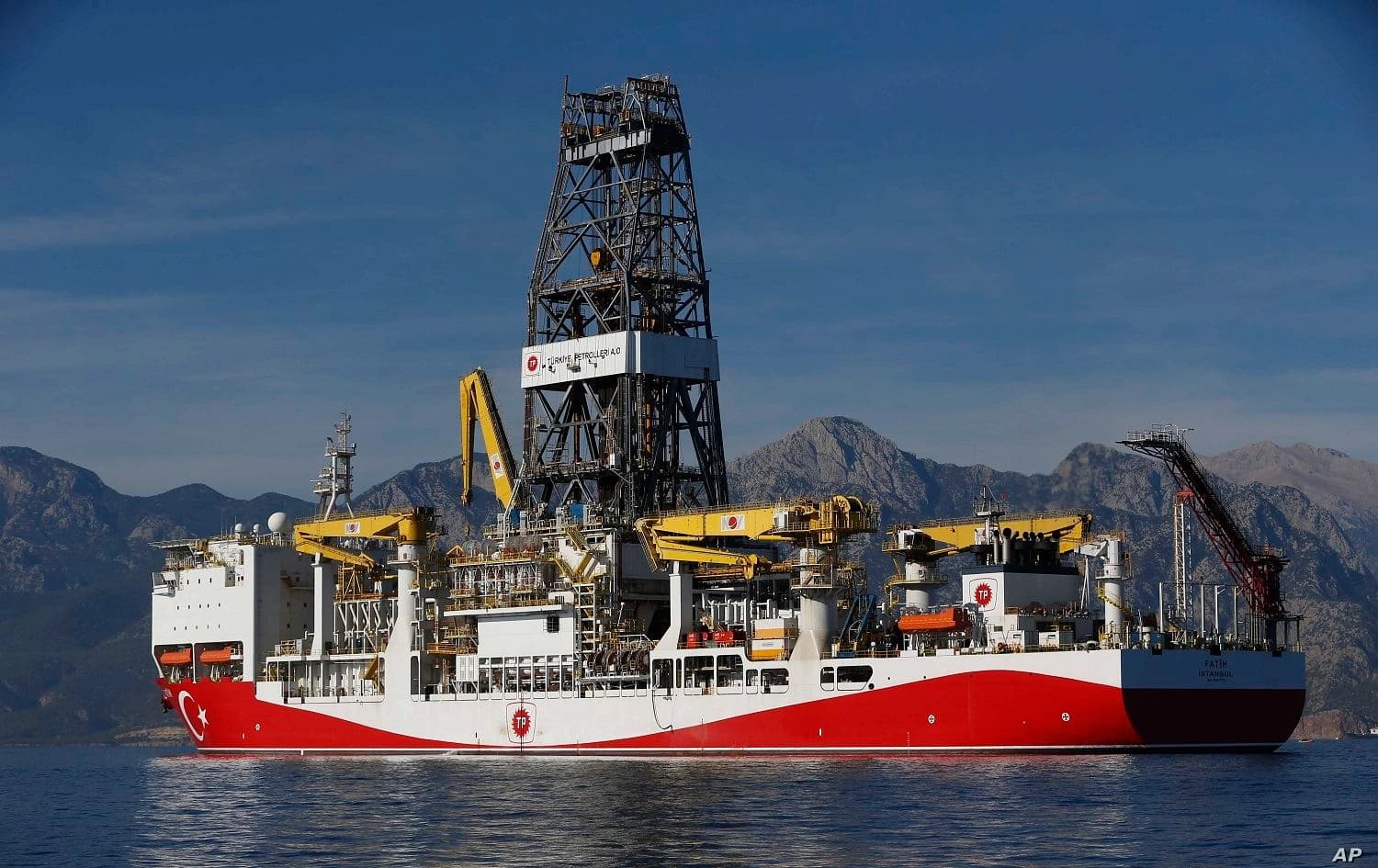
Turkey says it is entitled to search for oil and natural gas in the waterways of both Turkish-controlled Cyprus and the rest of the island. Ankara has so far prepared two ships for the venture. The European Union has strongly condemned Turkey's move, vowing to punish Ankara.
Earlier this month, Israel, Greece and Cyprus signed a historical agreement in Athens to establish a pipeline worth six billion dollars to export natural gas from Israel and Cyprus to Greece and Italy, as well as other European countries. This deal has angered Turkey a lot. Other than its own territories, Turkey does not want any alternative to be found for the exportation of natural gas to Europe.
The extension of the pipeline negates the maritime deal struck by Turkey and the al-Sarraj government.
The Turkish-Libya maritime border deal is sabotaging all the energy and natural gas projects of Israel, Cyprus, Greece and Egypt in the eastern Mediterranean. Such countries cannot accept this, given that their project has just started and if there is a giant geopolitical barrier, their economies will suffer.
Nevertheless, the completion and extension of this pipeline will fulfil the long-standing dreams of a country like Israel, which will export energy for the first time in its history. Israeli PM Benjamin Netanyahu on multiple occasions has branded energy exportation as a long-standing national objective.
Turkey's interests in Libya are also directly harming the interests and security of European countries.
"European countries are increasingly vulnerable to external pressure that prevents them from exercising their sovereignty," said High Representative of the European Union Josep Borrell in response to European reactions to the current events in Libya, adding that "the EU needs to learn to think like a geopolitical power."
“The only way to survive in this world of giants is to unite to be strong together," he said in July.
Borrell is right. If Russia is successful in persuading Turkey to help lay the groundwork for reconciliation between Haftar and al-Sarraj and on the mechanisms of managing oil and natural gas with Libya and Turkey, then it means Russia will gain access to another pipeline exporting natural gas to Europe.
The ongoing rivalries in the Mediterranean is a clear sign that for European countries and Turkey, it is now crucial to have access to new energies, similar to natural gas, to export to Europe.
The Kurdistan Region's natural gas sources have the potential to be paid attention to by the international companies. The Kurdistan Region, according to estimates from consultancy companies, has more natural gas reserves than Egypt, Cyprus and Israel.
This might lead to Turkey once again pondering the import of the Kurdistan Region's natural gas more seriously. If Turkey decides to publicly announce it is interested in buying the Kurdistan Region's natural gas, there is a strong possibility that international companies and oil exports will become more interested in the Region's natural gas.
The natural gas output of the Kurdistan Region, at this stage, does not meet domestic needs. But there is possibility that the output of natural gas will increase until 2023 given that the Dana Gas has increased daily produce at Kormor and Chamchamal fields.
If the large companies work at other fields including Miran, Bna Bawe and many others, they could be used to be exported to Turkey and Europe.
Omer Moradi is the desk manager of Rudaw Media Network's Economy Desk.