


Error occured during this request! Please try again later.
Analysis

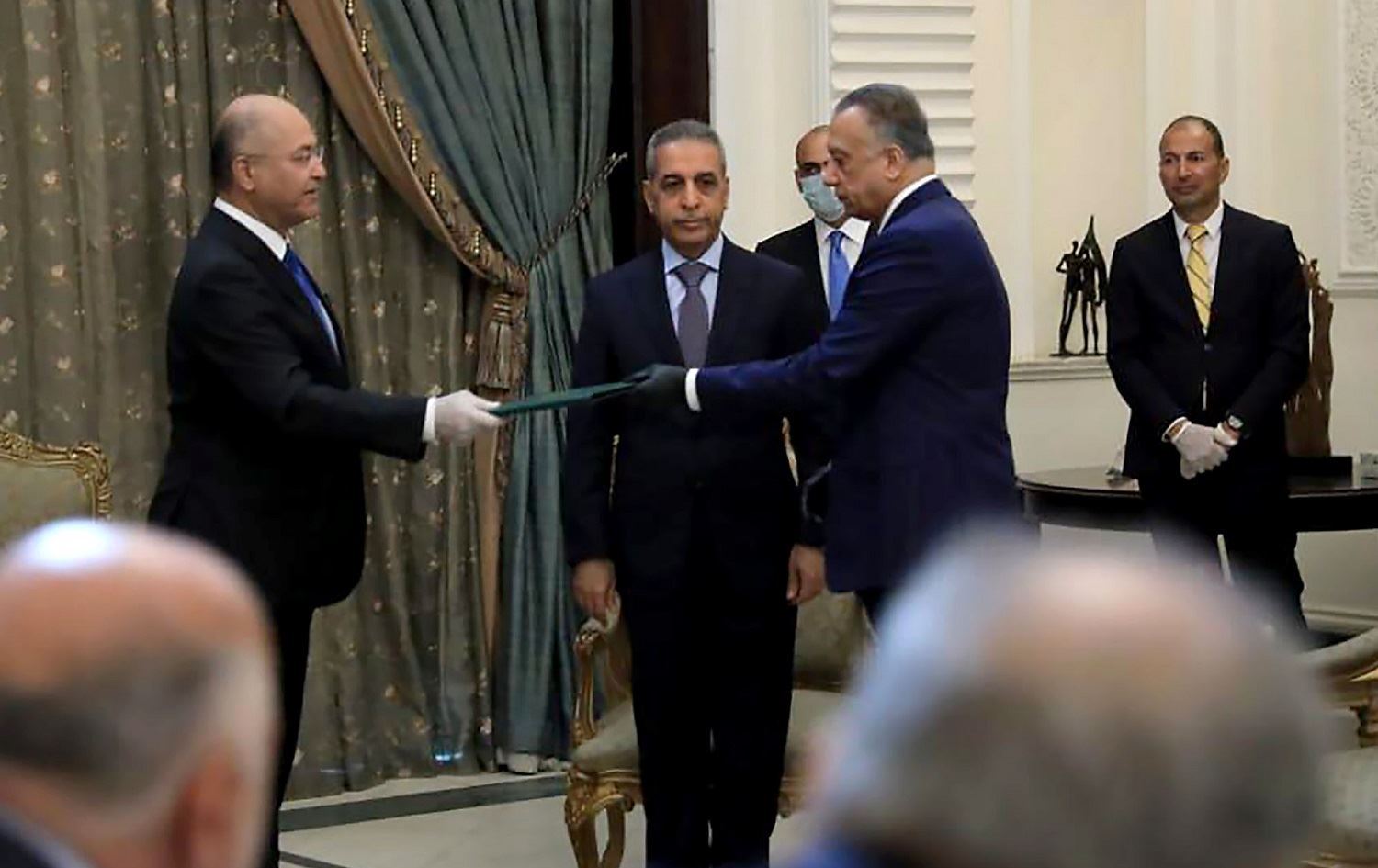
President Barham Salih (L) swears in Mustafa al-Kadhimi as Iraq’s new prime minister-designate in Baghdad, April 9, 2020. Photo: Iraqi Presidency Media Office
ERBIL, Kurdistan Region – In a rite of prime minister-designate passage, Mustafa al-Kadhimi handed over a letter containing a list of ministers nominated for Iraq’s next cabinet to Shiite political parties on Wednesday, according to the state Iraqi News Agency (INA) outlet.
A former director of Iraq’s intelligence service, Kadhimi was appointed as PM-designate on April 9, and granted a month in which to select a cabinet to be presented to Iraqi parliament.
His appointment has so far managed to garner more cross-party support than his two PM-designate predecessors – former communications minister Mohammed Tawfiq Allawi, then three-term Najaf governor and Nasr parliamentary bloc leader Adnan al-Zurfi.
But getting a selected cabinet approved has so far proven an impossible task for Iraq’s prime minister-designates.
When Allawi sought to get a cabinet of independent technocrats approved by parliament, Sunni, Kurdish, and some Shiite parties rebelled, fearing they would lose influence.
Zurfi was unable to hold the role long enough to make his cabinet picks, elbowed aside by parliament’s powerful Shiite blocs for their preferred candidate – current PM-designate Kadhimi.
And a member of the Sairoon coalition – parliament’s biggest faction, led by Shiite cleric Muqtada al-Sadr – has cast doubt on whether Kadhimi’s cabinet selections will be approved.
“It will be difficult for the cabinet proposed by Mustafa al-Kadhimi to be passed by Iraqi parliament,” Sairoon MP Badir al-Ziyadi told Rudaw English on Thursday.
“The ministers proposed for the cabinet in Kadhimi’s letter result from pressures from political parties for their own interests,” he said.
Ziyadi’s fellow Sairoon MP Riyadh Mohammed Ali Dahish voiced similar concerns that Kadhimi’s current selections have been pushed through by political parties for the sake of their own interests, rather than being chosen for their expertise.
“The Sairoon coalition demands a capable cabinet, one that can solve Iraq’s current crisis,” Dahish told Rudaw English on Thursday. “The names in Kadhimi’s cabinet list have come about through pressure from some political parties in the Kurdistan Region, some Sunni political parties, and some Shiite parties.”
Iraq’s post-2003 order was organized along the lines of confessional politics, which meant that ministries and other positions of state, including the most senior jobs of prime minister, president, and parliamentary speaker, were divided along ethnic and sectarian lines.
The process, called “Muhasasa”, entitles political elites to govern based on consensus and informal agreements. However, it has had the effect of empowering Shiite-majority parties over other sects.
An end to the Muhasasa system has been among the many demands made by Iraqi protesters who have been occupying public squares across Iraq since October 2019.
Persistent protester calls for change, despite lethal repression from Iraqi security forces, forced then-Prime Minister Adil Abdul-Mahdi to resign after just a year in office.
However, he still holds the office in a caretaker role, his full departure still yet to be finalized almost five months on after Shiite political parties dragged their heels, first on candidates for the premiership, then on the agendas of those nominated.
One member of Sairoon’s biggest rival in Iraqi parliament – the Hadi al-Ameri-led Fatih coalition – said a decision on Kadhimi’s cabinet list is still being mulled over.
“Fatih is currently studying the resumes of the Iraqi-PM designate’s candidates and will make a decision on the cabinet list in the next few days,” Fatih MP Audai Awad told Rudaw English on Thursday.
“Some names in the cabinet list might be changed, depending on the career background and skills [of candidates].”
Some MPs have expressed fear that the PM-designate’s choices don’t mark enough of a change from what protesters, activists, and reformist politicians wanted to see overhauled.
Where these groups called for an end to cronyism and corruption in the post-2003 political arena, some political parties are looking to install a member of their own in the new cabinet for financial gain, Sairoon MP Dahish said – leaving the interests of ordinary Iraqis in the rearview mirror.
According to an unconfirmed copy of Kadhimi’s cabinet list circulated on social media late on Wednesday, two ministers who have served under Abdul-Mahdi’s tenure are to retain their roles – finance minister Fuad Hussein, and health minister Jafaar Alawi.
Yousif Kilaby, an independent opposition member of the Iraqi parliament, told Rudaw English on Thursday that Kadhimi must avoid nominating ministers from the last cabinet, or else face rejection by some MPs.
“We saw the letter sent by Mustafa al-Kadhimi to the political parties regarding his new cabinet, and we noticed that some ministers chosen by Kadhimi as candidates were in Abdul-Mahdi’s cabinet,” Kilaby said.
“One such name is Fuad Hussein, who has been re-nominated as finance minister by Kadhimi, and we reject that completely.”
Dana Mohammed Jaza, a Kurdish member of the Iraqi parliament from the Kurdistan Democratic Party (KDP) defended his party’s choice of Fuad Hussein as candidate for finance minister as a matter of normal parliament workings.
“All of Iraq’s political parties are demanding ministries and government positions from Iraqi PM-designate Kadhimi as a condition upon whether or not they will grant his cabinet the votes it needs in Iraqi parliament,” Jaza told Rudaw English on Thursday.
Jaza seemed fairly confident that Kadhimi would be able to clear the so far insurmountable hurdle his PM-designate predecessors have failed to overcome.
“We as Kurds think that Mustafa al-Kadhimi will be passed by parliament, and will form the next Iraqi cabinet.”
Editing by Shahla Omar


Comments
Rudaw moderates all comments submitted on our website. We welcome comments which are relevant to the article and encourage further discussion about the issues that matter to you. We also welcome constructive criticism about Rudaw.
To be approved for publication, however, your comments must meet our community guidelines.
We will not tolerate the following: profanity, threats, personal attacks, vulgarity, abuse (such as sexism, racism, homophobia or xenophobia), or commercial or personal promotion.
Comments that do not meet our guidelines will be rejected. Comments are not edited – they are either approved or rejected.
Post a comment