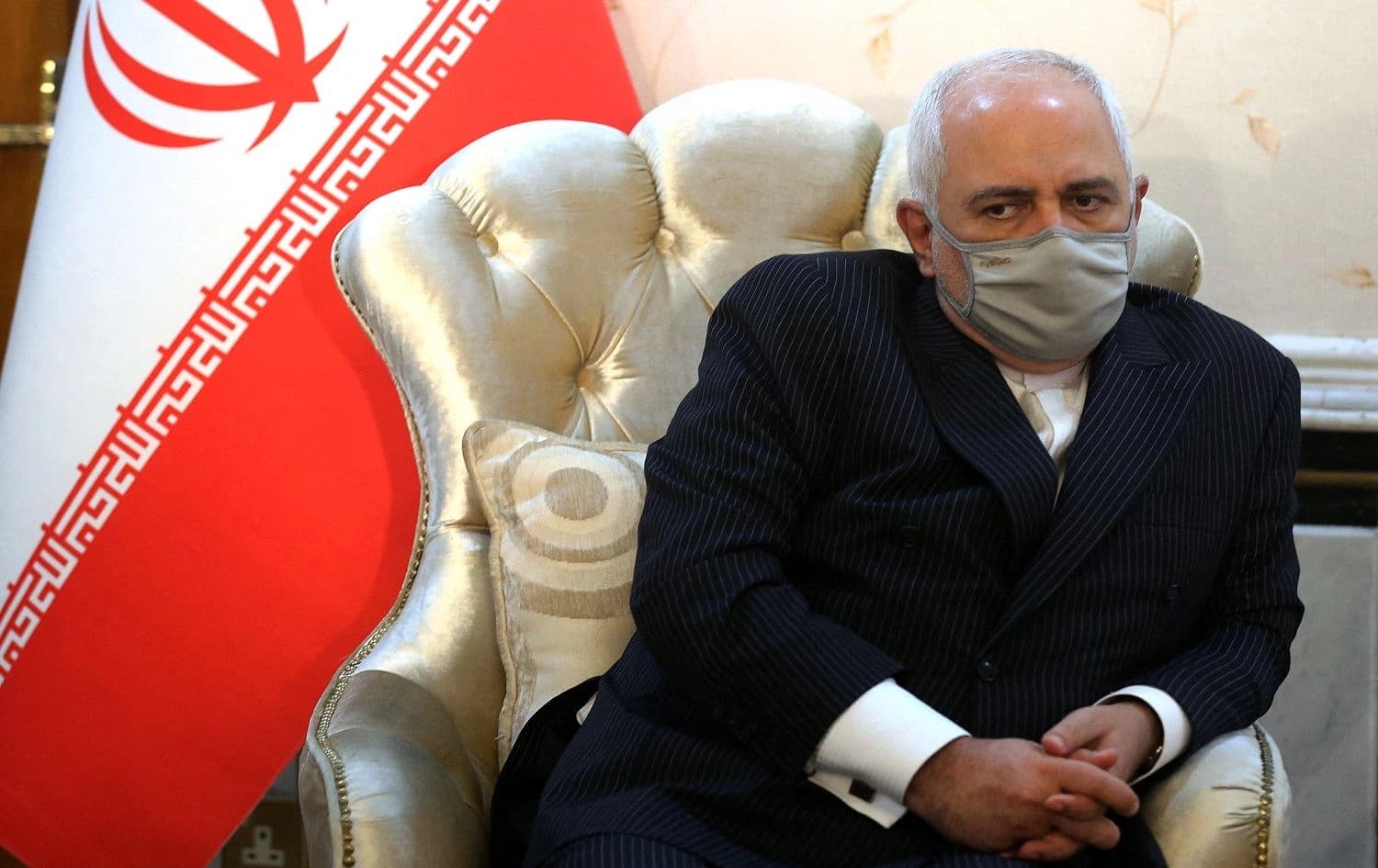
When Iranian Foreign Minister Mohammad Javad Zarif sat down in late February with a reformist economist in Tehran for a long interview about his tenure, he hoped to set the record straight with hardliners on numerous issues.
Zarif repeatedly told the interviewer, Saeed Laylaz, not to release the audio until after the election, fearing that what he said – including damning criticism of Iran’s infamous commander Qasem Soleimani – may jeopardize his ambition of becoming the next president of Iran.
“Almost every time that I went for a negotiation, it was Soleimani who would tell me about this or that. I was negotiating for the success of the battlefield,” Zarif was quoted as saying by Iran International, a UK-based outlet with alleged ties to Saudi's crown prince which leaked the interview on Sunday. “During my work, I was never able to tell the battlefield commander [Soleimani] to do something for my diplomacy.”
In Zarif’s view, Soleimani, the late commander of Iran’s Islamic Revolutionary Guard Corps (IRGC), executioner of Iran’s Middle East policy and head of the Quds force, was key to placing military considerations above Iran’s overall interests.
His comments have now come back to haunt him, published just as the FM took off for visits to Qatar and Iraq amid alleged Baghdad-brokered talks with arch foe Saudi Arabia.
On Monday, foreign ministry spokesperson Saeed Khatibazadeh said he was unaware of who was behind the leak or why they leaked it, coming to the defense of his superior.
“The longstanding friendship and closeness of Mohammad Javad Zarif with martyr … Soleimani is not hidden to anyone,” he wrote.
Upon his arrival to Baghdad, Zarif made sure to pay a visit to Soleimani’s shrine at Baghdad International Airport, where the commander was killed in a US airstrike last January, sending US-Iran tensions skyrocketing.
For the past year, rumours have been swirling that Zarif would run for the presidency in June, riling up the IRGC.
The IRGC is also against President Hassan Rouhani’s efforts to revive the Joint Comprehensive Plan of Action nuclear deal (JCPOA) by negotiating indirectly with Joe Biden’s administration. The IRGC and the hardliners maintain that the Washington should not be trusted and instead of looking to the west, Tehran is better off strengthening ties with countries closer to home.
Earlier this month, IRGC intelligence tried to sabotage the negotiations in Vienna by airing a spy drama called Gando, portraying an incompetent minister that hired dual nationals to be on negotiation team, only for them to be revealed as spies for foreign powers. One reformist analyst in Tehran told the Financial Times that the purpose of the drama was “to tell Zarif that should he dare to announce his candidacy, he will be destroyed immediately.”
Iranian-American scholar Vali Nasr said the leak was "designed to stop him running for president," warning that the move indicated "Iran is in for a very difficult two months."
Now, the leaking of his interview to a Saudi-funded channel in London appears to be the final nail in the coffin for Zarif. The hardliners particularly hate Saudi Arabia, and the IRGC is heavily involved in funding the Yemeni Houthi rebels against a Saudi-led coalition. The IRGC appears to be providing missiles and drones to the Houthis to target Saudi cities and oil installations.
”With this audio file and confrontation with the champion of the battlefield [Soleimani], Zarif is on the brink of political and social annihilation,” IRGC outlet Farsnews said on Monday.
The IRGC outlet accused Zarif and the government of releasing the audio file to blame the military and the IRGC for the myriad of hardships facing the country, and to tell voters that a change of president in the upcoming election will not matter – military matters come first.
The leaking of the interview prompted former US Secretary of State Mike Pompeo to once again justify the killing of Soleimani.
Our Administration’s exquisite strike on Qasem Soleimani had a massive impact on Iran and the Middle East. You don’t have to take my word for it. Ask @JZarif. President Biden still thinks it was a mistake. #AmericaFirst #AbrahamAccords https://t.co/NmbETQx05B
— Mike Pompeo (@mikepompeo) April 26, 2021
Zarif was also critical of Russia during the interview and said the Russia was trying to sabotage the 2015 nuclear deal with the help of hardliners and Soleimani. “When the battlefield rules over the strategy of the country, this is the result.”
IRGC outlet Tasnimnews described Zarif’s comments on Soleimani as inappropriate and false, blaming Zarif’s diplomacy and Rouhani’s actions for the “formation of, historically, the most severe sanctions against Iran.”
While it is not clear who leaked the interview, the IRGC and the hardliners, who hope to install a hardline government, appear to be the main beneficiaries.