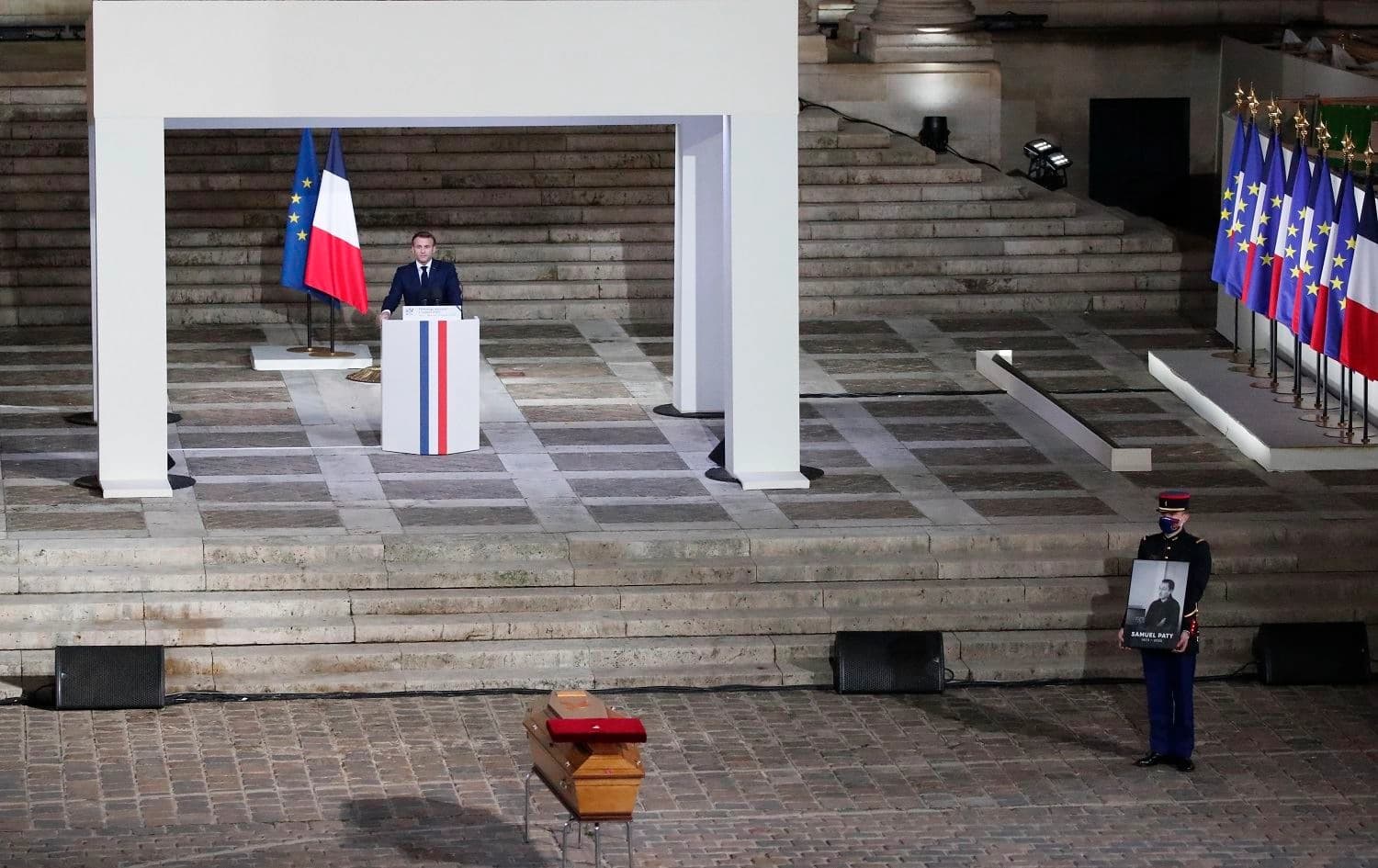
In the wake of the beheading of Samuel Paty, a history school teacher who had shown his students caricatures of Islam Prophet Mohammed, French President Emmanuel Macron has championed the country's secular values and vowed to seriously clamp down on radical Islam in his country, remarks which drew condemnation from leaders across the Muslim world.
Kurdish intellectuals have cautioned that the Kurdistan Region's public opinion should not be provoked by remarks from Islamists, especially those influenced by other countries, considering France a close ally who has come to the aid of Kurds during hardship
Paty was killed on 16 October by Abdoullakh Abouyedovich Anzorov, an 18-year-old Russian-born refugee of Chechen descent, after he displayed caricatures by the French satirical Charlie Hebdo of the Prophet Mohammed in a class on freedom of expression.
Charlie Hebdo’s office in Paris was the site of a bloody terror attack in January 2015, when terrorists killed 12 people following the magazine’s publication of caricatures of the prophet.
Paty’s murder shocked France, and the teacher was honoured in a national homage in which French President Emmanuel vowed to crack down on "Islamist separatism" across France.
"We will not give up cartoons," Macron said, prompting a fierce backlash from some Muslim leaders.
Reactions
Turkish President Recep Tayyip Erdogan on Saturday questioned Macron’s state of mental health in a speech at a provincial congress of his Justice and Development (AK) Party.
Paris fired back, condemning Erdogan's remarks as "unacceptable" and recalling its ambassador.
France and Turkey have been at loggerheads over a range of issues including maritime rights in the eastern Mediterranean, Libya, Syria and most recently the conflict between Armenia and Azerbaijan over the Nagorno-Karabakh region.
The controversy has spread further than Turkey, however.
Pakistan's Prime Minister Imran Khan joined Turkish President Erdogan on Sunday in slamming Macron for his comments.
Other countries have seen social media campaigns to boycott French products.
"This is a time when President Macron could have put a healing touch and denied space to extremists rather than creating further polarization and marginalization that inevitably leads to radicalization," Khan wrote on Twitter.
Islamabad summoned the French ambassador to Pakistan on Monday.
Macron said that his government does "not accept hate speech and defend reasonable debate."
"We will always be on the side of human dignity and universal values," he said on Sunday. "We respect all differences in a spirit of peace."
Kurdish reactions
Just like large parts of the Muslim world, Macron’s comments have also stirred debate among Kurds.
Some slammed Macron's comments, while others hailed Paris as a “best friend” of the Kurdistan Region.
France and the Kurdistan Region have long ties which date back to late French President Francois Mitterrand encouraging the UN Security Council to establish the no-fly zone to protect Kurdish areas against the former Baath regime in the 1990s, making way for the establishment of today's Kurdistan Region entity.
Iraqi Kurds remember France's first lady Danielle Mitterrand's historic visit to their region in 1991 when Saddam Hussein's helicopter gunships were massacring them.
"That was my first time seeing a foreigner weeping for the Kurds," said Kurdistan Democratic Party (KDP) President Masoud Barzani upon meeting Mrs Mitterrand.
"Right after the [2017] referendum, the whole world imposed an embargo on Kurdistan, closing down the skies and grounds on us. The first country which welcomed the leadership of Kurdistan was France," Adel Bakawan, a sociologist and associate research fellow at the Paris-based French Institute of International Relations told Rudaw on Sunday.
"France was the first country and still is against the withdrawal of US troops from Syrian Kurdistan [Rojava, or northeastern Syria]," he added.
"Had it not been for Macron, massive catastrophes would happen in Rojava." Bakawan said.
"International support for Kurds is critical for Kurds because we don't have sovereignty," he added.
However, he added, the French president should not debate depictions of the prophet.
"This is against the dialogue that Macron wants to have with Muslims," he said, citing France’s large Muslim community – the biggest in Europe.
He added reactions made by Islamic parties are not out of their loyalty to Islam, but political agendas.
"Some Islamic parties from Doha to Erbil are more interested in the interests of their states rather than Islam as a universal religion," Bakawan added.
"Islamic parties should choose a new model and not Daesh (ISIS) while condemning the caricature of Prophet Mohammed in a civilized and democratic way," he said, using the Arabic acronym for ISIS.
"France has always had dialogue from the very right wing to the very left wing, from the extreme Islamic to the extreme secular political parties of Kurdistan and the Kurdistani leadership. And such dialogue has shown that the nation in Kurdistan considers itself a friend of France."
"Insulting any religion is very sensitive for its followers. In Europe and for the European countries, freedom of expression is unlimited," Prof. Jabbar Qadir, an expert in Middle East politics told Rudaw via Skype from the Netherlands.
Asked whether the reactions were natural, or there were some sides stirring the motion of Muslims to react, he replied "there are some sides stirring it and the public follows them. The large number of people who react against Macron, they even do not know what has he said, but all they trust is a Muslim cleric who they listen to making things up"
"This whole issue is generated by the Muslim Brotherhood, currently represented by Erdogan."
"All I want to reiterate here is that the French government does not interfere in religion, nor does it use or stand against it," he added.
A former senior Kurdistan Islamic Union (KIU) member condemned the caricature of Prophet Mohammed, saying under the guise of democracy, "undemocratic conduct" take place.
Abu Bakir Karwani believes reactions to Macron's comments are "natural” and politically motivated at the same time.
"Turkey has capitalized on Macron's comments and works to show that it represents the Muslim world," he added.
Concerning reactions from the Kurdistan Region, Karwani believes that there should be a "balance between religion and nationalism"
“Our people should condemn only the comments of one person, not the entire people and country of France.”