


Analysis

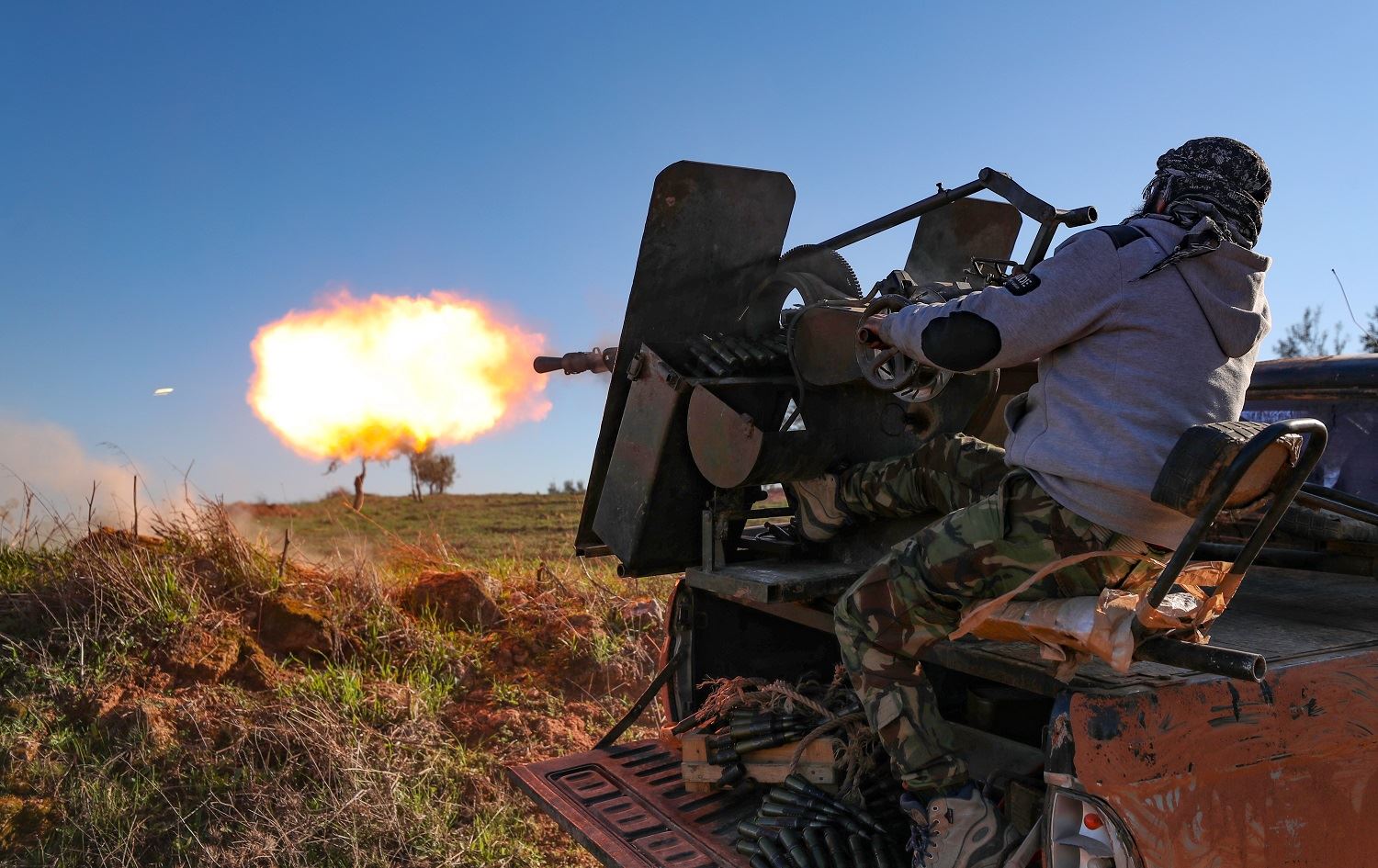
A Turkey-backed Syrian fighter fires a truck-mounted gun toward the town of Saraqib in the eastern part of Idlib province in northwestern Syria on February 26, 2020. Photo: Omar Haj Kadour / AFP
It became abundantly clear that Russia would not stand idly by in the face of Turkish aggression toward Syrian regime forces last Thursday, when Russian airplanes intervened and thwarted an attack by Islamic extremist groups backed by Turkey. The attack took place on February 20 in the town of Nirab, 8 kilometers southeast of Idlib’s center, and made evident a clear predicament for the future of the Turkish military in northwestern Syria.
The Syrian Army’s operation, launched about a month ago with Russian support, regained control of more than a third of the governorate of Idlib, the entire south and west of the governorate of Aleppo –including the entire M5 International Road between Aleppo and Damascus.
Turkey is continuing to deploy its forces in the Aleppo and Idlib governorates of northwestern Syria. It is reported that the Syrian army’s operation led to the deployment of 15,000 Turkish soldiers with a multitude of heavy and sophisticated weapons, spread over 39 locations.
The large-scale deployment suggests a Turkish willingness to wage war with the Syrian army. But how easy would it be for Turkey to actually wage such a war?
A Turkish tight spot
The three previous Turkish operations in Syria – Euphrates Shield in the areas of Jarablus and al-Bab, Olive Branch in the Afrin region, and Peace Spring in and around the north Syria towns of Sari Kani (Ras al-Ain) and Gire Spi (Tal Abyad) – were launched with the green light from Russia and the United States.
But any future Turkish operation in Idlib and Aleppo would be in direct confrontation with Moscow, which controls the airspace of the region and directly supervises the Syrian army's battles. Syria would certainly not have launched a widespread operation in Idlib and Aleppo if it did not have Russian approval to do so. Statements by Russian officials confirm this.
It is worth noting that this Russian-Syrian military cooperation was going to be launched back in September 2018, but was halted by the Sochi agreement made that same month. Russian President Putin and his Turkish counterpart Recep Tayyip Erdogan agreed on the establishment of a demilitarized zone of 15 to 20 kilometers along the seam line, starting on October 15, 2018.
Nearly two years on, this agreement had yet to be implemented, mainly due to Turkey's lack of commitment – which may have acted as justification as Syria and Russia’s launch of its current operation. Now, Turkey feels betrayed by Russia’s actions, and wants to keep it from the gains it has made in the north and northwest of the country.
Turkey also fears that Iran and Syria may push beyond the borders agreed to at Sochi and retake all areas controlled by Turkish-backed armed groups, independent from Russian consent. Therefore, Turkey will request that Russia either stop Iran and Syria itself, or that it does not oppose Turkey from stopping them.
Any Turkish military operation against Syrian forces would pit it against Russia, which cannot abandon its control over Syria. There is little guarantee of victory in this confrontation, and it would threaten all previous diplomatic agreements with Russia, including its territorial gains in the East of Euphrates region, Afrin and other areas of northern Syria. This confrontation would also push Russia to isolate Turkish-backed Syrian opposition and strengthen the Syrian Democratic Forces (SDF), which Turkey considers its only real opponent in Syria. This would dramatically reduce Turkey’s ability to influence any post-conflict solution. These developments may lead Turkey to consider turning to America.
Seeking NATO help
It is likely that Turkey would seek support from the North Atlantic Treaty Organization (NATO) if major confrontation involving Russia were to occur in northwestern Syria. However, it is unlikely that direct military engagement between the Alliance and Russia will take place, with the latter not a good strategic enemy for NATO to have.
Moreover, they do not consider Turkey as under an attack which requires the intervention of its allies, but rather that Turkey is launching an attack on Syria, a sovereign member state of the UN itself. It is likely that America will pressure Russia to show greater flexibility for a political solution in Syria, especially since there are American-Russian understandings at a certain level. And when we know the size of the efforts, concessions and pleas made by Turkey to Russia in order to avoid the repercussions of shooting down a single Russian plane in November 2015, we will realize the difficulty Turkey has in confronting Russia militarily in Syria. In the face of these facts, Erdogan may be forced to submit to a new settlement with Putin, instead of putting himself on course for a fatal blow on Syrian soil.
A Russia-Turkey settlement, at the expense of Kurds
When a new settlement between Russia and Turkey inevitably occurs, it is only logical to expect this will be at the expense of the Kurds in the East of Euphrates region. Russia understands that the main goal of Turkey in the region is the eradication of self-administration and the SDF.
Additional Turkish force coordination with Russia would also weaken America's influence in that region and perhaps lead to more US-Turkish tensions. It will also put more pressure on the SDF and the Kurdish self-administration to accept Russian-Syrian conditions for dealing with the region.
Russia has reportedly shown willingness to talk to Turkey about Kobane, Ain Issa and the countryside of Tel Tamr. Meanwhile, Turkey has meanwhile focused on the Derik region and eastern Qamishli to reach its oil fields and cut off communication between western (Syrian) and southern (Iraqi) Kurdistan – but Russia has told Turkey it cannot make decisions on this area, as it is under American influence.


Comments
Rudaw moderates all comments submitted on our website. We welcome comments which are relevant to the article and encourage further discussion about the issues that matter to you. We also welcome constructive criticism about Rudaw.
To be approved for publication, however, your comments must meet our community guidelines.
We will not tolerate the following: profanity, threats, personal attacks, vulgarity, abuse (such as sexism, racism, homophobia or xenophobia), or commercial or personal promotion.
Comments that do not meet our guidelines will be rejected. Comments are not edited – they are either approved or rejected.
Post a comment