


Analysis

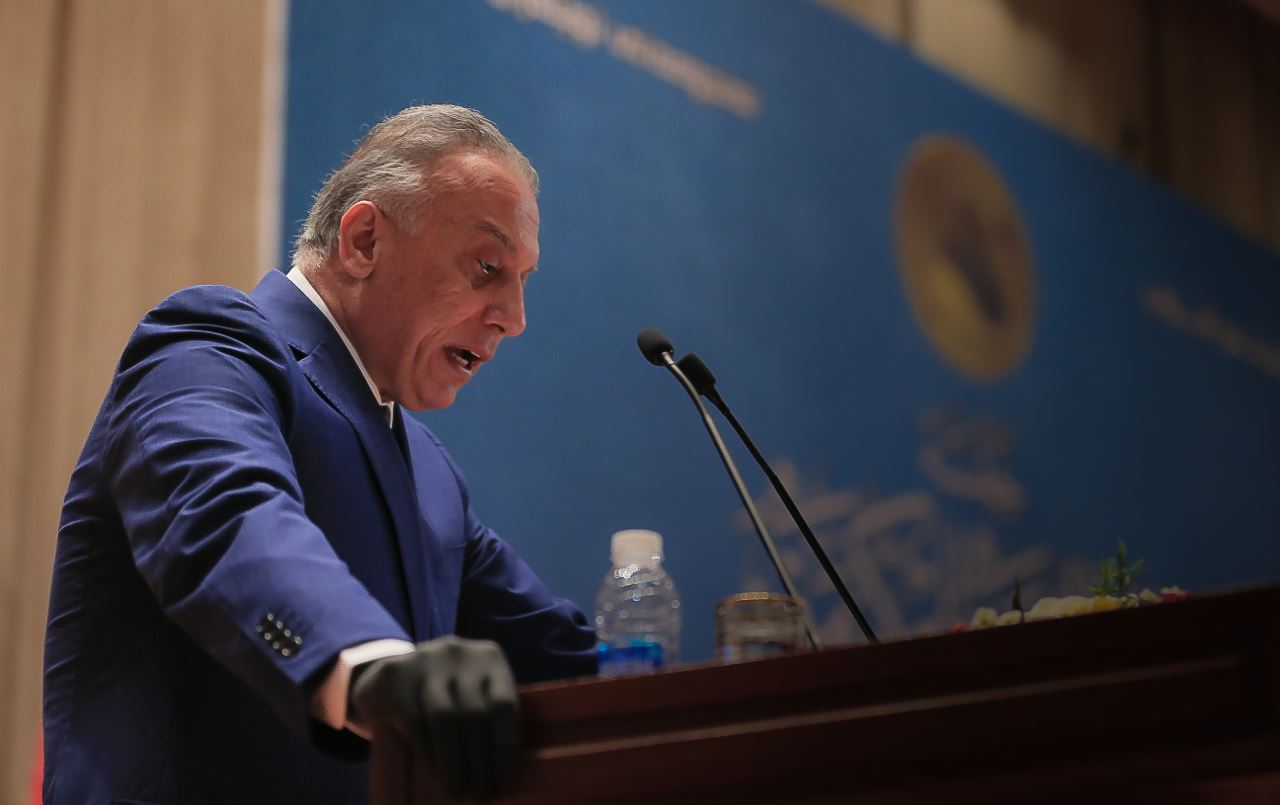
Prime Minister Mustafa al-Kadhimi faces multiple challenges to Iraq's sovereignty. Photo: Iraqi Parliament / Handout
Three days after an Iraqi delegation held its first round of negotiations with the United States government representatives over the future of the US forces in the country, Turkey launched an extensive bombing campaign in several locations in the north of the country, including in the Kurdistan Region, on suspected PKK locations. Iran followed suit and started shelling a number of locations in the border area, following a meeting between its foreign minister and his Turkish counterpart in Ankara on June 15. Five Kurdish civilians have been killed in the attacks.
Coupled with the upcoming strategic dialogue with the United States, these attacks have raised serious questions about Iraqi sovereignty and what Prime Minister Mustafa al-Kadhimi can do to uphold it.
Pro-Iranian Shiite forces are urging Kadhimi to completely expel the US forces, claiming that the American presence in Iraq impedes the country’s sovereignty. At the start of the US-Iraq strategic dialogue, Iran-backed militias regularly targeted Baghdad with Katyusha rockets to reiterate their message.
For those anti-American groups, “sovereignty is applied selectively” says Bilal Wahab, a Wagner Fellow at The Washington Institute for Near East Policy. Kadhimi's recent condemnation of the Turkish and Iranian attacks “carry significant symbolic weight,” added Wahab, “however, regaining respect for Iraq's borders will be a long process that requires persistence and consistency.”
Turkey and Iran continue to launch airborne and land operations against Kurdish insurgents within the Kurdistan Region of northern Iraq. Turkey deployed its commando forces on Iraqi soil, in the Haftanin region last week. Iran’s Islamic Revolutionary Guard Corps (IRGC) also mobilized large forces on its borders with the Kurdistan Region on Thursday.
These attacks come while the new Iraqi government attempts to consolidate the country’s sovereignty and rebalancing Iraq’s diplomatic relations.
The Turkish side of the operation, dubbed Operation Claw-Eagle, began on June 15 with Turkish airstrikes shelling several locations of the Kurdistan Workers Party (PKK) inside the Kurdistan Region.
The PKK is a Kurdish armed organization founded in the 1970s demanding greater ethnic and cultural rights for some 15 million Kurds living in Turkey. The PKK’s main hub is located in the Qandil mountain range along Turkey's border with Iraqi Kurdistan.
Iran’s Ministry of Foreign Affairs, Mohammad Javad Zarif, visited Ankara on June 15 and met with his counterpart Mevlut Cavusoglu. In less than 24 hours, Iranian artillery pounded the Kurdistan Region border area.
Although Iran has joined in Turkey’s operations against Kurdish insurgents in previous years, this time Tehran’s motives might be different. “For the Islamic Republic, this is a way to thank the Turkish foreign minister for his Istanbul statement against US sanctions” says Aykan Erdemir, senior director of the Turkey Program at the Foundation for Defense of Democracies and a former member of the Turkish parliament.
Iran may also be reciprocating in order to win the Turkish government’s good will so that Ankara can speed up repairs on a natural gas pipeline that damaged by a PKK attack on March 31 and resume buying Iranian gas at a time when the country badly needs revenue, Erdemir explained. Iran has criticized Ankara repeatedly for delays in mending the pipeline on its side of border which was damaged in a PKK explosion earlier this year.
Several factors could explain the timing of the Turkish offense. The Turkish government often launches attacks on the PKK bases around these times of the year, due to the better weather conditions. Flexing muscles against the Kurdish movements also tends to rouse nationalist Turkish voters. Hence the Operation Claw-Eagle may serve Recep Tayyip Erdogan’s popularity, which has declined due to the recent financial crisis that his country is facing.
The joint Iran-Turkey operations have resulted in the death of five Kurdish civilians so far, when Turkish aircraft bombed various locations in Duhok and Erbil provinces. The PKK claims that only two of their fighters have been wounded.
Compared to the previous cabinets, the new Iraqi government under Kadhimi appears more reactive to the Turkish and Iranian attacks. Baghdad summoned the Turkish and Iranian ambassadors to Iraq last Thursday to present them with a “strongly-worded protest note calling for the cessation of such provocative acts.”
Baghdad also sent a military delegation to Duhok to monitor the aftermath of the Turkish bombings.
“Mr. Kadhimi, who owes his rise to the premiership to the protesters, promised to rebalance Iraq's foreign relations and insist on respect for Iraq's sovereignty” said Wahab. “The stern messages the Iraqi government conveyed to the Turkish and Iranian ambassadors to Baghdad are promising steps to establish credibility and demand respect.”
On its part, the KRG asked both Turkey and the PKK to “respect” its sovereignty, calling on Turkey to cease attacks, and on the PKK to leave its territory. The KRG’s statement came only after many Iraqi Kurds voiced their concerns over their government’s unwillingness to officially condemn the killing civilians due to the Turkish airstrikes.
According to Wahab, “since there is little the KRG as a subnational government can do to stop such attacks, Kurdish leaders would find in Baghdad an avenue to more strongly voice their concerns to Ankara and Tehran for their transborder attacks that have killed and displaced many civilians.”
Nevertheless, Kadhimi’s nascent government might not be able to stop the two powerful and expansionist neighboring countries. Turkey invokes its previous agreement with the Iraqi regime in 1990s which allows the NATO member to enter Iraq and pursue Turkey’s Kurdish insurgent groups on Iraqi soil. As for Iran, Mr. Kadhimi’s cabinet was blessed by the pro-Iranian forces loyal to Tehran, which makes it difficult for him to stand up to its Shiite neighbor.
Pishtiwan Jalal is a Rudaw reporter in Washington D.C and holds a PhD in International Affairs from Virginia Tech


Comments
Rudaw moderates all comments submitted on our website. We welcome comments which are relevant to the article and encourage further discussion about the issues that matter to you. We also welcome constructive criticism about Rudaw.
To be approved for publication, however, your comments must meet our community guidelines.
We will not tolerate the following: profanity, threats, personal attacks, vulgarity, abuse (such as sexism, racism, homophobia or xenophobia), or commercial or personal promotion.
Comments that do not meet our guidelines will be rejected. Comments are not edited – they are either approved or rejected.
Post a comment