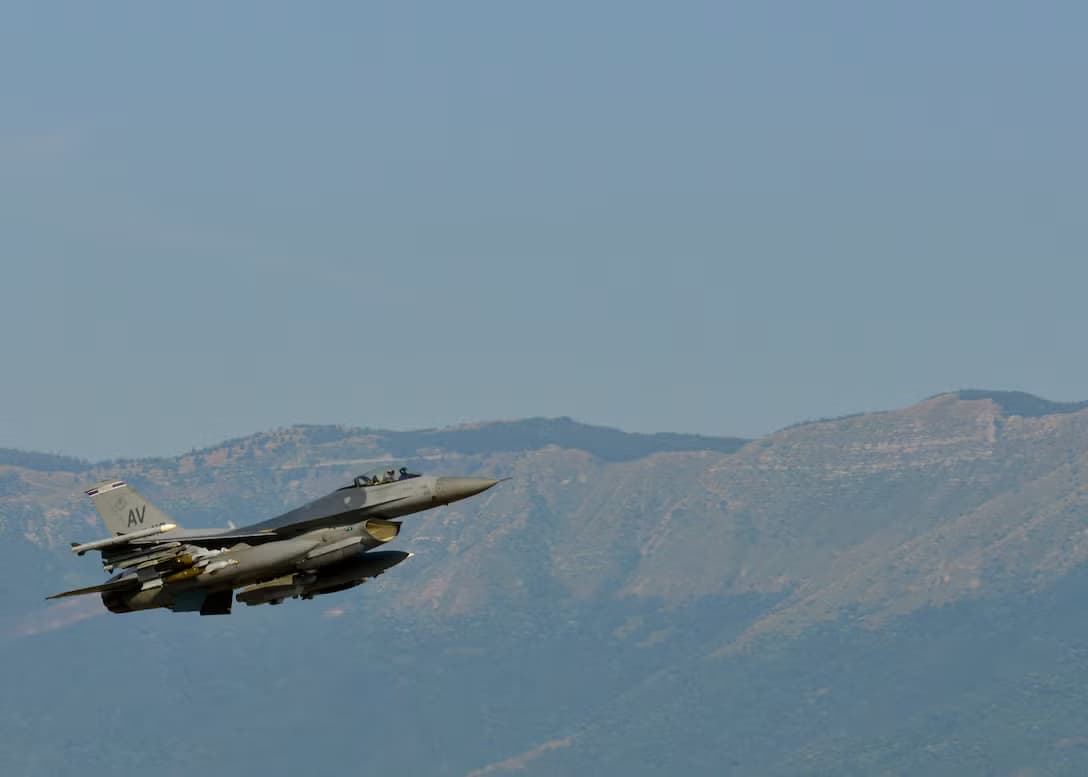
ERBIL, Kurdistan Region - Shortly after the last US-led coalition troops withdrew from Iraq at the end of September, Baghdad boasted that it’s independently maintaining and operating its American-made F-16 Viper fighter jets. In the past, Iraq struggled to keep much of this mainstay fighter fleet airworthy without consistent, hands-on support from American technicians. Furthermore, Iraq has required significant coalition support even for its own airstrikes targeting Islamic State (ISIS) militants on its territory.
Iraqi Defense Ministry spokesperson Maj. Gen. Yahya Rasool told Iraqi media in early October that Iraqi crews are handling the flight operations and maintenance of the country’s 34 F-16IQ Block 52 aircraft. It only relies on US manufacturer Lockheed Martin for spare parts and future upgrades. Rasool also claimed that Iraqi engineers and technicians have provided 100 percent of the maintenance work since 2025.
Iraqi F-16s conducted two airstrikes against a suspected ISIS hideout in Diyala province on Sunday. Earlier Iraqi strikes killed a senior ISIS figure in the same province in June as part of an independently planned operation.
These incidents, and Rasool’s claims, suggest Iraq can maintain and operate these jets as effective weapons against ISIS remnants and for providing air support to ground forces fighting the militants.
“Iraq’s air force can be indefinitely sustained as a close air support branch of the Iraqi armed forces for internal combat missions,” Nicholas Heras, Interim Executive Director at the Middle East Policy Council and Senior Director at the New Lines Institute, told Rudaw English.
“The US is providing the Iraqi air force with enough backend technical advice to allow Iraqi maintenance crews to do the job of keeping Iraq's F-16s viable as flying artillery against non-state armed groups, especially ISIS,” Heras said.
“The US is interested in keeping Iraq’s air force capable of an internal security role.”
The strikes in Diyala targeted ISIS in one of the security gaps between the Iraqi Army and the Kurdish Peshmerga. ISIS has exploited these gaps for about a decade, since the destruction of its self-styled caliphate in Iraq in 2017.
Iraqi parliament Security and Defense Committee member Mazen Gharib told Rudaw on October 10 that ISIS movements in Kirkuk province have increased and the militants are undeterred by Iraq’s air force. Unlike US and French jets conducting coalition airstrikes from high altitudes, where they are harder to see and hear coming, Iraqi fighters often fly low, inadvertently giving the militants warning. The ISIS al-Naba outlet has mocked Iraq’s Counter Terrorism Service for its alleged dependence on air cover.
Ryan Bohl, a senior Middle East and North Africa analyst at the risk intelligence company RANE, said he would be surprised if Iraq has developed a “complete indigenous ability” to maintain its F-16s.
“There may be some increased confidence that Iraq can run its own squadrons with less of this support,” Bohl told Rudaw English. “But in order to maintain the full-scale effectiveness of these platforms, they’ll need to continue to have access to American technical expertise.”
Muaz Al Abdullah, Middle East Research Manager at the non-profit Armed Conflict Location & Event Data, cited data collected by the conflict monitor which illustrates a consistent year-by-year decline in recorded Iraqi airstrikes against ISIS. In 2023, there were 63, followed by 61 in 2024 and 33 in 2025. So far in 2026, ACLED recorded a comparably paltry 15.
“The slide began before the evacuation,” Abdullah told Rudaw English. “It coincided with three things: Lockheed’s contract expiring, the coalition support that Iraqi strikes relied on winding down, and ISIS shrinking to what Iraq’s air force commander calls a very limited threat.”
“The data cannot separate a thinner fleet from fewer targets.”
ACLED data has also shown that Iraqi forces are leading most operations against ISIS in the country.
“Between January 2025 and September 2026, ACLED recorded nine events involving the US-led coalition against ISIS in Iraq: only one direct strike, in March 2025, and eight in support of Iraqi forces; only one of these eight events was in 2026,” Abdullah said.
RANE’s Bohl believes that the Iraqi Air Force can play a supportive role in the country’s counterterrorism strategy against ISIS.
“Given that ISIS is currently highly disorganized and is largely cell-based rather than a militia capable of taking and holding territory, Iraq’s air force doesn’t necessarily have to serve at its highest possible capability to be effective in helping disrupt and disorganize the threat of ISIS,” Bohl said.
“I think the greater
test may come in the future if ISIS ever does demonstrate an ability to take
hold of territory again either in Syria or Iraq,” he added. “And here we’ll see
whether or not Iraq’s air force has truly modernized and developed enough
independence to combat such a threat to its nominal effectiveness.”
The coalition has
helped Iraq combat ISIS with airstrikes since 2014. In addition to this, Iraq
also heavily relied on intelligence, surveillance, and reconnaissance (ISR) provided
by the coalition for many of its own airstrikes against the militants. Baghdad
will probably still require such support for reliably locating and targeting
ISIS remnants in an effective and timely fashion.
“While the US support is likely to narrow further, with intelligence sharing becoming one of its main remaining functions, it is the mission most likely to last because it needs no troops or bases on Iraqi soil, which makes it the easiest form of cooperation for Baghdad to defend politically,” Abdullah said. “But it will continue as bilateral US support delivered from outside Iraq, not as a coalition mission inside it.”
Bohl also expects such intelligence-sharing and covert support to continue for the foreseeable future.
“Iraq is not an island, any more than any of these other countries facing threats from ISIS are, and intelligence sharing and coordination are essential parts of a sustainable counterterrorism campaign with a transnational group like ISIS,” he said.
“I think the United States will continue to have a political interest in doing so, even as it retrenches from the region in the face of the Iranian threat,” he added. “Places like Syria, Jordan, and Iraq will all maintain a similar interest to keep these connections going.”
Another factor that bodes well for Iraq’s capability to deal with the ISIS threat more independently is the group’s current state of weakness. Abdullah noted that ACLED has recorded a decline in ISIS attacks from 222 events in 2023 to a comparatively minor 44 in 2025.
“The fact that the Iraqi army was the main actor leading the anti-ISIS operations in 2025 and 2026 indicates that the Iraqi forces currently have the capacity to continue their operations to suppress ISIS and prevent it from launching large-scale attacks,” Abdullah said. “Although the security situation in Iraq and the disarmament plan of the PMF militias might change this reality.”
Bohl believes that “political baggage” from Baghdad could hinder the Iraqi Air Force more than any maintenance, technical, or intelligence issues.
“While the Iraqi Air Force has made significant strides in its tactical capabilities and professionalism, it’s the political paralysis, corruption, and sectarian politics of Baghdad that serve to hamper the air force’s ability to serve at its full capability,” he said.
“In addition to that is the potential for funding issues, especially given Iraq’s negative fiscal outlook resulting from its inability to reliably export oil throughout much of this year,” he added.
“So for the Iraqi Air Force, it’s more about being held back by political and economic factors from exemplifying its full capabilities.”
The views expressed in this article are those of the author and do not necessarily reflect the position of Rudaw.