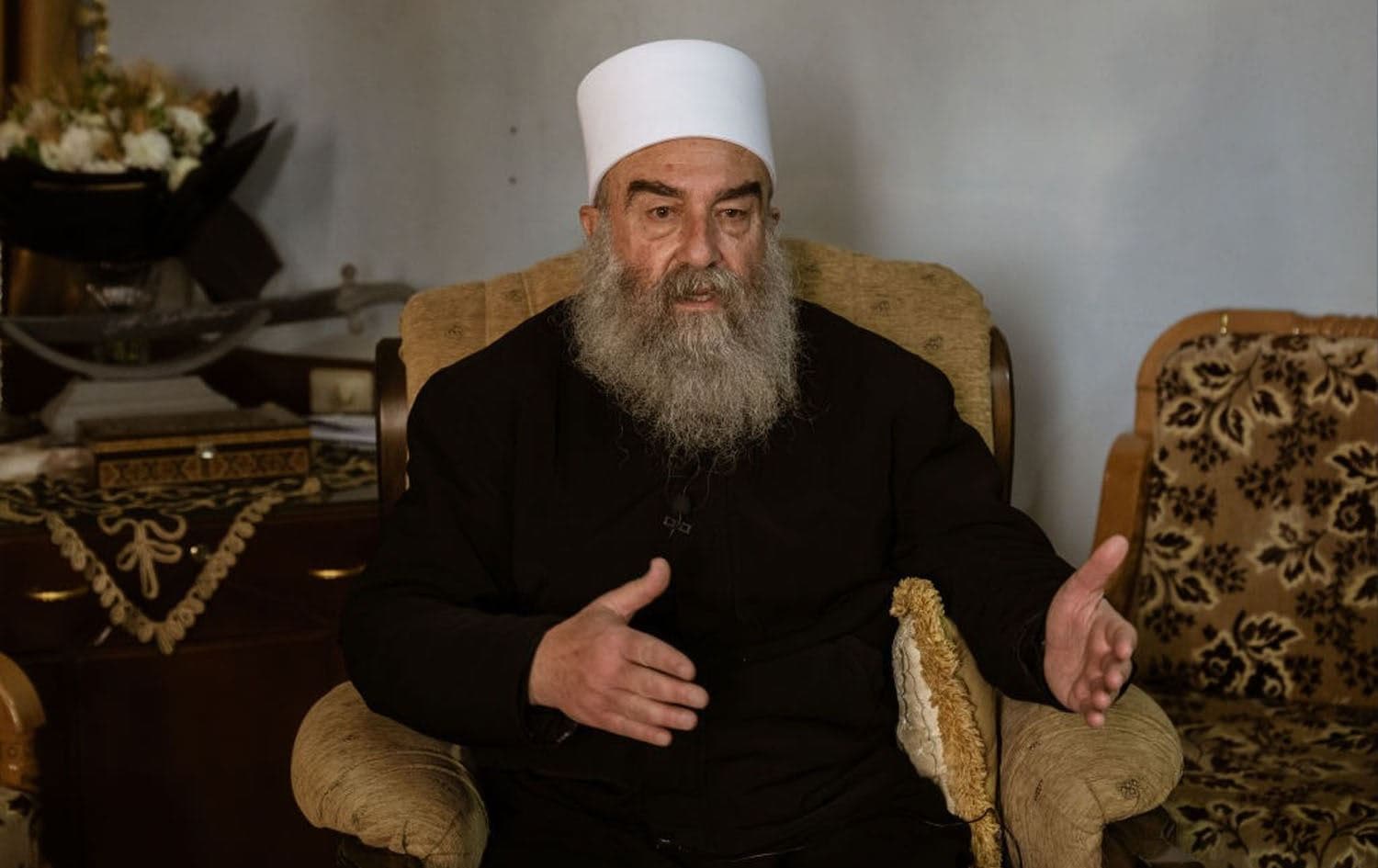

ERBIL, Kurdistan Region - The spiritual leader of Syria’s Druze community, Hikmat al-Hajari, on Monday reiterated his rejection of Syria’s new constitutional declaration, labeling it a “declaration of tyranny” that threatens the country’s sectarian and ethnic fabric.
“What was called the constitutional declaration was in reality a declaration of tyranny, and we and all of Syria's components did not agree with most of its articles,” Hajari told Rudaw in a written interview. “What it lacks in rights is not just for the Kurds but for all sects, spectrums, and components.”
The constitutional declaration, signed in March by interim President Ahmed al-Sharaa, was introduced by the Islamist-led interim government that came to power after Sharaa’s now-dissolved Hay’at Tahrir al-Sham (HTS) overthrew the regime of Bashar al-Assad.
The document emphasizes Islamic jurisprudence as a primary source of legislation, drawing criticism from Syria’s Christian, Druze, Kurdish, and Alawite communities, who view it as exclusionary and a threat to religious and cultural diversity.
“The brothers [HTS] who reached Damascus call on us saying that ‘whoever liberates decides,’” Hajari said, explaining that the new government makes unilateral decisions without consultation of minority groups. “All of us as one people are partners in victory. Otherwise, we will return to another face resembling the tyranny of Bashar.”
The Druze, a religious minority concentrated in southern Syria, as well as parts of Lebanon and Israel, have expressed growing concern over the Islamist-led government since Assad’s fall. Tensions have risen between local groups in the Druze-majority province of Suwayda and the new authorities in Damascus.
In April and May, deadly clashes erupted in Suwayda after an offensive audio recording about the Prophet Muhammad - initially attributed to a Druze cleric - sparked sectarian anger. More than 100 people were killed in the fighting, according to the UK-based Syrian Observatory for Human Rights.
The Rijal al-Karama (Men of Dignity) Movement, the largest Druze armed group in Suwayda, has played a key role in defending the province from external threats and local corruption since the fall of Assad.
In early April, Hajari denied making any political agreements with Damascus, calling the current government “extremist in every sense of the word.”
While the state-run SANA news agency reported in late May that Druze representatives had reached a “preliminary agreement” with the government to halt the violence, local outlet Suwayda24 said the meeting ended without a clear deal, noting only “non-binding points,” including a proposed ceasefire and the formation of a joint committee to address the aftermath of the clashes.
The following is the transcript of the interview with Hikmat al-Hajari.
Rudaw: Can a stable Syria be built with the current form of governance?
Hikmat al-Hajari: Stability will only come by taking into consideration Syria's situation and the composition of its people, as well as the distribution and mixing of its communities and components. Therefore, as long as the current temporary form of governance does not establish a balance for all of this and does not work in a rational, studied manner, it will remain unsustainable... and problems will persist. That's why we, along with the sons of Syria, have called for administrative decentralization, which will be a political system closer, more comprehensive, and more successful than all others in steering the country toward a better, more stable future.
From time to time, disagreements between you and the new authority in Damascus are renewed. What is the fundamental reason for this difference?*
In truth, there is no disagreement between us, because since the fleeing…[of Bashar al-Assad], we have been demanding the rights of the people and revolutionaries through comprehensive dialogue, a proper civilized constitution, modernization and optimal building of institutions, and distribution of wealth to the people... wealth that was subject to sale and plunder in the bygone era. We called from the beginning that all Syrians were partners in the victory, and no one has favor over another, as everyone made their efforts, international will was imposed, and what happened happened. But what's happening is a lack of credibility. The brothers who reached Damascus tell us ‘whoever liberates decides,’ and we tell them that we and you and all the revolutionary people are the ones who liberated and the ones who decide - not you alone, and you are not an occupation or invaders to impose your viewpoint and color alone on all components. Rather, all of us as one people are partners in victory... Otherwise, we will return to another face resembling the tyranny of Bashar and his father's Baathist [party], and this was not among the revolutionaries' demands.
They delude us that they agree, but unfortunately, they do not fulfill our clear, peaceful, national requests, which were never demands of a sect or province or special group, but were agreed upon by all sons of Syria from various backgrounds. But media corruption and the awakening of online flies [social media users] that the bygone regime established have returned in the guise of accusations of treason - the same ones with some terminology changes. To push us away from these national demands, there was distortion, forgery, and incitement, which caused the shedding of innocent blood in attempts to intimidate and try to push us away from stating our firm national demands or backing down from them.
The Syrian people consist of different ethnicities, religions, and sects. In your opinion, is recognizing this plurality a source of strength or weakness?*
We are not about to recognize or deny these realities and these colors, and our statements have been completely clear in this regard. We have repeatedly said about the beauty of Syria that we take pride in and cherish citizenship and love among all sons of the Syrian people with all their religions, sects, colors, spectrums, ethnicities, and variations. This beauty is like the beauty of a cohesive, strong fabric. We don't speak of minorities or majorities but of a popular fabric of all that we mentioned has distinguished Syria and given it a civilized character and colors that make it a shining beacon close to all the world's peoples. This statement is a source of pride, beauty, and strength, not the opposite at all.
The temporary constitution, according to the Kurds' opinion, hasn't changed anything and hasn't given any recognition or rights to the Kurds. How do you view this constitution?
The constitution? What constitution are you talking about? What was called the constitutional declaration was in reality a declaration of tyranny, and we and all of Syria's components did not agree with most of its articles. What it lacks in rights is not just for the Kurds but for all sects, spectrums, and components. Even the Sunni brothers were not satisfied with it. There's no room to go into its details, and we affirm the request to amend it completely.
The Kurds, Christians, and Alawites are demanding a constitution written with everyone's participation that includes everyone's rights and is built on the principle of decentralization. How do you envision the new permanent constitution for Syria?
We affirm that we were the first to call for amendments by specialists, and we advocated clearly and without regard for anyone for a unified state with a decentralized, democratic, civilian system. This is what brought upon us all those online attacks, hostile media campaigns, incitement, and other forms of harassment, as we mentioned to you above.
Recently, the leader of the Kurdistan Region’s ruling Kurdistan Democratic Party (KDP) Masoud Barzani said in a television interview that Syria’s future must be decided by the people of the country and that he sees federalism as a suitable system for Syrian Kurds. How do you view a federal system in Syria that preserves unity and guarantees the participation of all nationalities and components in Syria?
We have stated our position on this matter, and you asked us about decentralization and we answered that we affirm it. This is everyone's viewpoint and a consensus among politicians and specialists who distinguish between federalism and decentralization and favor the latter. In the end, specialists from all segments of the nation, according to the reality and nature of the country, are the ones who will see, reach consensus, and determine [the system], and we agree with the sound, justified opinion regarding these detailed aspects whose specifics we refer to the specialists [to answer].
How do you view the rights of the Kurds in northeast Syria (Rojava), as the second largest ethnic group in Syria living on their historical land and having sacrificed more than 12,000 fighters in the war against the Islamic State (ISIS)?
The Kurdish brothers are one of the spectrums and colors of the Syrian people that we mentioned in our previous answers. They have offered martyrs like the rest of the Syrians to support their rights as a component and in defense of their rights, land, dignity, and livelihood. We pray for [the souls of] the martyrs and we honor their noble loyalty and their choice [to serve] the motherland of Syria, which brings us together with them in complete love and harmony.
Is it true that the Syrian Democratic Forces offered to provide you with the names of kidnapped Druze individuals so they could be included in prisoner exchange negotiations with ISIS, in return for ISIS detainees held by the SDF?
That was during the ISIS attempt to invade the eastern villages in the [eastern Suwayda] province in 2018, when a group of our… sons were kidnapped. The initiative of the Kurdish brothers was indeed to offer this proposal and this sacrifice to save our sons and daughters from the ISIS kidnappers. We sent them a letter of thanks and gratitude, and we direct the same gratitude to them today for their good deed, chivalry, and evidence of their sincerity and brotherhood.
Israel always declares the necessity of preserving the rights and security of the Druze and also mentions the security and rights of the Kurds in Syria. How do you view this Israeli position?
No one disagrees on giving rights to their rightful owners, and whoever takes a step toward us, we take a step toward them. Here they are holding meetings and negotiations with the interim Syrian leadership and gaining recognition from it. So the answer is clear and can be read from the narration of facts, and all countries and peoples of the world demand our rights and security as a people.
How can a permanent and broad relationship be built with the Kurds?*
The permanence of the relationship between the Druze and Kurds is not new, and I mentioned it in a previous question. Our concerns and pains are shared. When the history of ancestors brings us together, the future of descendants will bring us together, and we are preservers of this good relationship.
As you know, the late Lebanese politician, Kamal Jumblatt, who was a Druze, is a Kurdish. Do the Druze have Kurdish roots?
You speak of the honorable Jumblatt family, and perhaps friendship, concerns, and crises have brought us together with our honorable Kurdish brothers. But history says that the Druze from Bani Maarouf [Jordanian Druze community] are historically from the ancient Arab tribes that originated from Yemen and the Arabian Peninsula. They accompanied the Noble Prophet [Mohammed], where they were around the venerable companion Salman the Persian [Imam and scholar]. All respect to you and to your history that you take pride in... and we respect it in all its details.
.jpeg&w=3840&q=75)