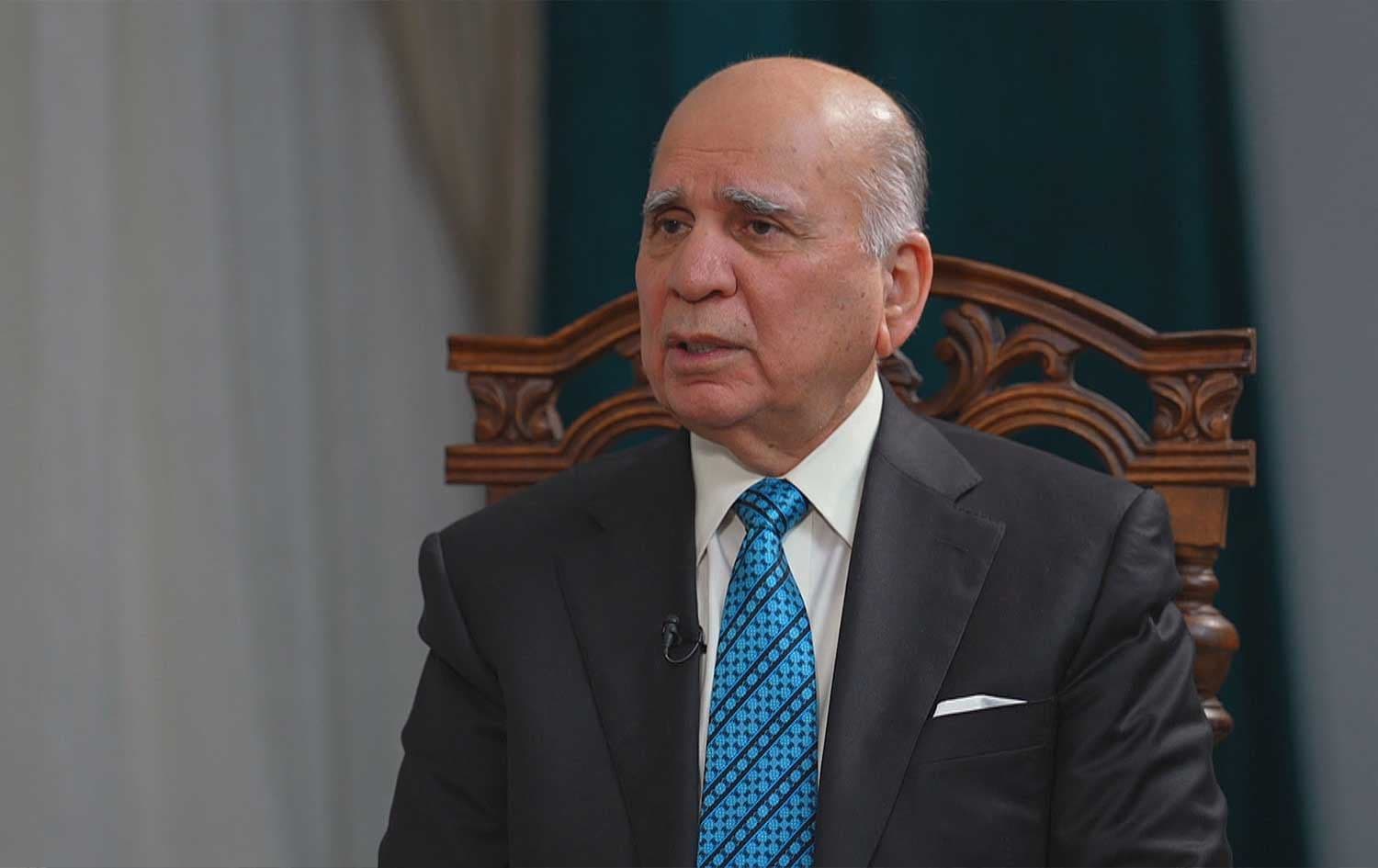

ERBIL, Kurdistan Region - The Islamic State (ISIS) remains a serious and ongoing threat to stability in Iraq, Syria and the wider region, though it is unlikely to launch another full-scale war, Iraqi Foreign Minister Fuad Hussein has told Rudaw.
In an interview with Rudaw's Sangar Abdulrahman on Monday, Hussein warned that ISIS could still conduct terrorist attacks and that risks emanate from thousands of ISIS prisoners held in Syria. About 7,000 are expected to be transferred to Iraq by the US military.
Hussein said ISIS “remains and it exists.” While the Kurdish-led Syrian Democratic Forces (SDF), the Iraqi military and the Peshmerga led ground operations alongside a US-led military coalition to defeat ISIS territorially in Iraq and Syria, remnants of the group are considered an ongoing threat to international security.
Hussein said that while ISIS is unlikely to take over vast swaths of territory as they did in 2014, “terrorist activity is always dangerous.” He expressed deep concern over thousands of ISIS detainees in SDF-managed prisons - particularly in northeastern Hasaka province - noting their escape or release would threaten Iraq and neighboring countries.
Hussein made the remarks amid instability in northeast Syria (Rojava), where the Syrian Arab Army and allied groups have launched a large-scale operation against Kurdish forces who control prisons holding thousands of ISIS militants. ISIS fighters escaped a major prison that came under attack, triggering alarm from the international community and a UN Security Council hearing last week.
A ceasefire between the Syrian Arab Army and the SDF has been extended through February 8 to allow for the US to transfer prisoners to Iraq.
Hussein said discussions were held on transferring ISIS prisoners to Iraq, but the details remain unresolved.
“Transferring 8,000 to 9,000 terrorists first requires special prisons, which we don’t have,” he said, adding that many detainees are foreign nationals whose countries refuse to repatriate them.
Hussein said instability and clashes involving the SDF and Arab tribes in Syria heighten the risk of ISIS regrouping. Tribes once allied with the SDF are now fighting against them, Hussein noted, describing the situation as “very dangerous,” particularly around detention facilities holding senior ISIS figures.
Despite these challenges, Hussein said Iraq’s security forces are far better prepared than in the past. He asserted that while ISIS remains a threat, “it cannot be compared with 2014.”
On Iraqi politics, Hussein confirmed the Kurdistan Democratic Party (KDP) is prepared to hand over its federal posts to the Patriotic Union of Kurdistan (PUK) in exchange for the presidency if they agree on a candidate.
“Whatever positions we have… would be given to them,” he said, adding that talks are ongoing.
Regionally, Hussein warned that tensions between Israel and Iran, as well as between Tehran and Washington, are intensifying. He said the lack of dialogue between the United States and Iran - and the risk that escalating rhetoric could trigger conflict - were contributing to “more complications” in the region.
The following is the full transcript of the interview with Fuad Hussein, Iraq’s Minister of Foreign Affairs.
Sangar Abdulrahman, Rudaw: I’m in Baghdad and sense that there’s momentum to postpone Tuesday’s parliamentary session for the presidential vote. Will it be delayed?
Fuad Hussein, Iraqi Foreign Minister: This proposal exists and it’s been discussed. The proposal was made by both the PUK [Patriotic Union of Kurdistan] and the KDP [Kurdistan Democratic Party], but Shiite leaders have also made this suggestion. I believe the meeting will be postponed.
To when?
From what I know, to Sunday.
Will you stay in the race as the KDP candidate?
Yes.
Today I saw something on several [social media] pages suggesting you had withdrawn, but I didn't believe it.
I haven’t withdrawn; this is also propaganda.
Is this propaganda, you continue?
Correct.
Do you have the coordination and support required to become president?
Support from whom?
Members of Parliament, the blocs?
Well, during this period, I have been in close contact with everyone - all parties, leaders, and blocs. I went to Parliament and received hundreds of messages from MPs. To be honest, thank God, people speak highly of our reputation, our work and our history. Thank God, our situation is good.
Do you predict the conflict will be settled in your favor in the first round [of presidential voting]?
We will wait, but because 220 votes are needed in the first round, and because there are 18 candidates, this means the votes will be divided [among them.] No one will win in the first round; it will go to a second round of the vote.
Who will make it to the second round?
Well, I cannot speak to that now, but I have confidence that I will make it to the second round.
What happens in the second round?
I don’t know. That is the decision of the MPs. It is difficult to say "this is what will happen" in Parliament or to decide for them. I leave the decision to the members of Parliament.
The members of Parliament or the political blocs?
Both. Because I am in Baghdad, I know the political parties, the leaders and the MPs well. There’s a situation in Baghdad where some political forces [parties] follow their leaders’ decisions. But with other political forces [parties], the MPs aren’t as committed to their leaders' decisions. This means they’re free to decide and vote as they wish, and that makes a difference.
So you are looking toward both?
I am looking toward the members of Parliament, the blocs and the political party leaders. You must work at every level, and we have worked for it.
Why couldn't you reach an agreement with the PUK or other Kurdish forces [parties] on a joint candidate?
Personally, I believe that Kurdish political forces need to have a unified stance. I would like them to be unified in Kurdistan, but in Baghdad, unity is essential. Unfortunately, the reality is that they are not unified, and we have not been together so far. I don’t know if we’ll reach an agreement in the next three or four days. I don’t know.
With whom?
With the PUK.
On what?
To have one candidate. If we reach that agreement, it would be a good thing.
Does this relate to other matters?
It relates to the fact that the KDP is ready to hand over the positions it currently holds to the PUK in exchange for the presidency, if we reach an agreement.
Meaning if there’s a mutually agreed upon candidate, it will be you and not a PUK candidate?
Yes. Meaning we reach an agreement. The KDP and PUK will reach an agreement that…
On nominating you?
Yes, that’s true. In return, the positions the KDP holds in Baghdad would be given to them.
Do you mean the Deputy Speaker of Parliament post?
All of them. Whatever positions we have.
And the other ministers?
The positions we have. What do we have? We have [the positions of] Deputy Prime Minister, Minister of Foreign Affairs, Minister of Construction [and Housing] and the Deputy Speaker of Parliament.
So all of those would go to the PUK?
The PUK positions would be ours.
Have you officially given [this proposal] to the PUK?
We’re currently discussing it.
Officially?
We will also give it [to them] officially.
Will you give them [the posts] to the PUK?
We will officially give them [the positions]. And we will formally discuss it with them.
So, all those other positions the KDP holds would be given to the PUK in exchange for the post of president?
That is correct.
Do you think the PUK will agree to that?
I don't know.
What if they don't agree?
If they don't agree, it means we’ll enter Parliament as competitors.
What if the PUK says, ‘All our positions are for you, but you need to give up the post of president?’
What do they have?
Minister of Justice…
No, no, even if they have everything… they have the presidency. If they give the presidency [position to KDP], that’s it. Because they have the presidency, it’s not with us.
I mean, they hold the presidency now.
No, Mr. Latif [Rashid became president] with our help and support. At the time, [Nouri] al-Maliki, [Mohammed] al-Halbousi, and Falih al-Fayyadh were against him until the last moment.
When he won the post, they immediately said he was PUK. We said, “Well, we didn't say he was KDP.” So in the end, he became president under the PUK name, but with the support of the KDP and other Arab political forces [parties].
My point is, if they say they will give the Ministry of Justice and the Ministry of Environment - which they hold - to the KDP in exchange for the presidency, would you [KDP] agree? Meaning, reversing your proposal to the PUK.
Well, in that case, the presidency must come to us. You mean they give us those two ministries in exchange for the presidency? That would mean four ministries for the KDP. They haven't proposed this, but if they do, we’ll think about it then.
There’s another suggestion, Doctor: Among those 18 candidates, some are hoping that the conflict between the KDP and PUK will work in their favor.
I don’t believe that would be successful. They’re good people, but in this struggle and negotiation, the issue is between the PUK and the KDP, that they both agree on one person between themselves. Because if you say “this in exchange for that,” then what about the others who have nothing to offer? How would that work?
If you become president, what promises will you make for Iraq?
You know, I was in Baghdad in 2003. Initially, I was an adviser in the Ministry of Education, then a member of the Governing Council. Later, when I was in Kurdistan [as chief of staff to President Masoud Barzani], almost the entire Baghdad file was with me. It was related to the presidency, but also related to other political forces [parties] and blocs. They were all with me.
I’ve seen the problems, studied them, and thought about their solutions - both then and now that I intend to become president. If I’m in that post - the president can do many things. Some people think the presidency is only ceremonial; it's true there is a ceremonial aspect, but it has many executive duties as well. Within the framework of the constitution, the presidency is also a political position.
It’s impossible for the country to have problems [and for the president not to act] - such as the problem between the Kurdistan Region and Baghdad, or problems between parties. The president's job is to bring those people together, find solutions and bring people closer to one another.
Furthermore, it is the duty to protect the constitution, because the constitution is basically protected by the president. If the government or a party opposes the constitution, the president must speak up. The president can be active. From a political standpoint, the president can have relationships with world leaders.
Do you have complaints against previous presidents?
I am not in a position to complain. Because every time someone was president, the situation was very different; every person has an understanding of the presidency. I leave this for historians to evaluate the president’s [performance]. But you asked me what I will be doing, I’ll be an active president. My nature is such that wherever I have been, first, I was committed to the place; second, I was loyal to my work; and third, I was active.
And fourth is that you don't get tired.
That’s also true, as you say. I thank you. I work about 12 to 13 hours daily. It is the same now. If you work for 12 to 13 hours, you can do a lot of things.
I can testify to that; there are times I call you at 12 midnight and we talk.
Yes, thank God.
Thank God. Wishing you good health, Doctor. You mentioned the constitution: How will you protect the constitutional commitments in Iraq?
We have a problem. From my experience working in Baghdad, both after the changes [in 2003], and after 2005 when the constitution was new, and during the time we monitored the situation in Baghdad from Kurdistan, I’ve realized we have a problem.
In reality, we have a very good constitution, but many constitutional articles haven’t become law. When you don’t turn a constitutional article into law, a gap is created - a legal vacuum. What fills that gap? The old laws. What are the old laws? Most of them are laws from the era of Saddam Hussein. How do the laws of the Saddam Hussein era fit with a constitution full of democracy, openness, a free economy and a federal country?
Our main problem is that many articles haven't been made into laws. Second, understanding of the constitution is low in our country. The parliament, government, and parties need to better understand the constitution, and we need to commit to it. The problem with commitment is that when you are committed to an article, you need a law to implement that article, but the law doesn't exist.
The main dispute between the Region and Baghdad, when I looked into the heart of the problem, is this: When the people of Kurdistan speak, they talk about their rights within the framework of the constitution, which is correct and their right. But Baghdad officials talk about the law. The laws they talk about are old laws related to the past. This constitution the people of Kurdistan talk about is correct, but the laws for it haven't been issued.
This constitution needs to be turned into laws and many of its articles need to become the foundation of legislation; this is the solution to the problem. For example, one of those problems is the oil issue. To be honest, in the Kurdistan Region we observe the constitution; in Baghdad, they talk about the law, and the law is from the era of Saddam Hussein.
Do you anticipate that the oil and gas law will be passed in the next parliamentary term?
If God wills and I become president, certainly one of the main tasks I will strive for will be to pass the oil and gas law, because the president also has the right to submit draft laws.
There is a draft that has been edited several times; is that what you mean?
That draft goes back to 2007 and it was later edited several times. It doesn't matter whether there’s a draft or not, because those drafts can be utilized. But in any case, the draft oil and gas law must be submitted so that this problem can be solved legally and within the framework of the constitution.
We talked about oil; is Kurdistan Region oil currently being exported without issue?
According to my information, yes, it continues.
How many [barrels] are exported daily?
I don’t know. When exporting started, it was 230,000 barrels, but honestly, I don't know what it is now.
The [Baghdad-Kurdistan Region agreement to export oil to Turkey] ends on March 31. Do you think it will be extended? The agreement was every three months; initially until December 31, then extended for another three months until March 31.
I predict... you know, the situation in Baghdad and the Kurdistan Region is favorable for resolving these problems.
I mean, won’t the Kurdistan Region oil exports be halted again?
I don’t think so.
Has this impacted the new agreements for [civil servants'] salaries between Erbil and Baghdad?
Certainly. When the discussions were held, and later salaries were provided, part of it was related to the oil issue. When oil was exported, the issues of oil and non-oil revenue were on the table, and they were all interconnected. When the salary problem was solved, the issue of non-oil revenue naturally came forward, and I believe that has also been solved to an extent.
Every time we do an interview, you say “don't talk about salaries,” but the people are waiting, so I am sure you...
No, the people have their right; certainly, the situation is difficult. Salaries affect people's lives, and I understand that.
Every time you say, ‘I am busy with my own work.’
No, I was busy with that issue as well. Because every time salaries were halted, I got involved and was part of the solution.
That’s exactly why I always ask you about salaries. I know what your role is. Are there any problems with January salaries as of now?
Based on my understanding, legally there is no problem with January’s salaries. Because now the distribution of salaries - meaning the fiscal policy - relies on the one-and-a-half rule. This means that just as salaries were issued in January last year, they must be given the same way this year. This is also based on the issue of non-oil revenue, which must be handed over.
If I am not mistaken, in the past day or two, you chaired a Ministerial Council meeting for the economy of Iraq?
No, I did not participate.
You didn't participate? But was the meeting held?
The meeting was held, but I haven't followed up on it because I was very busy and did not participate.
I want to ask whether the subject of non-oil revenue and those 120 billion dinars [nearly $92 million] will continue, or has a committee been formed to review it?
The committee itself exists, but January salaries must be paid - meaning they have started. If they don’t reach a new agreement, it means the old agreement will continue as it is.
I will move to the situation in Syria and the circumstances there. What has Iraq done to prevent the dangers from spilling over into Iraq?
Generally, we are all very concerned - all of us officials in Baghdad. We had a security meeting; the prime minister and I were present, and they presented a security report. We are very concerned about the situation in Syria, both the situation of the Kurds in Syria and the situation of the ISIS [Islamic State] prisons.
From what I understand, there are about 8,000 - some people say 12,000 - terrorists in those prisons under the control of the SDF [Syrian Democratic Forces]. Certainly, some places fell to the Syrian government, and some [prisoners] got out, were released, or escaped, I don’t know. The people in Hasaka [prison], are numerous and very dangerous - and are from the leaders of ISIS and major terrorists. We are talking about thousands of people. Imagine if they escape, or are released, or flee and once again return to the field of terrorist activity.
A large number of them are Iraqi, and this is a major threat to Iraq, to Syria, and to the security of the region. Therefore, we have investigated this closely, and I myself, in my contacts with American, European, and even Gulf officials, have tried to get them to support extending the ceasefire and for the problem between the SDF and the Syrian government to be solved through dialogue, because that’s the right way. The use of weapons…
So you, as the foreign minister of Iraq, played a role in extending the ceasefire?
No - rather, it’s my job.
I mean, did Iraq have a role in this [ceasefire]?
I don’t know if it was my role or not, but we have contacted all sides and hope this ceasefire continues. The issue is that it must not turn into a war, especially in Hasaka.
If war breaks out in Hasaka, several things will happen: First, the issue of those terrorists in the prison in Hasaka who are truly dangerous. Second, if war breaks out and a military attack is launched on Hasaka, it means all civilians will flee. Where will they flee to? Either they come into Iraq, or they go toward the Kurdistan Region. This creates another problem of refugees and displaced persons for us this winter, which certainly becomes a humanitarian problem. We hope none of this happens.
In your remarks, you referred to the prisoners and ISIS leaders and said “be released” or “set free.” Who would release them? Or is [the concern] that they will escape?
That's right. If they escape themselves.
That is one thing, but does the Iraqi government fear that the Syrian government might release those prisoners?
You see, there are one or two things. the SDF had many Arab tribes with it, had armed them, etc. All those tribes are now against the SDF. They were together for many years, but now they stand against them. Sometimes they act on their own, meaning they go to a prison themselves and release the people in the prison, even presenting it as if they released their own brothers and relatives. This doesn't mean it's the policy of the Syrian state, but that situation exists there. This is dangerous, very dangerous.
What is Iraq afraid of?
First, the issue of security in Syria, and if Syria is not stable and has war in it, there will be an impact. Second, those prisoners - the terrorists - will immediately reconnect with ISIS, because ISIS exists in Syria; meaning the ISIS organization exists in Syria. When they are on the border and 2,000 to 3,000 of them are Iraqi, they will certainly try to return to Iraq as well.
However, the border demarcation is controlled by the Iraqi army and Iraqi forces, so it is not easy for them. But in any case, one must account for it, because we saw how it was when ISIS came and how their behaviour was. It remains and it exists. Their organization is very strong and they can carry out terrorist acts in many places. Therefore, when one talks about that, one must make preparations, because we have a bitter experience with ISIS.
That experience was 12 years ago, in 2014. Hasn’t the Iraqi army grown stronger during these 12 years?
It has experience and more information. Previously, when ISIS came and took the areas of Mosul and later Salahaddin and reached Ramadi and near Kirkuk and Makhmour and south of Baghdad, that information on ISIS was not available. But in recent years, there is a lot of information on them and much intelligence work has been done on them; certainly, it cannot be compared with the year 2014. In military terms, both the Peshmerga, the Hashd al-Shaabi [Popular Mobilization Forces (PMF)], and the Iraqi army have experience; they have good experience too.
Won't that experience repeat where ISIS captures a city in Iraq?
I don't believe so, but terrorist activity is always dangerous. Because four people can also carry out a terrorist act; the issue is not a frontline war. A full-blown war will not happen, but in the ISIS era, it became a full-blown war. In a short period, about two months, they seized all those areas. On the 10th of June, they were in Mosul, and on the 5th and 6th of August in 2014, they reached south of Makhmour. In that period I mentioned, they were in Mosul, and in August they reached south of Baghdad. Meaning two capitals - the capital of the country and the capital of the Region - were under the threat of ISIS.
Those prisoners the Americans are transferring to Iraqi prisons - does that include all ISIS prisoners or only those prisoners under SDF authority?
We have discussed this in principle; this has not been implemented yet. In principle, we have discussed with the federal government that it is better - if the situation is like that - to transfer those ISIS members to prevent some tribes from releasing them or them escaping themselves. It is better for us to transfer them, because they were part of a terrorist organization and that organization killed people in Iraq and Syria, so legally it is our right.
So, in principle, we have discussed it, but in our contacts, both with the Americans and the Europeans, we have also discussed it and told them this is a major task. Transferring 8,000 to 9,000 terrorists first requires special prisons, which we don’t have, or they must be distributed, which is also not easy.
Second, they will stay in prison for 20 or 30 years; the question is, how will their expenses be covered? Some of them are citizens of other countries; they’re not all Iraqi and that’s the problem. Those who are Syrian will likely remain in Syria, but those who are Iraqi or citizens of other countries - it’s true they committed crimes on Iraqi soil and must be tried here - but at the same time, they are citizens of other countries, such as European and Arab countries, they’re too much.
So, the proposal is for them to go back to their own countries?
No, no one accepts them.
This hasn’t been implemented yet, right?
No, no. This has been discussed only in principle.
What do the Americans say?
The Americans would like it, because the Americans help the SDF protect these [prisoners], but that war that started between the Arab tribes - and at times the Syrian government - against the SDF has created a problem in that area. Therefore, the Americans are concerned that those [ISIS prisoners] might be released or escape, so it’s better for them to be in prison somewhere else.
If they are transferred, how long will they stay in Iraq?
The judiciary will decide on that, because they were tried by the SDF, but the SDF courts do not have international recognition because [the SDF] is not a state. Therefore, according to international laws, they have not been tried anywhere, and a new case must be opened for each of them.
Where is the Syrian government in this equation? Why aren't those prisoners handed back to the Syrian government?
The prisoners are not currently under the control of the Syrian government; rather, they are under the control of the SDF. The reason for the concern of the Americans and other parties is that if war breaks out between those two sides, controlling those prisons will be impossible, and the prisoners will flee, because the SDF controlled that area.
According to reports from human rights monitoring organizations, many violations occurred in the January 22 attack on SDF and Kurdish areas. As you know, until now, Kurds in the Kurdistan Region and other global cities have been protesting [to condemn those violations]. You, as a Kurd who is the Foreign Minister of Iraq, what have you done to convey these violations to the world?
Certainly, part of the actions that were taken were by the tribes. There is a problem in Syria now; you have the government forces, the SDF forces, and the tribal forces. Most of those tribal forces that were previously with the SDF have split from it and are now working against the SDF and fighting against it. In reality, some of the actions that were taken were done by those tribes. In our contacts, we ask European countries and America to put pressure first on the Syrian government so that it can prevent those actions. But believe me, in some locations the Syrian government also has no authority, and those forces are independent and tribal.
Meaning they are not under their control?
In some places, they are not under their control.
If the Syrian government wants to, can’t it control them?
How?
If the Syrian government forces want to?
I am not an expert on their military and security capability, but I am talking about the situation and the reality. Those tribes that were with the other side suddenly turned. They are all armed and have been trained by the SDF and the coalition.
Did they defect?
I don’t know. The SDF should [answer this question]. I don’t know the reason for this sudden switch, because they were together for many years, were heavily armed, and were receiving salaries. They suddenly turned.
Do you predict another Israeli attack on Iran?
I cannot determine that, but the Iranians themselves say - meaning when I was in Iran, Iranian officials themselves said it's possible they will be attacked, but by whom is a different matter. The Iranians themselves say they will not attack and will not take the initiative, but they are preparing themselves to defend themselves if an attack is made on them, and they have made statements in that regard.
A few days ago, you were in Iran; has Iran prepared itself for another war?
To defend itself.
To defend itself?
Yes, that’s true.
You, with that experience you've had - a while ago, you gave a statement in Qatar and said the situation of the region is not easy and is not moving toward peace; in your exact words, you said it is not moving toward peace. Is it still like that now, and the situation hasn't calmed down?
Yes, it is becoming more complicated.
Is the regional situation becoming more complicated?
Yes.
Where and what is the reason?
These very threats, because these days threats - meaning words - become bullets. There are many threats.
Who is making them, and against whom?
Threats in the region, we see that the Americans talk about, meaning they also talk harshly about the situation of Iran. When they talk harshly about the situation of Iran, it means that the problem that exists between Washington and Tehran has not been solved; there is no sitting [meeting], no dialogue, and no contact. Therefore, the problem remains, and the problem is big.
Is the situation such that from time to time it gets hot and then cools down?
It might get hot and cool down, but it is in a state of psychological war. It is a media war. The question is, will this media and psychological war turn into a hot war? I don't know, but all indicators show that the region is moving toward more complications.
Mr. Mohammed Shia’ al-Sudani has stated in his interviews that they are trying for Iraq to mediate between America and Iran. There are also rumours that a meeting might be held in Baghdad. Have you worked on such a thing?
That is a difficult task. I went to Tehran and listened to Iranian officials, as well as the American side. The problem now is that there is no direct contact. Perhaps there is contact through messages, but there is no meeting. If there is no meeting, a problem is created. If a decision for a meeting is made, then we can put ourselves in between them, but from the American side, there is no decision for a meeting.
There is no decision from the American side. Is Iran ready for a meeting with the Americans in Baghdad?
It doesn't necessarily have to be in Baghdad; wherever it may be. I cannot speak on behalf of Iran, but my prediction is that it is not unlikely that Iran has a desire for a meeting, but they also say that conditions must not be imposed on them, and the meeting must be without conditions.
What are America’s conditions?
For America, every stage has had different conditions, but initially it related to the nuclear weapons project, later it went into details such as uranium enrichment and the percentage that Iran must have or not. My view is that the problem is not that now, because a major blow was dealt to Iran’s projects, and most of the materials they had are now underground. They indeed have their uranium, but the Iranians are ready to solve it and give clear signals that they are ready to discuss that subject, but so far, there has been no response from the American side.
Have you conveyed the messages of both sides to one another?
I won’t say I conveyed the messages of both sides, I listened to both sides and discussed these subjects with both sides.
My point is, does Iraq mediate?
We are not mediators at this stage, because mediation requires both sides to agree on negotiation, and if there is a small problem, you solve it for them. Currently, negotiation and a negotiation process are not on the table.
Meaning if there were a small problem, you would have solved it, so the problem is very big now?
It is very big.
The problem between Iran and America is very, very big.
They see it as big themselves.
Yes. Regarding America and Iran, another question about Iraq occurred to me. Is it true that the Americans have requested that the first deputy speaker of parliament be changed?
I have heard it that way.
What have they told Iraq officially?
I am not aware of who they told officially, because they also talk with the [Coordination] Framework as a political force, but I don’t know if they discussed it with the Framework or not, although it was discussed in the media as well.
In your opinion, will the framework comply with this American request?
That depends on who forms the next government in Baghdad and how and when it is formed.
What are your views on Maliki’s nomination for prime minister?
That is clear. We were pleased that the framework reached a decision, which was the nomination of Mr. Maliki. We supported that decision and said we support any of their decisions. Certainly, we supported Maliki because he is an acquaintance and a friend, and we know him, but in the end, this is the decision of the framework.
I return to the beginning of our talk regarding the formation of the Iraqi government. You said the presidential vote might be postponed until Sunday; won't this timeline create a constitutional problem?
No, they discussed it in a way that the 29th of the month falls on a Thursday. They discussed that after Thursday, Friday is an official holiday and no session is held. Also Saturday is a holiday, so the session falls on Sunday. I believe they have solved it legally. Meaning, the legal side of the subject was discussed that way.
So, the constitutional issue has been solved?
They discussed it that way themselves. I don’t know how legal experts will analyze it later, but this was what they discussed.