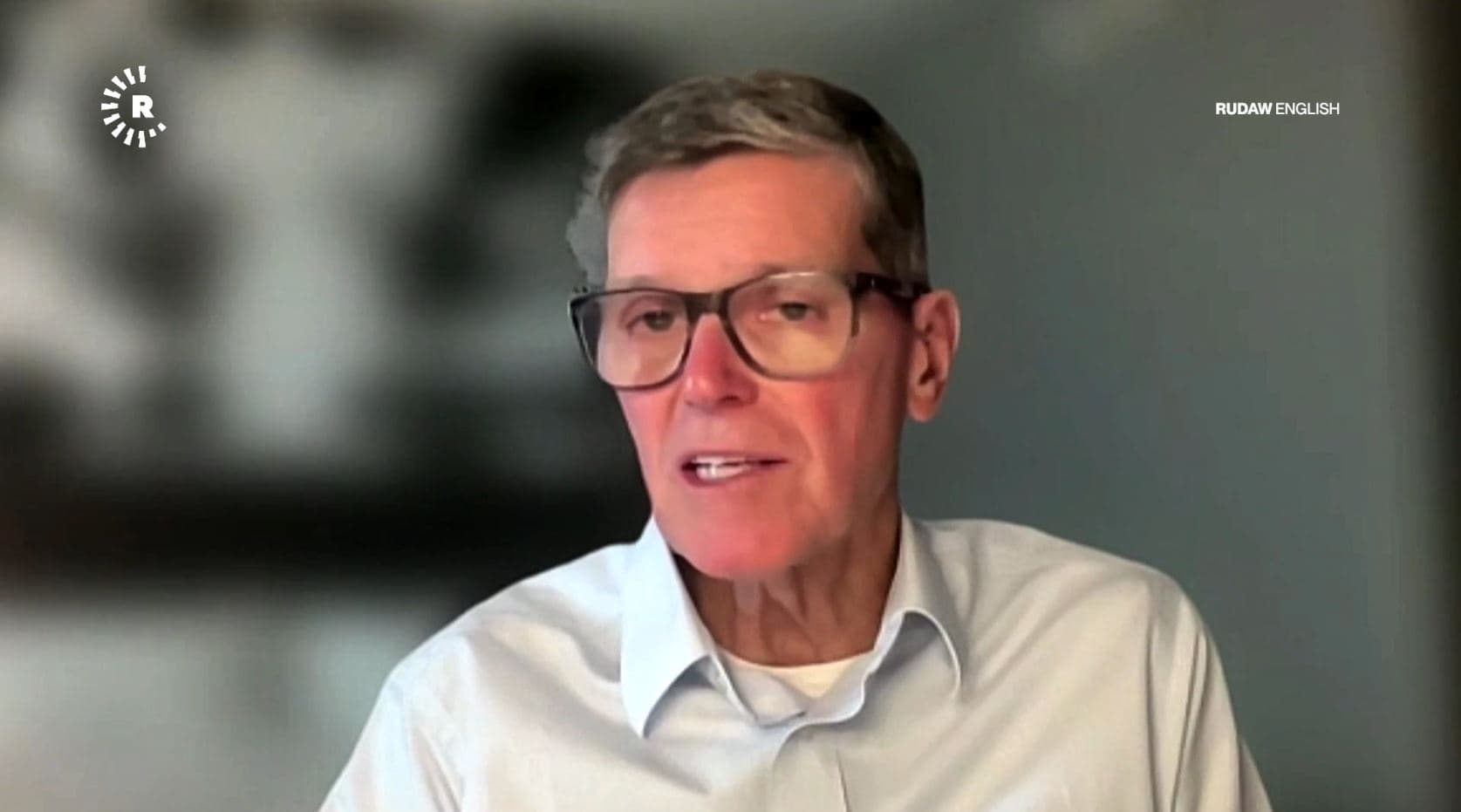
ERBIL, Kurdistan Region - Islamic State (ISIS) remnants could exploit Syria's political transition and mount a resurgence, requiring Iraq and Syria to maintain pressure on them, retired US General Joseph Votel has told Rudaw.
Votel, who served as Central Command (CENTCOM) commander during the war on ISIS until its 2019 territorial defeat in Syria, said on Wednesday that Iraqi security forces have developed strong capabilities and should remain focused on eliminating ISIS pockets to prevent the group’s resurgence.
He described Syria's situation as “more difficult" as the Syrian transitional government takes over Syria’s counter-terrorism responsibilities from the Kurdish-led Syrian Democratic Forces (SDF).
The SDF was the sole Syrian ally of the US-led military coalition against ISIS, and controlled former ISIS strongholds until being driven out by the Syrian army earlier this month.
The transitional governmaent must work closely with former SDF fighters to maintain pressure on ISIS and eventually assume full responsibility for counter-ISIS operations, Votel said.
The Syrian government and Kurdish leaders are negotiating the integration of the autonomously-run SDF into Syria’s army, a critical step in centralizing Syrian institutions after a 14-year civil war and five decades of Ba’athist rule. The Syrian army’s seizure of Kurdish-held territory has triggered fighting between the SDF and the army, ISIS prison breaks and a humanitarian crisis, testing the country’s fragile security.
ISIS prisoners transfer to Iraq a ‘risk-reduction effort’
Votel described CENTCOM transferring up to 7,000 ISIS prisoners from Syria to Iraq following the prison breaks as a risk-reduction effort. Iraq’s stability and more capable security forces allow them to safeguard prisoners and prevent ISIS remnants from accessing former fighters, he said.
He added that Iraq could potentially use its diplomatic relationships to help repatriate foreign fighters.
Asked about the risk of former ISIS fighters now serving in the government’s Syrian Arab Army and potentially working alongside coalition forces, Votel acknowledged this creates a "very difficult situation" for the United States. However, he said US policy is tilting toward the Syrian transitional government and working to ensure Syrian forces remain professional and capable of securing the entire country.
The US launched large-scale strikes on ISIS positions after an ISIS sympathizer serving with Syrian security forces killed three US military personnel in Palmyra last month.
US seeks ‘sovereign’ Iraqi partner, curbed Iranian influence
Votel expressed confidence in the Iraqi military, saying Iraq is capable of securing the country against a potential ISIS threat with continued coalition assistance, training and intelligence support. Iraq said the US military withdrew its final advisors from federal Iraq earlier this month but maintains a presence in the Kurdistan Region.
Votel emphasized that Iraq must focus on its sovereignty and prevent Iranian-aligned armed groups from gaining outsized influence. He praised Iraq's long-standing focus on sovereignty, maintaining that strong partnerships with the US and coalition while protecting Iraqi interests remains essential.
The following is a transcript of the interview. It has been lightly edited for clarity.
Rudaw: What can regional countries - especially Iraq and Syria - do to prevent an ISIS resurgence?
General Votel: Certainly the Iraqi security forces have developed some excellent capabilities and have a strong relationship with the remnants of the coalition - the United States included. So they have to stay focused on these pockets of ISIS resistance in Iraq and make sure that they are unable to reconstitute themselves.
I think the challenge is a little more difficult in Syria right now, particularly as we undergo the transition between the SDF and the Syrian transitional government. In many of these areas, the Syrian transitional government is going to have to step up or is going to have to work very carefully with the Syrian Democratic Forces - the remnants of the Syrian Democratic Forces - to keep pressure on ISIS so that ISIS cannot take advantage of this changing situation in Syria. But ultimately, the Syrian transitional government will need to take control and assume responsibility for counter-ISIS operations.
What was the reasoning behind the decision to transfer 7,000 ISIS prisoners from Syria to Iraq?
Well ultimately, these fighters were from Iraq. And so the desire, of course, is to return them to their home country.
A small number are Iraqis - most are foreigners.
Certainly a portion of them are Iraqi, so they should return to their own home nation. But I think perhaps the reason for the US government making this decision was to reduce the risk that currently exists in Syria.
Obviously Iraq is much more stable right now. And the Iraqi security forces are very capable. The Iraqi government is more capable of taking these prisoners on - and hopefully not just guarding them, but hopefully using their relationships to get them back to their home countries.
But certainly to safeguard [prisoners] - to prevent ISIS remnants from within Syria from trying to ‘liberate’ them [i.e. prison breaks] and bring them back into the [insurgent] fighting force. So I think it is mainly a risk-reduction effort.
Videos show that some soldiers and military commanders in the [government’s] Syrian Arab Army were previously affiliated with ISIS. How does the United States justify trusting and relying on these forces [serving] in the Global Coalition against ISIS?
This is obviously a very difficult situation here. Ultimately the Syrian transitional government has to bring control over their own forces. I think we have seen them operating in a more cohesive and effective way. Most recently we saw some challenges with them during operations last year. They seem to be overcoming that, but certainly they are seeming to exert some more control over their own forces.
This is clearly a difficult situation for the United States. Obviously, we have to be careful as we move forward with this - but I think what you do see is the US policy is clearly tilting toward the Syrian transitional government and trying to work with them to make them successful in their efforts and to help secure all of Syria.
So that will mean that the United States will have to work through these difficulties, and work with the Syrian transitional government, to try to make sure that that force remains as professional and capable as it can be.
In your opinion, are Iraqi security forces adequately prepared to prevent the re-emergence of ISIS?
I think the Iraqi forces have demonstrated a high level of expertise and competence. And while ISIS is a very savvy terrorist group - it can still launch attacks; it can still cause casualties; it can still cause problems - I think the Iraqi security forces, with the assistance of the coalition, and as it continues to migrate and transition with the assistance of some of its Western partners [with] some training, some equipping, some intelligence work and some other assistance - I think they are very, very capable of securing Iraq against the threat of a resurgent ISIS.
US President Donald Trump warned that US support for Iraq could be cut if Nuri al-Maliki were to become prime minister again. How could this affect Iraq’s security situation and the risk of an ISIS resurgence?
I think it will certainly have an impact on Iraq's ability to secure itself and particularly secure itself against threats from organizations like ISIS.
I know we don't want to get into the policy aspects of this - I am not an expert on what the US policy is. But certainly it was under the leadership of Prime Minister Maliki when ISIS came and took over large swaths of Iraqi terrain. A lot of that, I think [it was] felt was his responsibility, and Iraqi forces were unable to step up to the need at that particular time. So there is, I think, a very significant concern from the US side on this. But hopefully this can be averted and US support for the Iraqi security forces can be continued.
How can Iraq protect its security interests amid ongoing tensions between Iraq and the United States?
Yes, of course, the United States is trying to send a very clear message to Iran. And I think the main purpose of a lot of these deployments into the region is deterrence. But what Iraq can do is continue to be good partners with the United States, with the coalition - [to] continue to focus on its own sovereignty and make sure that militia groups, and particularly those militia groups that have in the past been primarily responsive to Iran, don't carry outsized influence in the country.
One of the things that I always appreciated about Iraq was the fact that Iraq was for Iraqis. While they live in a very challenging part of the region, they were mostly concerned with their own sovereignty. So I think it's very important for Iraq and for Iraqi security forces to be focused on the sovereignty of Iraq; [to] protect the Iraqi people from threats like ISIS and certainly from threats that could be posed by militia groups whose allegiance is to somebody outside of Iraq. I think that's the most important aspect that the Iraqi security forces - the Iraqi government - should be focused on.