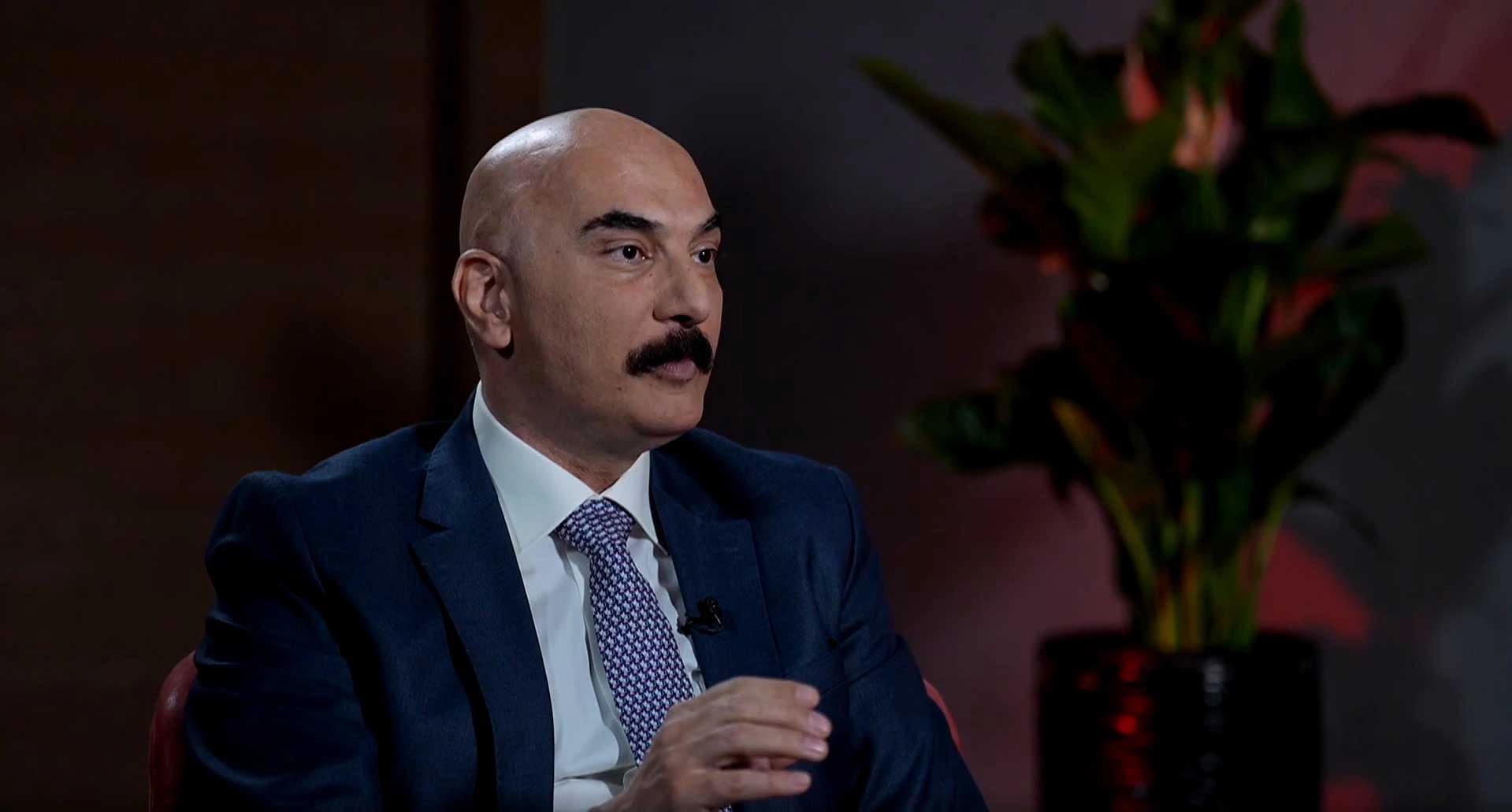
ERBIL, Kurdistan Region - Iraq’s Central Bank Governor Ali al-Alaq said there are no plans to change the dinar’s exchange rate, stressing that the bank’s foreign reserves remain strong and that recent market speculation is misplaced, while confirming that the government is pressing ahead with customs reforms, including the UN-backed ASYCUDA system and new tariffs.
“There is great confusion occurring,” Alaq told Rudaw on Tuesday, adding that the Central Bank of Iraq (CBI) “is not studying the topic of changing the exchange rate.” He said such a decision would only be considered if Iraq faced an inability to meet demand for foreign currency due to weak reserves, which he said is “not the case at the present time.”
Iraq is pressing ahead with efforts to reform the banking sector and regulate dollar transactions amid heightened international scrutiny over financial compliance and money laundering.
Meanwhile, the Iraqi dinar continues to trade below its official rate, with the CBI setting the exchange rate at 1,320 dinars per US dollar, while the currency trades around 1,500 dinars on the parallel market.
Alaq rejected claims linking a potential exchange rate adjustment to Iraq’s budget deficit, calling it “an incorrect link.” He warned that tying the dinar’s value to fiscal shortfalls would undermine confidence in the national currency, emphasizing that “stability is a fundamental condition for achieving economic and investment movement.”
He said Iraq’s foreign currency and gold reserves are at comfortable levels and would not be threatened even if oil prices fall. Iraq’s foreign reserves exceed $100 billion, including more than 76 tons of gold, he noted.
Addressing monetary conditions, Alaq said Iraq’s money supply stands at roughly 100 trillion dinars [$76.3 billion], with more than 80 percent held outside the banking system. He attributed this largely to tax evasion and weak disclosure in the trade sector, rather than a lack of liquidity.
“There is confusion in this understanding,” he said, dismissing claims of a cash shortage. He explained that salary delays or funding gaps stem from a widening fiscal deficit caused by high spending relative to revenues, not from limitations at the CBI.
On customs reforms, Alaq said demand for dollars through official transfer channels has declined temporarily following the rollout of the ASYCUDA system and revised tariffs, as some traders paused activity. However, he said the government’s position is clear.
“Applying the tariff, applying the ASYCUDA system, and applying the advance customs declaration, the government is proceeding with it,” he said, calling the measures beneficial beyond fiscal gains.
Baghdad’s main commercial districts were largely shut down on Sunday after wholesale traders went on strike to protest newly imposed customs tariffs on imported goods. The tariffs, which range from 5 percent to 30 percent, took effect on January 1.
Alaq added that discussions are ongoing between Baghdad and the Kurdistan Regional Government to resolve technical issues related to the system’s implementation.
Mohammed Fatih contributed to this report from Erbil.
The following is the full transcript of the interview with Ali al-Alaq:
Rudaw: Is there any current intention to change the dollar exchange rate against the dinar or not?
Ali al-Alaq: We hear a lot of what is being said and expected, and there is great confusion occurring, especially during periods that witness some kind of turbulence in the market or general disturbances about the topic of changing the exchange rate. We have confirmed and reconfirmed that the Central Bank is not studying the topic of changing the exchange rate, and it is the exclusive jurisdiction of the Central Bank, as you know. Scientifically, economically, and monetarily, the exchange rate is supposed to change in Iraq's case if the Central Bank diagnoses a problem in responding to demand for foreign currency, such as being due to a shortage in foreign reserves or certain requirements related to monetary policy, and this is not the case at the present time. Meaning the Central Bank has no problem with its reserves, which enjoy a very comfortable level.
Therefore, any talk circulating about the topic of changing the exchange rate - some link changing the exchange rate to the budget deficit, and this is an incorrect link, because the financial deficit has financial solutions related to financial policy, and the topic of changing the exchange rate is linked to the Central Bank's calculations and monetary policy. So whenever the Central Bank finds that it has difficulty maintaining the exchange rate or responding to demand for foreign currency, then the decision must come from the Central Bank and from its own circumstances and challenges, and not be linked to the budget deficit. If we link the topic of changing the exchange rate to the budget deficit, it means we have set a shaky foundation for the future of the national currency in Iraq, meaning that whenever a deficit occurs, we expect there will be a change in the exchange rate, and this is among the most dangerous things that can happen. We want to maintain the purchasing power of our currency, and stability is a fundamental condition for achieving economic and investment movement and activity in the country.
If oil prices fall and stabilize at $55 per barrel, will you resort again to resetting the exchange rate or not?
As I confirmed, first regarding the oil price, if it is at the level of 50 or 60, which we consider a normal price and not a low price. When we take the time series of oil prices throughout its history, it is now at a high level, we can say, and therefore this price is not really low, but rather a reasonable and expected price. Therefore, I affirm the principle that the Central Bank does not reconsider the exchange rate unless it reaches a critical situation in terms of its reserves of foreign currency and gold, and is unable to cover demand for foreign currency. This must be the principle, and our reserves are at a level that will not decrease in a way that threatens the exchange rate in the foreseeable future, at a minimum, even with current oil price levels or those we expect may decrease in the coming period. We have gone through such circumstances before, and the oil price reached $20 and less than $20 in years before that, and even in 2016-2017, and despite that, the reserves were less than half of what we possess today, and yet we did not change the exchange rate at that time.
Can you speak about the size of the printed money supply in Iraq in general? And what is the size of the money supply outside the banking system and inside the banking system?
The money supply, meaning the issued currency, amounts to approximately 100 trillion Iraqi dinars [$76.3 billion], and the growth of this mass was occurring at high rates, frankly, in previous years. Therefore, during the last two years, we managed to control the growth of the money supply in a way that does not create pressure on prices, and we maintain the level of inflation. And certainly, the core of monetary policy is monitoring the money supply and controlling it, and we succeeded in that, because we notice that the money supply during the last two years is completely under control. Unfortunately, more than 80 percent of this mass exists outside the banking system as a phenomenon we all know, and it has several reasons linked to it.
For example? Which reasons?
Of course, when we talk about a large money supply existing outside the banking system, it is not present in the pockets or safes of employees or those with limited income, but certainly it is present with the business class in its various types. And this is in fact primarily linked to the phenomenon of tax evasion, and non-disclosure of revenue levels, profits and income that are achieved, especially in the trade sector which represents the largest activity in Iraq. This, in fact, contrary to how some interpret it, is the fundamental or primary cause. Of course other factors come such as trust factors in the banking sector, but this is also resolved because we now have deposit insurance, and there are well-known, very strong banks and insured government banks and so on, but there are many social factors, as some don't deal with banks for religious reasons for example, or the weakness of existing banking culture.
Is this a dilemma or a problem?
No, it is a problem that can be solved.
Can it be solved?
Meaning if money owners feel reassured about the existence of a fair and transparent tax system, they will bring their money and deposit it in banks. But in truth, we need to reconsider the tax system and the method of assessment and calculation, and the income tax structure. They must be in a way that reassures and is capable of attracting the money existing with businessmen.
Is there any plan to absorb the money supply outside the banking system? For example, raising the interest rate or issuing treasury bonds? What is the optimal solution for absorbing this money supply?
It is a set of solutions. For example, banks call these impossible goals to be achieved at once. Banks can attract a certain percentage of these deposits through raising the interest rate, but this rise would have to be high enough to entice the citizen to deposit this money, because the opportunities that exist now in Iraq, work and investment opportunities, achieve more than what deposits in banks achieve. As you know, if you invest in a certain property, you expect it to bring you more revenue than if you put your money in the bank and wait a year or two for little interest. And for you to be driven to this practice of depositing this money with banks, you need to guarantee receiving a high return. Meaning the bank must give high profits or interest.
The problem here is that banks may be able to attract these deposits by offering high interest, but in this case, lending interest will also become high, because a bank works in a way that it achieves profit or return through the difference between the interest it gives and the interest it takes. If we assume it gives you 10 percent interest on your deposit, it must lend at least 12 percent to achieve 2 percent. These are equations that are not easy, especially since we, in general, due to various factors, do not want interest [rates] to rise too much.
What is the current interest rate from the Central Bank?
The signal [policy] rate at the Central Bank is 5.5 percent.
And 5.5 percent is the lowest interest rate?
The freedom to determine interest rates is realized for banks, as the Central Bank does not interfere in determining the interest rate and leaves the matter to competition.
But the Central Bank's interest rate is 5.5 percent?
We do not lend, but we give a signal rate. And the loans that are lower interest or almost zero interest are those that the Central Bank provides to the Real Estate Bank and Housing Bank to finance real estate loans of various types.
Is there any real problem in the shortage of cash liquidity in Iraq, given reports talking about that?
There is confusion in this understanding, as some portray the matter as related to the available cash, which is not the case. There is also confusion in roles between the Central Bank and the finance ministry. The finance ministry mainly relies on oil revenues for its management. Exported oil is entered in dollars into our accounts abroad, and the finance ministry receives from the Central Bank the equivalent in dinar. Meaning in simple terms, we exchange it for them. Whatever oil dollar comes to the Ministry of Finance, we give the equivalent in dinar. Therefore, it is quite strange to hear someone say that the Federal Reserve does not grant Iraq money; therefore, there are no salaries. And this is, in fact, very strange, because every dollar that comes down to the finance ministry’s account, we give the equivalent in dinar. The finance does not spend in dollars, but spends in dinar, and the dinar's source is the Central Bank and not the Federal Reserve.
And the federal finance ministry, so as not to be delayed, operates daily, so every day an amount comes down in the dollar account, the Central Bank directly gives the Ministry of Finance the equivalent in dinar. So if there is a shortage, it means revenues are insufficient to cover expenses, and not for reasons related to cash liquidity. In fact, what happened and what is happening is that the size of the budget deficit exceeds the capacities to cover this deficit. Meaning, when state revenues in the past three years are approximately 80 billion dollars from oil, and the deficit is 70 trillion dinars [53.4 billion], this is an abnormal level of deficit. And the equation cannot be this way with the inability to increase local revenues, or in this case, to create a state of balance; either we increase our local revenues, or we press on expenditures, or we work on both together. Local revenues are still at a very low level, and therefore, oil revenues are insufficient to cover expenditures, and the budget is designed with expenditures at a level that exceeds the ability of revenues to cover them, and this is the core of the problem. And this is what some international financial institutions have called fiscal recklessness, meaning planning expenditures that greatly exceed your revenues.
There is a monthly problem in the Kurdistan Region, which is the delay in funding employee salaries, and in the Federal Ministry of Finance and the Parliamentary Finance Committee, they say that it is due to a cash liquidity problem. Is that correct?
There is indeed a deficit, but this deficit, as I showed, is due to the size of expenditures compared to revenues. Therefore, even if we wanted to resolve the core of the problem and exit the deficit trap we fell into, we must re-engineer the economic and financial situation in the country. Meaning is this deficit that occurs and the inability to cover expenditures, is it a situation that cannot be remedied? We believe this matter can be remedied through diversifying the economy and through increasing the efficiency of local revenue collection. We have spending on the electricity sector, for example, between 23 and 25 trillion dinars [$17.5 billion and $19 billion] annually, on fuel, imports, maintenance costs, operation, and all these aspects. And revenues are around one trillion dinars [around $763.2 million] from citizens. Treating this sector can fill the entire deficit. And likewise, for example, the size of the subsidy that the oil ministry provides to the private sector, citizens and electricity annually amounts to 13 trillion dinars [$9.9 billion], meaning the annual fuel subsidy value is 13 trillion dinars [$9.9 billion], and the annual electricity expenditure size exceeds 23 to 25 trillion dinars [$17.5 billion and $19 billion]. And customs fees are supposed to not be less than 8 to 10 trillion dinars [$6.1 billion to $7.63 billion], calculated on trade and imports and the nature of materials present in their details. And we have losing public sector companies that cost the state annually three trillion dinars [$2.28 billion] to cover the deficit in their salaries.
Which companies, for example?
The companies, most of them are in industry and agriculture, and these companies have been idle since 2003 or 2004, and until now, the state is the one pumping to cover the deficit in their salaries. And there you can calculate over 20 years, every year two to three trillion dinars [$1.5 billion to $2.28 billion] are paid without any return from these companies. Therefore, we believe that, yes, there is a deficit, but Iraq's natural and human resources and the opportunities available in it from minerals, investments, and others are capable of achieving a strong economy and achieving financial sustainability. And this deficit can be remedied if we re-engineer matters.
But remedying it is not easy?
There is no remedy that can happen through a stroke of a pen; measures must be taken. But there are many remedies that have been long delayed, and there are obstacles that must be understood at the national level and overcome. Two obstacles cause obstruction of reform, which are corruption and populism. And certainly, without treating both phenomena, and although reform will be difficult and not easy, especially when the two issues merge together, the populism issue and corruption with each other and intertwine, but despite that the situation is possible, provided it is viewed with an economic eye and national interest, and with an eye to achieving stability of the general financial situation in the Iraqi state. And there are great opportunities for reform, and without creating pressure or harm on ordinary citizens.
There is a problem regarding dollar circulation in parallel markets represented by the old print and the new print [dollar bills]. Do you have any plans to address that?
We have been informed of this, and this is one of the strange phenomena in the country, that there is an old print and a new print [in dollar bills], and each has a price. Of course, this has absolutely no validity, and we at the Central Bank deal with all prints. Some time ago, we issued a circular in which we warned banks, dealers and exchange companies against discriminating between the two prints.
After activating the Automated System for Customs Data (ASYCUDA) system and renewing customs fees on imported goods and services, have you noticed an increase or decrease in traders' demand for dollars through the electronic platform?
Yes, and this, in fact, is because some traders, due to these procedures, ‘took a break.’ Some expect that it is possible a change may occur in the system or a change of return to previous customs fees; therefore, there is a state of anticipation with some. But I think the government's message was clear that it is proceeding with this application, and it can look at some cases if they have real factors or reasons to look into. But in general, applying the tariff, applying the ASYCUDA system, and applying the advance customs declaration, the government is proceeding with it, and this in fact achieves great interests for the country, and not just financial matters.
‘
What have you noticed, an increase or decrease in dollar demand?
There is a decrease in external transfer demand through transfer channels.
Temporarily?
Of course, and some traders who have not yet entered this new system tried to cover their dollar needs from the market; therefore, pressure occurs on the market. But this is an abnormal situation. In the end, this trader cannot continue buying from the market, because the goods will be costly for him, and also the practice will not succeed, because the trader is required to enter goods within the system, and this system will reveal whether there was an external transfer or there was no external transfer. The process could potentially be considered money laundering operation. In the end, we really experienced this when we transitioned remittance operations for the first time in 2023 on the electronic platform; it took a long time for traders to get used to it.
Have you set a time ceiling for the Kurdistan Regional Government's compliance with the ASYCUDA system or not?
This topic is being discussed between the Region and the Federal Government, and we are not a party to the topic of customs declarations or the ASYCUDA system, but we believe it is important, and we follow up considering it has repercussions on the exchange rate and on the external transfer process, as you mentioned. Therefore, the talk today was with the Kurdistan Region Prime Minister Masrour Barzani on this topic, and there is communication between the government in Baghdad and the government in the Region to reach an arrangement of this topic. And it seems there are technical matters related to system connectivity and others, which supposedly do not constitute major obstacles to implementing this system, and we hope to reach a remedy so that the situation returns to stability in the market.
What is the size of the foreign currency at the Iraqi Central Bank? And what percentage is gold?
We do not measure foreign reserves as a number, but measure them as an equation, because the number might be - you have $50 billion, and it is large because we measure it against the issued currency, and the issued currency might be $300 trillion, then $50 billion will not cover it. And sometimes you might have a small amount, but the issued currency is also small, so it is sufficient. The standard is the coverage of foreign reserves for the issued currency and for foreign trade and external debts in a compound equation, and we are now, in fact, within the calculation of this compound equation that is followed internationally, in a very excellent position.
Meaning the size of foreign reserves is more than $100 billion?
Yes, more than $100 billion.
And the percentage of gold in these reserves?
Gold has now reached 76 tons or more than that.