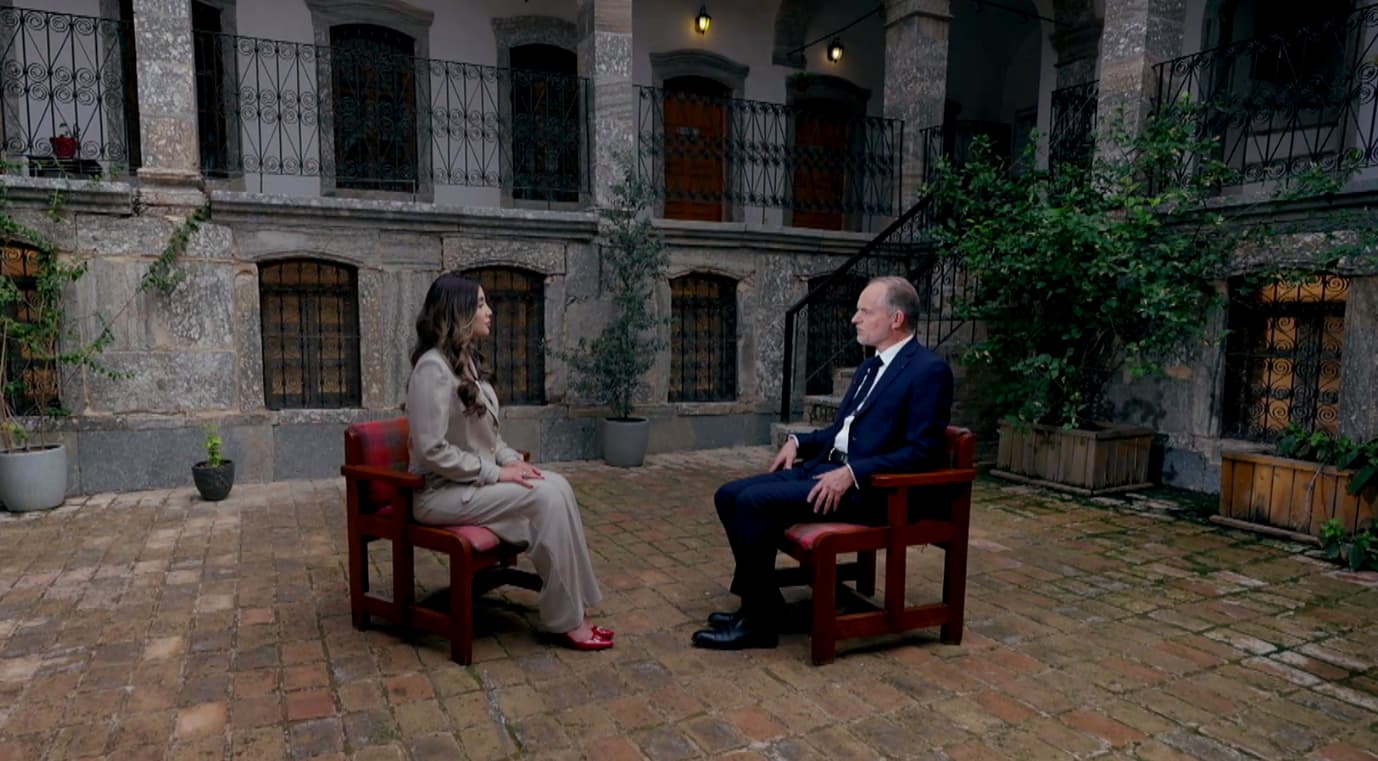
ERBIL, Kurdistan Region - Abdullah Mohtadi, leader of the Komala Party of Iranian Kurdistan, said Iran is “the best country for implementing federalism,” arguing that its diverse national and cultural makeup makes power-sharing essential for stability and democracy.
In an interview with Rudaw's Zinar Shino at the European Parliament in Brussels, Belgium, on Wednesday, Mohtadi stressed that federalism offers a viable path forward.
“If federalism is useful and appropriate for anywhere, it is exactly Iran,” Mohtadi said, adding that a democratic system recognizing different identities would bring peace internally and with neighbors.
He also said that the Kurdish opposition parties from western Iran (Rojhelat), have stayed out of the current war between the US, Israel, and Iran.
“We have not been a part of this war. We believe the original creator of this war is the Iranian regime,” he said, accusing Tehran of pursuing expansionist ambitions and spreading proxy groups across the region.
The United States and Israel launched a large-scale war against Iran on February 28, initiating nearly 40 days of fighting with a joint aerial campaign targeting thousands of sites across the country. Several senior Iranian leaders and commanders were killed in the opening strikes, including former supreme leader Ayatollah Ali Khamenei.
A Pakistan-brokered two-week ceasefire between Washington and Tehran came into effect early last week, with the first round of talks in Islamabad failing to yield an agreement last week.
Some media reports in early March alleged that the US was funneling weapons and intelligence to a newly formed coalition of five major Kurdish dissident groups to stretch Iranian security forces during domestic unrest.
However, Mohtadi said that Kurdish groups chose not to join the conflict as conditions were not ripe for an uprising. “We neither viewed Iran as being sufficiently weakened yet, nor did the people take to the streets in large enough numbers,” he said.
Mohtadi rejected accusations of ties with Israel, calling them routine rhetoric by Tehran.
“Anyone who is not with them… is labeled an Israeli agent,” he said.
Following is the full transcript of the interview with Abdullah Mohtadi.
Rudaw: Similar to other parties within the alliance of Iranian Kurdish parties of Rojhelat, you have not become a part of this [current regional] war. Was this your own stance, pressure from the Kurdistan Region, or is there another reason?
Abdullah Mohtadi: We have not been a part of this war. We believe the original creator of this war is the Iranian regime, because for 47 years they have been pushing for war with America, seeking the destruction of Israel, and aiming to expel the US. They themselves spoke of controlling five Arab capitals and have spread their proxy groups throughout the region. We saw that once the war began, they attacked more than 10 countries that were not even part of the conflict. They attacked oil, gas, hotels, homes, and commercial sites.
Therefore, this war stems from ideologies; it originates from an apocalyptic worldview held by those who believe the Muhammad al-Mahdi [a messianic figure in Islam] must return. They also believe they must create a great Shiite empire and seize control of the entire Middle East. This is the primary source and starting point of this war. The other side consists of America and Israel, who fear Iran’s nuclear and missile programs; they have their own interests as well.
We, as Kurds, find our interest in neither of those two sides; we strive for our own nation. Whether there is war or not, our struggle continues. But are we forbidden from utilizing war? Are we forbidden from utilizing the crises of the Islamic Republic? Yes, we are entitled to, but in this specific war, we neither viewed Iran as being sufficiently weakened yet, nor did the people take to the streets in large enough numbers [for an uprising]. That remains for later stages. Thus, our struggle continues, but we did not deem it necessary [to join this war] and have remained in a state of defense and protection. Just last night and the night before, they attacked Kurdish parties with drones again; this means this ceasefire seemingly does not include the Kurds. It seems the Kurds must continue to be suppressed, killed, bombed, and shelled.
The Islamic Republic of Iran often accuses you, specifically Komala, of cooperating with Israel. Is this true?
The Islamic Republic even accused [Mohammad] Khatami, who was their own president, of having ties with Israel and George Soros. In other words, if you listen to the Iranian authorities, everyone - from the Kurdistan Region to Saudi Arabia, the Emirates, and all those countries - are servants of Israel. This is because they have adopted the slogan and chant of destroying Israel and the Jews, which is a heavy and massive slogan. Anyone who is not with them and does not accept that ideology is labeled an Israeli agent by them.
Within the alliance of Iranian Kurdish parties of Rojhelat, you are calling for federalism. Is there a basis for implementing this demand in Iran now, or after this war ends?
During the era of Saddam Hussein, did anyone think the Kurds of Iraq would obtain federalism? No one thought so. But they struggled for Kurdish rights, gave tens of thousands of martyrs, and eventually, an opportunity arose which they utilized. They allied with America and achieved good results; they also had ties with the Iraqi opposition. We are the same, with one difference: Iraq consists of two main nations - along with other smaller nations- but it is primarily Kurds and Arabs. Iran consists of five or six nations. Therefore, if federalism is useful and appropriate for anywhere, it is exactly Iran.
Iran is the best country for implementing federalism because it is the remnant of a great empire and, like all empires, it contains various nations, religions, and different cultures. If the Iran of tomorrow wants to see the face of democracy, be at peace with its own people, and have harmony with its neighbors, it must have a form of official recognition and inclusion of these different identities. Federalism means that everyone shares in power and we can administer our own regions. Yes, in my opinion, there is an opportunity for this and I hope it happens. This is something we must work for - to convince the Europeans, the Americans, and the international community that it is truly in their interest as well. A peaceful Iran is in their favor - not a totalitarian Iran - but a democratic one.
Let me ask another question about the stance of the parties within your alliance. You are different parties and often have completely different stances on details. My question is specifically about the positions of PJAK [Free Life Party of Kurdistan]; are their positions compatible within the framework of this alliance and the foundations of your joint work?
PJAK has signed and accepted all the documents that were agreed upon and reached by consensus; they work within that framework. Obviously, every party has its own program, politics, and agenda, and they have the right to strive for them. Every party has that right. However, all of us - including PJAK and the others - must be committed to the general interest represented by the alliance. This alliance is a good step forward, and we must protect and develop it.
Regarding the current ceasefire between the US and Israel with Iran, do you think this will lead to a stable peace?
An agreement hasn't been made; a meeting took place, but they haven't agreed and are not in sync. I don't think it's easy for them to settle, because what America wants - which is justified and correct - is that Iran must abandon its nuclear program, because everyone knows Iran's nuclear program is for building an atomic bomb. If you want to work on a nuclear reactor [for energy], you place the reactor on the ground like the rest of the world. If you go 300 meters under the mountains, dig deep, and build something where no one knows what you are doing, you clearly have an objective.
In any case, Iran must completely abandon its nuclear program, cease having long-range missiles, stop supporting the proxy groups in the region, and become a normal country. I find it difficult for that to happen. Or rather, I find it difficult for Iran to accept those terms. On the other hand, as you know, Iran makes many baseless claims, but they are saying "I am the winner." Why do they say they won the war? Because simply remaining in power is what they consider winning. Otherwise, it is clear they have no economy left, no livelihood, no navy, no air force, and no air defense. Their country is in ruins, but they don't care about that. They don't care about the country, the people, or the economy - only their own survival in power. Because they have remained in power until now, they consider themselves winners. Furthermore, because they see themselves as winners, they tell America they must be compensated for the war, that the US must leave the region and pack up its bases. It is difficult for America to do that - an America that also considers itself the winner. Therefore, the two sides are currently very far apart; let’s see what happens.
Is the phase of war more difficult for Iran to handle or peace?
If they are forced to accept America's conditions, I believe they would prefer an American missile over accepting those conditions.