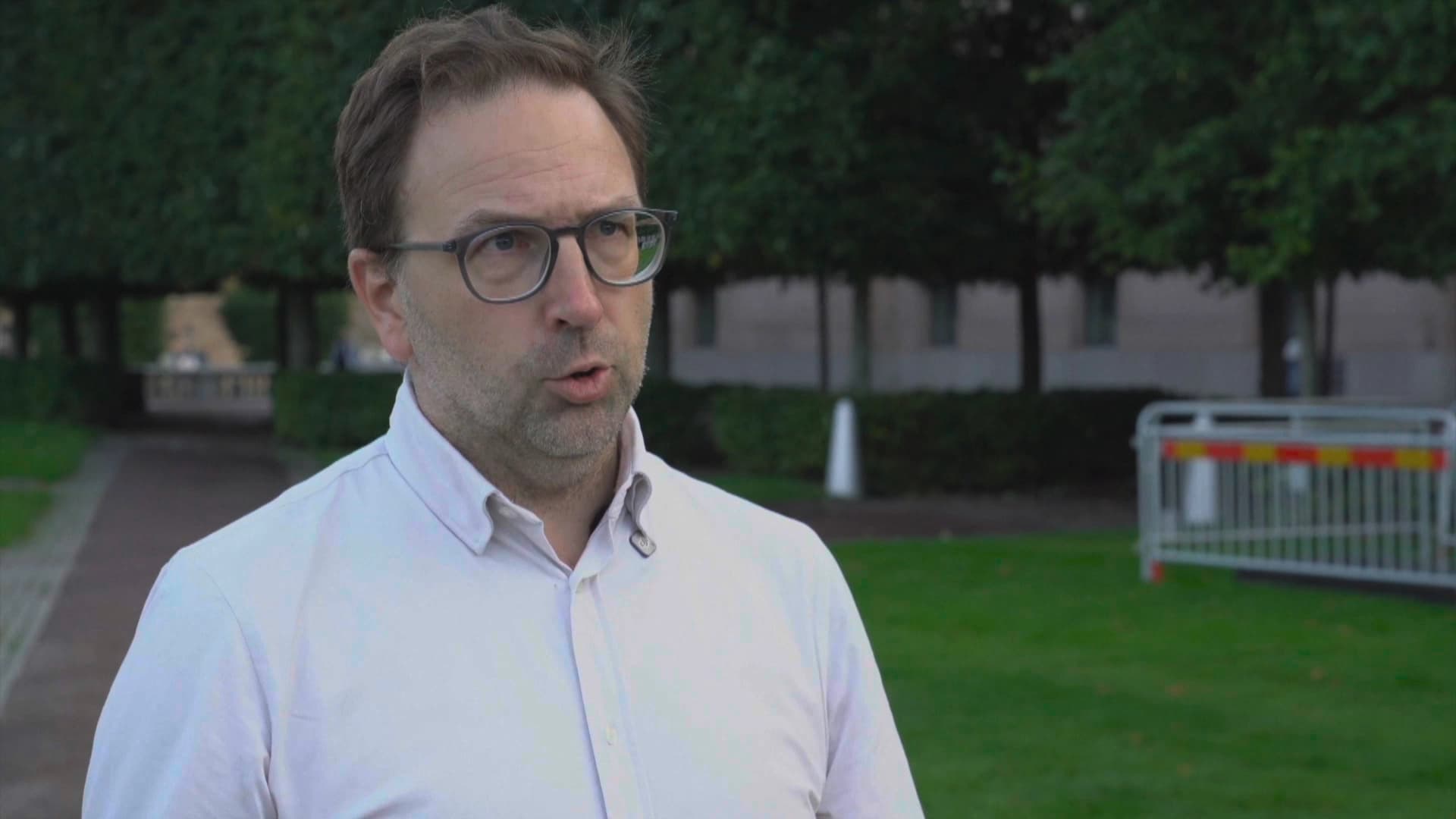
ERBIL, Kurdistan Region - Iran has no negotiations underway with the United States and will only consider talks to formally end the war if Washington meets strict preconditions, including compensation for damages, an end to assassinations, removal of all sanctions and international recognition of Iranian sovereignty over the Strait of Hormuz, a director of an Iranian think tank told Rudaw on Thursday.
Hamid Reza Gholamzadeh, head of the Tehran-based Iran Diplomatic House, said in an interview with Rudaw's Hevidar Zana that Iran is not currently engaged in talks with the US, but noted that Tehran has conveyed its preconditions for any negotiations. These consist of “five main points: compensation [for war damages], an end to assassinations, the cessation of tensions on all fronts - not just in Iran - recognition of a new framework for the Strait of Hormuz, and the removal of all US sanctions against Iran.”
Earlier in the day, media affiliated with Iran’s Islamic Revolutionary Guard Corps (IRGC) reported that Tehran had officially responded to a 15-point proposal from the US aimed at ending the deadly war that began in late February, while expressing skepticism about Washington’s intentions.
Tasnim News Agency cited “an informed source” as saying that Iran’s response to Washington’s 15-point proposal “was officially sent last night [Wednesday evening] through intermediaries” and that “Iran is now waiting for the other [American] side’s response.”
The US President Donald Trump on Tuesday revealed that Washington had made the proposal to Tehran to end the conflict, with sources telling Reuters that the proposal reportedly includes demands for curbing Iran’s nuclear and missile programs and transferring control of the Strait of Hormuz.
However, the outlet quoted Iranian sources as reporting that Tehran has hardened its stance since the war began, demanding guarantees against future military action, compensation for losses, and formal control of the Strait of Hormuz, and has stated that Lebanon must be included in any ceasefire deal.
Gholamzadeh, who previously served as editor-in-chief to the semi-official Mehr News Agency, reaffirmed that “there have been no negotiations between Iran and the United States,” adding that “whenever the Americans are ready to meet those conditions [set by Iran], we can then consider negotiations.”
He also highlighted the roles played by Pakistan, Turkey, and Egypt in efforts toward a diplomatic solution, as well as the Kurdistan Region’s decision to remain neutral and refuse the use of its territory for attacks on regional neighbors, including Iran.
Nonetheless, Gholamzadeh anticipated “more escalation for the time being,” including a potential ground offensive by US forces, which he described as “a serious escalation” that “Iran is prepared for” and “very experienced” in handling. He added, “After such an escalation, it is possible that a de-escalation could follow.”
The US and Israel on February 28 launched a coordinated military campaign against Iran amid ongoing nuclear talks between Washington and Tehran. US Central Command (CENTCOM) Commander Brad Cooper reported on Thursday that the operation, dubbed Operation Epic Fury, struck more than 10,000 targets across Iran, aiming to achieve “clear military objectives of eliminating Iran’s ability to project power in meaningful ways beyond its borders.”
In response, Tehran has continued to carry out drone and missile strikes across the Middle East, targeting what it says are US assets in the region, particularly in Gulf Arab states, and has launched retaliatory attacks against Israel.
Iran has also tightened its grip over the strategic Strait of Hormuz - a key chokepoint that links the Persian Gulf to the Gulf of Oman and the open ocean, typically handling around 25 percent of all seaborne-traded oil and 20 percent of global petroleum consumption. Hormuz is also the primary exit for nearly 20 percent of the world’s liquefied natural gas (LNG).
Following is the full transcript of the interview with the Director of Iran’s Diplomatic House, Hamid Reza Gholamzadeh.
Rudaw: Tehran is reportedly coming under heavy attacks from the United States and Israel. If you are speaking to us from Tehran, what is the situation there like right now?
Hamid Reza Gholamzadeh: Thank you very much for having me. We actually experience attacks almost every day on Tehran and other cities across the country. For the past week, I can say that most of the bombardments have been against civilian areas, because the enemy has run out of strategic targets in its bank of targets. They no longer have particular buildings to attack, so they are targeting civilians to frighten people and discourage them from supporting the government. Their aim is to increase casualties and victims of war to pressure Iran, but this strategy does not work. Iranians are instead more encouraged to take to the streets, support the government, and show unity against the enemy.
In general, the atmosphere is like this: we have bombardments every night, yet people continue to gather in main squares, chant against the enemies, and express support for the Islamic Republic. After that, there are motorcades across neighborhoods and streets, with people waving flags and chanting against the enemies, as I mentioned. This has been the trend for almost four weeks - every single night, massive rallies are held across Tehran. In other cities, usually there is one main gathering point, and people participate to show their support in their own way.
Is Iran ready now to enter into negotiations with the United States?
Actually, the Americans are not ready to negotiate. Iran was in negotiations with the Americans both times it was attacked. So there are no grounds for talks anymore, because they are continuing their attacks against Iran. They have not withdrawn, and they are still attempting to assassinate [Iranian] officials. The Americans are not serious about negotiations.
Even what President Donald Trump posted on social media the other day was meant to influence market prices. It was not based on facts, and there were no actual talks between Iran and the United States. He made false claims to manipulate oil and market prices at the beginning of the week, and he successfully managed to do that. He is buying time to carry out further strikes and to have boots on the ground in Iran - essentially giving their forces time to arrive in the region.
Since it is the American side that is not genuinely seeking talks - and even if they come to the table, they only want to dictate terms - Iran is not ready to engage in such negotiations. However, Iran has provided its conditions. The preconditions are on the table, and there are five main points: compensation, an end to the assassinations, the cessation of tensions on all fronts - not just in Iran, recognition of a new framework for the Strait of Hormuz and the removal of all US sanctions against Iran. These are Iran’s preconditions for coming to the table to end the war, not just for a ceasefire. From the Iranian perspective, the goal is to ensure that there will not be another attack like this in the future, and to bring an end to any further conflicts.
The whole world is talking about potential negotiations between the US and Iran following President Trump’s remarks. Do you believe negotiations have already taken place or are currently ongoing between Tehran and Washington?
Iranian Foreign Minister Abbas Araghchi had an interview last night, and he confirmed that there have been no negotiations between Iran and the United States and I also have my own sources, and they all confirm that there have been no negotiations as well.
The Americans have sent some messages through certain countries, but these are just messages being delivered to Iran. Iran has given the same response: Iran does not want any negotiations right now. Iran has preconditions and wants the war to end based on those conditions. Whenever the Americans are ready to meet those conditions, they can step forward, and then we can consider negotiations. But so far, there has been nothing that can be called actual talks or negotiations by any means.
To what extent is Iran satisfied with Pakistan’s position in this war, and does it believe in Pakistan’s mediation role?
Pakistan is one of the countries that has been trying to mediate to reduce - or actually stop - the violations and the conflict. However, it is not working because of the American side. Pakistan has been making very good efforts, and other countries have also been involved, trying to act as intermediaries. But, as I said, the problem comes from the American side.
From Iran’s perspective, we are grateful to any country that is helping or trying to resolve the situation. Anyone who supports Iran is admired. But this does not mean that Iran will withdraw from its position or accept talks unconditionally. Iran is grateful to Pakistan, Turkey, and Egypt for their efforts. We are also very thankful to the Kurdistan Region of Iraq, which has been very cooperative with the Islamic Republic in terms of security. So Iran appreciates these neighbors, but, if you want to be serious and realistic, negotiations are being blocked by the Americans.
Is it true that Iran has requested negotiations with Vice President J.D. Vance, and has asked that President Trump’s Envoys - Steve Witkoff and Jared Kushner - be replaced?
As I said, Iran has denied any talks. This issue was raised by the Americans because they want to track [the location of] Iranian Parliament Speaker Mohammed Baqer Ghalibaf. They framed it as a request for advanced talks. First of all, they know that Witkoff and Kushner failed in previous rounds of talks and did not understand what Iran had put on the table. The Omani Foreign Minister [Badr Albusaidi] even mentioned that Iran had proposed a strong package during the nuclear talks, but the Americans failed to recognize its value and rejected it.
Given the poor performance of Witkoff and Kushner, it is clear that the Americans themselves do not want them at the table. Yet they are shifting blame onto Iran, claiming Iran demanded these changes. Iran has not requested any negotiations and has not asked for any specific people to be at the table. But they [Americans] are doing that. They are changing their horses at the cost of Iranians, so they are claiming that the Iranians are the ones who made those demands.
Iran has not asked for any negotiations and has not asked for any person to be at the table. The proposal for J.D. Vance and the [American] interest in Mr. Ghalibaf are entirely American initiatives. They are using it as a pretext to trace him and locate him, possibly for an assassination attempt. There is no request from the Iranian side regarding this issue.
In your view, if negotiations take place, would Iran accept the reported 15‑point proposal from the United States?
Iran has already refused those 15 items suggested by the Americans. So officially, you can consider it a no from the Iranian side.
Who currently makes the decisions in Iran regarding a potential agreement or the continuation of the war?
According to the Iranian constitution, the Supreme National Security Council is the highest body responsible for foreign policy and security issues. All the heads of the branches of power are members of this council, including representatives from the parliament, the foreign ministry, and the government.
Of course, we have the Supreme Leader who also plays a central role. Based on the constitution, all these figures perform their duties, but the main decisions are made by the Council and then approved by the Supreme Leader. So, if there is going to be an end to the war, or any deals or agreements, it would be based on the decisions of the Supreme National Security Council, with final approval from the Supreme Leader.
What are Iran’s main conditions for reaching an agreement?
There are five points that have been clearly mentioned. First, an end to assassinations and killings. Second, an end to the conflicts, not only in Iran but also in Lebanon, Iraq, and anywhere else affected by the attacks. Third, compensation for the damages inflicted on Iran. Fourth, the removal of all US sanctions against Iran. And fifth, recognition of a new framework for the Strait of Hormuz, affirming Iran’s sovereignty over the Strait.
Is the conflict heading toward de-escalation, or is it likely to intensify further?
I would expect more escalation for the time being. First, the Americans do not want to accept that they have failed and been defeated. They are trying to achieve something because they have had no achievement aside from the assassination of Ayatollah [Ali] Khamenei [1939 - 2026]. They have not achieved their stated objectives, such as regime change and others.
So, the Americans are looking for any possible achievement. President Trump, along with his proxy [Israeli Prime Minister Benjamin] Netanyahu, is trying to do whatever they can. They now want boots on the ground, and if that happens, it would be a serious escalation. And to be honest with you, Iran is prepared for this. Iranians are very experienced and effective in ground combat, having previously fought alongside each other against terrorist groups. If the Americans dare to step onto Iranian soil, Iran expects to inflict heavy casualties and significant damage. After such an escalation, it is possible that a de-escalation could follow, once the Americans realize they have failed and made a grave mistake by engaging in a ground battle against Iran.
If Iran and the United States reach a ceasefire agreement, will Lebanon’s Hezbollah movement and other groups within the Tehran-led ‘Axis of Resistance’ adhere to it, or will the fighting continue on those fronts?
As I mentioned, one of the conditions that Iran has put forward is an end to conflict on all fronts, which includes Lebanon and Hezbollah. So if Israel attacks Hezbollah again, it would be a violation of a potential agreement, and Iran would respond and react naturally. All tensions in the region need to stop for the area to experience any real peace and stability.
What are Iran’s plans, both domestically and internationally, for the post-war and post-agreement phase?
With a new framework regarding the Strait of Hormuz, Iran’s position in the region would be stronger than in the past. Iran will demonstrate sovereignty and authority in the region, which would also increase revenue from the Strait.
Iran is also seeking compensation for damages, not only from the Americans and Israelis, but also from Arab countries that supported the United States. This compensation would provide resources to repair the damage caused by the war and sanctions, and to improve Iran’s economy.
If an agreement is reached and sanctions are removed, Iran would face no obstacles to economic trade with other countries, which would further improve the Iranian economy. Relations with neighboring countries would also change. Iran would recognize and maintain good relations with neighbors who have been cooperative. Those who helped the Islamic Republic would be acknowledged and included in future regional cooperation.
However, countries like the [United Arab Emirates] UAE, which supported the Americans against Iran, would be treated differently. Iran would not forget who opposed the Islamic Republic, and their role in future regional relations would reflect that.
Several days ago, six of the Kurdistan Region’s Peshmerga fighters were killed in their bases by Iranian missile strikes. How does Iran now view the Kurdistan Region?
As I mentioned, Iranian leaders are grateful for the cooperation that the Kurdistan Region has shown with the Islamic Republic, particularly for not participating in American strikes against Iran. This is something Iran significantly acknowledges and values. It has also been welcomed by many people, not only within the Kurdish community in Iran but across the entire patriotic Iranian community, who respect the Kurdistan Region’s decision not to take part in these strikes and aggressions against Iran. For us, both officials and the public, there is a mutual understanding that the security of the region, the security of Iran, the security of the Kurdish region, and the security of Iraq are all connected.
We share the same area and the same circumstances; insecurity in one part means insecurity in all. When this mutual understanding exists, cooperation is possible, which we have witnessed over the past four weeks. Iran will not forget this in the future. It will continue to cooperate with neighbors who have been helpful during this war. In the future, in the new Middle East and the new regional framework that emerges, Iran will work together with these supportive neighbors to build a stable and cooperative region.