


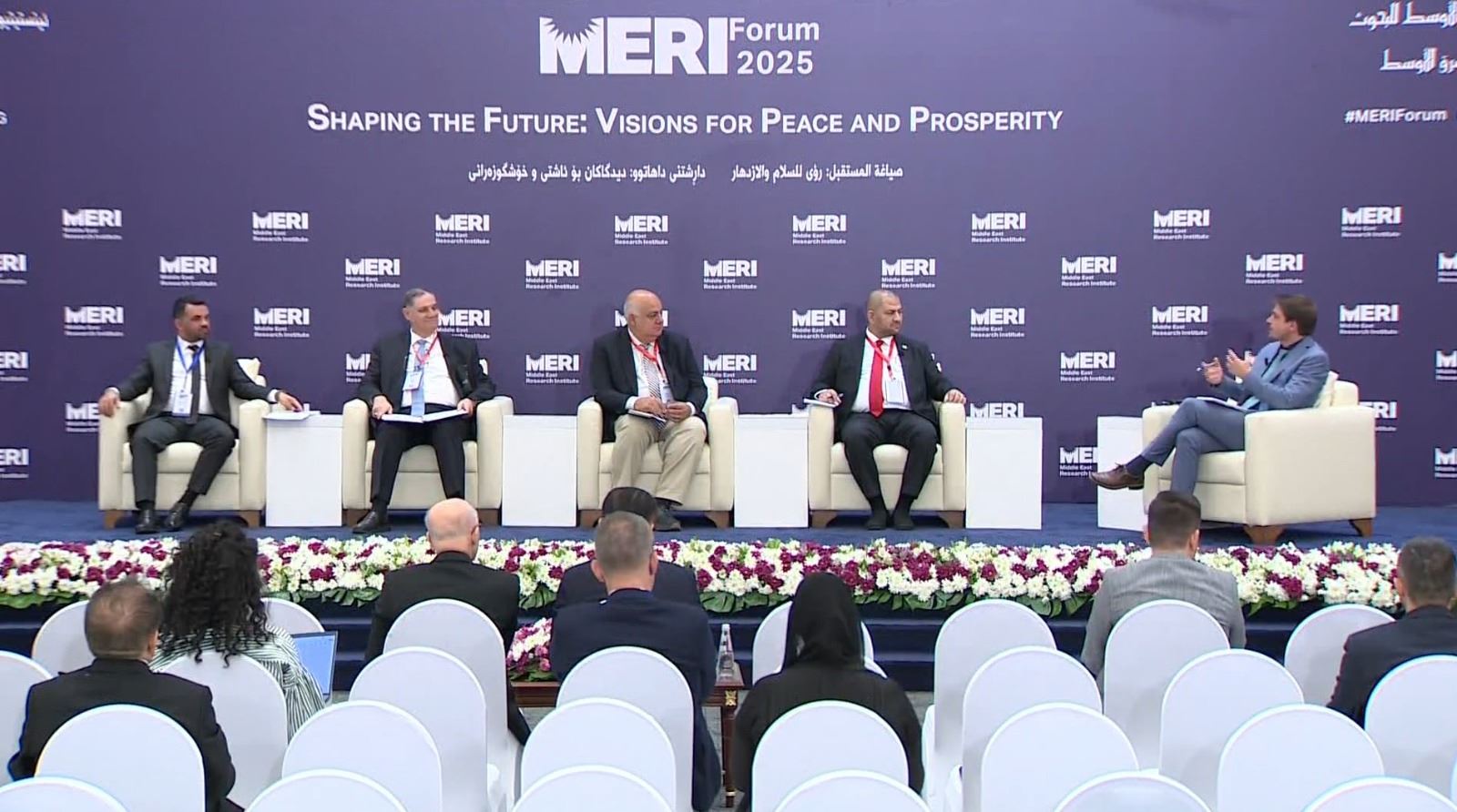
ERBIL, Kurdistan Region - Directors of leading Arab think tanks and experts emphasized the urgent need for collective regional efforts among Levantine and Gulf countries to promote peace, stability, and economic development. Their remarks came during the second day of the Middle East Research Institute’s (MERI) Forum 2025 in Erbil.
The panel, entitled The Levant Beyond Conflict: Strategies for Recovery and Reintegration, featured ex-Jordanian agriculture minister and regional political expert Said al-Masri of the Arab Thought Forum. He underscored the importance of Jordan pursuing collective efforts with its regional neighbors. “The Hashemite Kingdom of Jordan should work together with regional neighbors to promote peace and foster economic development, especially given the challenges currently facing the region,” he said.
He further highlighted the need for reconciliation through dialogue across the region, noting, “We were unable to unite behind common interests.” He proposed the creation of a large integrated market that would invite the European Union to deepen economic engagement with Levantine and Gulf Cooperation Council (GCC) countries to open new avenues for growth and cooperation.
Shifting to Lebanon, Director of the Lebanese Center for Policy Studies, Makram Ouaiss, stated that his country has been “systematically held back by the lack of national consensus on key issues and ongoing foreign aggressions.”
He further warned that “many parts of the region are either experiencing or edging toward conflict,” conditions that “deter investment, hinder cooperation and internal growth, and drive away expatriates.”
To counter these challenges, Ouaiss highlighted the importance of “addressing internal tensions, including the plight of refugees and internally displaced persons, and enhancing governance are crucial. But more significantly, we must outline a roadmap for the future to be implemented with governments and relevant parties.”
Ouaiss also called attention to the brain drain crisis, emphasizing the importance of investing in academia and retaining talent across the region.
On the Syrian stage, Sherwan Yousif of Syria’s DeFacto Dialogue Platform discussed the evolving nature of dialogue in Syria after the fall of longtime dictator Bashar al-Assad.🔴 LIVE| MERI Forum: Panel 7: The Levant Beyond Conflict: Strategies for Recovery and Reintegration https://t.co/NbSKQgafIV
— Rudaw English (@RudawEnglish) October 8, 2025
Yousif noted that “talk of change has become possible despite the perception of uncertainty among regional countries,” adding that current discussions focus on “the shape of governance and the nature of relations with regional countries, both of which are essential for enhancing stability.”
Director of Syria’s DeFacto Dialogue Platform further remarked on the “international openness toward Syria,” which he said “is helping solidify Syria’s role as a catalyst for regional peace.”
However, he cautioned that “a key issue remains: establishing effective, decentralized governance that ensures power-sharing among Syrian communities at the decision-making level.”
Pointing to the landmark March 10 agreement between Mazloum Abdi, the Kurdish-led Syrian Democratic Forces (SDF) chief, and Syrian interim President Ahmed al-Sharaa as a promising step, especially in light of intercommunal violence that rocked Alawite-majority coastal regions in March and predominantly Druze areas in southern Syria in July.
He stressed that the rift among Syria’s ethnic and religious communities “requires a dialogue climate among communities and countries in the region, possibly facilitated by think tanks and non-profits, to address it.”
For his part, Ammar Kahf from the Omran Center for Strategic Studies, said “Syria has a chance to avoid being a threat to neighboring countries - namely Lebanon, Iraq, Jordan, and Turkey - by cutting off arms and drug trafficking routes.”
Kahf credited the dismantling of Iran-aligned armed groups that were active in Syria during the Assad era as a critical factor that “opened the path for Damascus to build ties with global powers.” Furthermore, he highlighted the importance of establishing “a regional framework to facilitate the safe and coordinated return of refugees across neighboring countries.”
Across the panel, a shared message emerged: the complex challenges facing the Levant and broader region - ranging from governance deficits, refugee crises, economic stagnation, to social divisions - can only be addressed through collective, coordinated regional efforts.
The former Jordanian minister, Masri, stressed, “Dialogue and cooperation across the Levantine and Gulf states are essential to unlock a new era of peace and prosperity.”


Comments
Rudaw moderates all comments submitted on our website. We welcome comments which are relevant to the article and encourage further discussion about the issues that matter to you. We also welcome constructive criticism about Rudaw.
To be approved for publication, however, your comments must meet our community guidelines.
We will not tolerate the following: profanity, threats, personal attacks, vulgarity, abuse (such as sexism, racism, homophobia or xenophobia), or commercial or personal promotion.
Comments that do not meet our guidelines will be rejected. Comments are not edited – they are either approved or rejected.
Post a comment