


Kurdistan

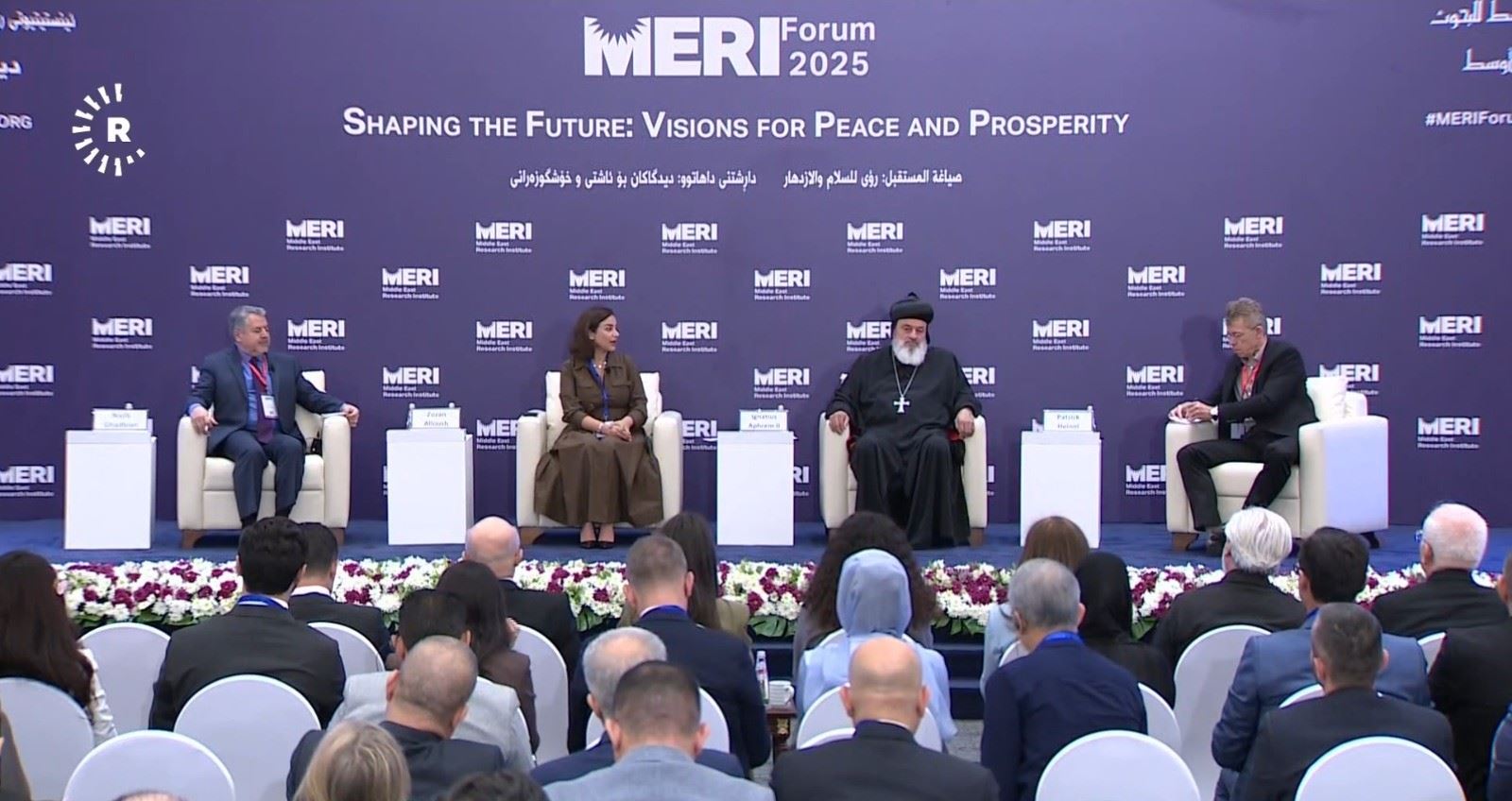
Najib Ghadban, advisor to the Syrian foreign minister (left), Zozan Alloush, a researcher with the DeFacto Dialogue Platform in Syria (center-left), the Syriac Orthodox Patriarch of Antioch and All the East, Ignatius Aphrem II (center-right) and Patrick Haenni, an advisor at the Switzerland-based Humanitarian Dialogue Centre participate in the MERI Forum 2025 in Erbil on October 8, 2025. Photo: Screengrab/Rudaw
ERBIL, Kurdistan Region - Decentralization, transitional justice, and ensuring Syria poses no threat to the region or the world were the key points emphasized by Syrian panelists at the MERI Forum 2025 on Wednesday. They further agreed that the high cost of regime change - borne by all components of Syrian society - demands a new, partnership-based model of governance for the future Syria.
The session, titled “Syria: In Search of Unity Amidst Fragmentation” and moderated by Patrick Haenni, an advisor at the Switzerland-based Humanitarian Dialogue Centre, featured discussions on the challenges of rebuilding the state, ensuring security, and navigating internal political divisions in a post-Assad Syria.
🔴 LIVE| MERI Forum: Panel 8: Syria: In Search of Unity Amidst Fragmentation https://t.co/6x1sT4GMVM
— Rudaw English (@RudawEnglish) October 8, 2025
Najib Ghadban, advisor to the Syrian foreign minister, noted that while the Syrian people succeeded in ousting longtime dictator Bashar al-Assad, the interim leadership has inherited a nation fractured by cost and conflict.
“Syrians paid a very expensive price - one million martyrs, destroyed infrastructure, and the majority of Syrians now live under the poverty line,” Ghadban said, identifying the immediate challenge for the new government as the "reconstruction, maintenance, and repair of the state."
He emphasized that the leadership in Damascus prioritizes security and stability, citing continued threats from the Islamic State (ISIS) and the need to control the borders - referencing the former regime’s history as a “narcotic state.”
Ghadban also highlighted the difficult political calculus facing the interim government, stating, “We need to keep civil peace while balancing it with transitional justice.”
Christian pulse
The panel notably featured Ignatius Aphrem II, the Syriac Orthodox Patriarch of Antioch and All the East, a prominent leader for Levantine Christians. He issued a powerful call for national unity, peace, and active participation from all communities in building a new Syria, while strongly cautioning against foreign interference.
Speaking not only as the head of the Syriac Orthodox Church but also “on behalf of all Syrians,” Patriarch Aphrem II declared, “I can tell you without a doubt: all Syrians want a better Syria - a Syria that is stable, a Syria that has a brighter future.”
He stressed that the Christian community’s aspirations are not unique, noting, “As Christians in Syria, we do not have special demands. We do not seek anything that others do not also seek.” Their singular desire, he said, is for “all Syrians - every single one of us - to live in peace and security in a country that respects them and is built by them.”
His Beatitude further championed Syria's unique demographic composition, rejecting the idea that minorities need foreign protection require foreign protection and stating clearly, "Christians in Syria will not be protected by external forces. They will be protected by their neighbors - whether those neighbors are Muslim, Jewish, or of any other ethnic or religious identity."
He highlighted the historic opportunity now available to all groups in Syria - “Arabs, Kurds, Syriacs, Circassians, Armenians, Muslims with all their sects, Christians with all their sects, Jews, Yazidis, and others” - to fully engage in rebuilding the nation.
“Before, we lacked this active participation. We were present - but we were not involved. Now, this is our chance.”
The Patriarch also expressed deep sorrow over the continued exodus of skilled and educated Syrians, warning that the lack of stability is causing a severe drain on the country’s potential.
He was also direct in condemning foreign interference, lamenting that “most of the time, the intervention serves their interests, not ours.” He warned that such interference leads only to further instability and division, concluding, “We do not want to see Syria divided. We do not want Syria to become a collection of fragmented pieces.”
Ultimately, the Patriarch urged for the formation of a government “that belongs to all Syrians - one that cares for all, regardless of ethnicity or religion. And we want every Syrian to join in building this country - not just to demand things from the government, but to offer what they can."
Decentralization ahead
For her part, Zozan Alloush, a researcher with the DeFacto Dialogue Platform, who is also a Kurd from northeastern Syria (Rojava), emphasized that the liberation of Syria from the Baath regime was a "collective and integrated operation," disputing any claim that the Syrian Democratic Forces (SDF) were not participants.
"The SDF liberated northeastern Syria from the former regime in 2013. They participated in liberating Syria from Daesh (ISIS) ... It was a collective and integrated operation," Alloush asserted.
Regarding ongoing negotiations between the new government in Damascus and the Kurdish-led administration in Rojava, Alloush insisted that "Dialogue and negotiation must be the language of the future."
However, she stressed that unification cannot mean a return to the centralized pre-war structure, especially given the distinct political realities created over 13 years of conflict.
"Syria today, after 13 years of war, is already a divided country," Alloush argued. "The unification of Syria cannot happen without decentralization." She warned against expecting regional actors to surrender power: "You can’t take a toy away from a child after they’ve played with it for so long."
Alloush urged the interim leadership in Damascus to be "smart and flexible" to succeed, stressing that international and regional support - including from the United States and France - and neighboring states like Jordan, is aligning to support the negotiation track.


Comments
Rudaw moderates all comments submitted on our website. We welcome comments which are relevant to the article and encourage further discussion about the issues that matter to you. We also welcome constructive criticism about Rudaw.
To be approved for publication, however, your comments must meet our community guidelines.
We will not tolerate the following: profanity, threats, personal attacks, vulgarity, abuse (such as sexism, racism, homophobia or xenophobia), or commercial or personal promotion.
Comments that do not meet our guidelines will be rejected. Comments are not edited – they are either approved or rejected.
Post a comment