


Kurdistan

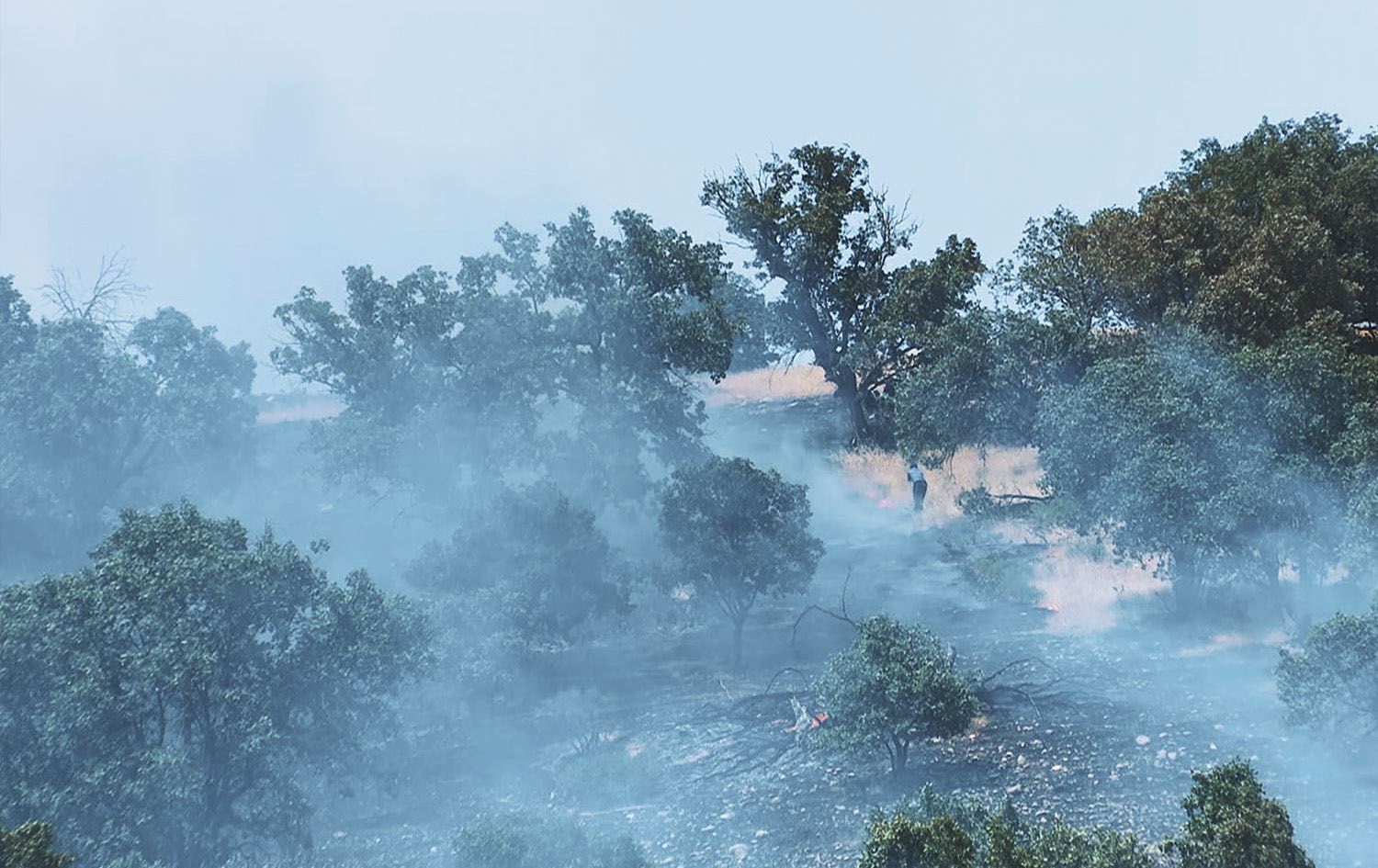
Fire in the forests of northern Duhok’s Amedi district following bombardment on July 17, 2023. Photo: Rudaw
ERBIL, Kurdistan Region - Nearly half of the Kurdistan Region’s forests have been lost over the past several decades, an environment official said Wednesday, as civil defense teams struggle to contain recent blazes that have destroyed thousands of dunams of woodland.
“We have lost nearly 50 percent of our forests in the last 50 to 60 years,” Sanan Abdullah, spokesperson for the Kurdistan Region’s Board of Environmental Protection and Improvement, told Rudaw.
He attributed the loss to “political, military, and social reasons,” as well as rising temperatures as climate change takes its toll on the region.
In June 2024, Turkey intensified its decades-long war against the Kurdistan Workers’ Party (PKK), particularly in northern Duhok province. The conflict sparked numerous fires that burned swathes of land and endangered the lives of villagers. However, amid the ongoing peace process, military attacks in the area have decreased by 97 percent, according to US-based Human Rights Watch and local conflict monitors, resulting in significantly fewer fires compared to last summer.
Leftover landmines from the Turkey-PKK conflict and earlier battles between the Kurdish Peshmerga forces and the former Iraqi regime have also contributed to the fires.
According to Abdullah, the Region had nearly 5 million dunams of forest land in the 1950s. From 2009 to 2022 alone, nearly 1 million dunams were lost. “This accounts for the loss of a historical sum of our forests,” he said.
A dunam equals 2,500 square meters.
“The [fires] have a significant long-term effect on the area. The growth of a forest takes many years of work… But fires cause them a lot of damage, and require [around] 50 years until a forest is revitalized,” Abdullah explained.
He urged the use of modern technologies to help mitigate wildfires. “We must protect the forests,” he said.
On Tuesday, Halabja declared two days of mourning for two people - a civilian and a member of the Kurdistan Region’s forestry police - who died while trying to extinguish a wildfire that has burned for a third consecutive day in the province.
The blaze destroyed large parts of dense, mountainous forest in hard-to-reach areas. An official from Halabja on Tuesday told Rudaw that uncleared mines have made it more difficult to contain the fire.
Wildfires in Sulaimani province in late June scorched hundreds of dunams of land, destroyed centuries-old trees, and caused widespread environmental damage. Officials and residents warned at the time that limited resources and difficult terrain were hampering firefighting efforts.
Wildfires are a recurring problem in Iraq and the Kurdistan Region, particularly during the summer months when extreme heat significantly increases the risk.
“We have lost nearly 50 percent of our forests in the last 50 to 60 years,” Sanan Abdullah, spokesperson for the Kurdistan Region’s Board of Environmental Protection and Improvement, told Rudaw.
He attributed the loss to “political, military, and social reasons,” as well as rising temperatures as climate change takes its toll on the region.
In June 2024, Turkey intensified its decades-long war against the Kurdistan Workers’ Party (PKK), particularly in northern Duhok province. The conflict sparked numerous fires that burned swathes of land and endangered the lives of villagers. However, amid the ongoing peace process, military attacks in the area have decreased by 97 percent, according to US-based Human Rights Watch and local conflict monitors, resulting in significantly fewer fires compared to last summer.
Leftover landmines from the Turkey-PKK conflict and earlier battles between the Kurdish Peshmerga forces and the former Iraqi regime have also contributed to the fires.
According to Abdullah, the Region had nearly 5 million dunams of forest land in the 1950s. From 2009 to 2022 alone, nearly 1 million dunams were lost. “This accounts for the loss of a historical sum of our forests,” he said.
A dunam equals 2,500 square meters.
“The [fires] have a significant long-term effect on the area. The growth of a forest takes many years of work… But fires cause them a lot of damage, and require [around] 50 years until a forest is revitalized,” Abdullah explained.
He urged the use of modern technologies to help mitigate wildfires. “We must protect the forests,” he said.
On Tuesday, Halabja declared two days of mourning for two people - a civilian and a member of the Kurdistan Region’s forestry police - who died while trying to extinguish a wildfire that has burned for a third consecutive day in the province.
The blaze destroyed large parts of dense, mountainous forest in hard-to-reach areas. An official from Halabja on Tuesday told Rudaw that uncleared mines have made it more difficult to contain the fire.
Wildfires in Sulaimani province in late June scorched hundreds of dunams of land, destroyed centuries-old trees, and caused widespread environmental damage. Officials and residents warned at the time that limited resources and difficult terrain were hampering firefighting efforts.
Wildfires are a recurring problem in Iraq and the Kurdistan Region, particularly during the summer months when extreme heat significantly increases the risk.


Comments
Rudaw moderates all comments submitted on our website. We welcome comments which are relevant to the article and encourage further discussion about the issues that matter to you. We also welcome constructive criticism about Rudaw.
To be approved for publication, however, your comments must meet our community guidelines.
We will not tolerate the following: profanity, threats, personal attacks, vulgarity, abuse (such as sexism, racism, homophobia or xenophobia), or commercial or personal promotion.
Comments that do not meet our guidelines will be rejected. Comments are not edited – they are either approved or rejected.
Post a comment