


Kurdistan

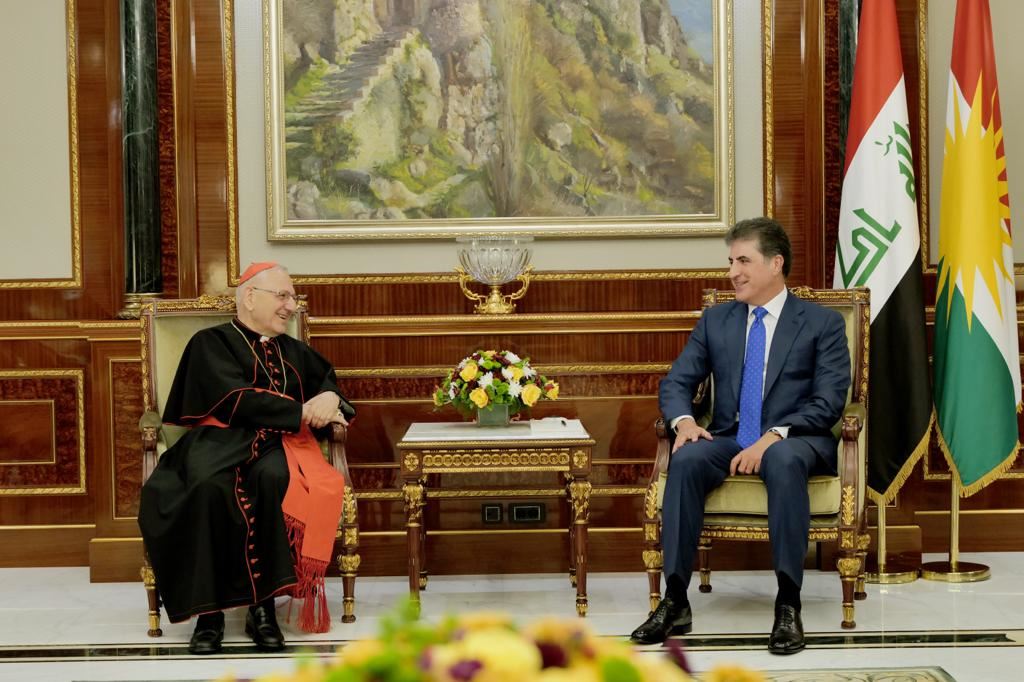
Kurdistan Region President Nechirvan Barzani (right) and Cardinal Louis Raphael Sako, patriarch of the Chaldean Catholic Church, (left) meeting in Erbil on July 25, 2023. Photo: Kurdistan Region Presidency
ERBIL, Kurdistan Region - Kurdistan Region President Nechirvan Barzani on Tuesday received Cardinal Louis Raphael Sako, patriarch of the Chaldean Catholic Church, in Erbil. He hoped that the Iraqi Presidency would resolve its tensions with the religious leader over the recent revocation of a decree crucial to his official status.
Tensions have surged in Iraq between the government and the Christian community after President Abdul Latif Rashid earlier this month cited constitutional grounds to revoke a special presidential decree formally recognizing Cardinal Sako and granting him powers over Christian endowment affairs. This angered the religious leader and his community. The Christian leader on Friday moved to Erbil as a protest.
During his meeting with Cardinal Sako on Tuesday, President Barzani “reiterated the importance of Iraq including the Kurdistan Region to embrace all religious and ethnic communities, and expressed hope that the President of Iraq would resolve the issue soon,” according to a statement from the Kurdistan Region Presidency.
After being warmly welcomed by the Kurdistan Region’s governmental, partisan and religious officials to Erbil, the religious leader told reporters that he would not return to Baghdad until Iraq restores the special presidential decree which was revoked by President Rashid.
Rashid’s decision came amid mounting pressure from Rayan al-Kildani, leader of the Christian Babylon Movement, a party and militia affiliated with the pro-Iran Popular Mobilization Forces (PMF, or Hashd al-Shaabi in Arabic).
“President Nechirvan Barzani reaffirmed that coexistence and mutual acceptance are uncompromising values and principles, and that Iraq’s strength lies in remaining a country for all communities, and protecting the rights of all,” added the statement from the Kurdistan Region Presidency.
“For his part, Cardinal Sako expressed his gratitude for the support of President Nechirvan Barzani and stressed that the Kurdistan Region is a land of coexistence and mutual acceptance and a source of pride for them,” the statement cited the cardinal as saying.
Tensions have surged in Iraq between the government and the Christian community after President Abdul Latif Rashid earlier this month cited constitutional grounds to revoke a special presidential decree formally recognizing Cardinal Sako and granting him powers over Christian endowment affairs. This angered the religious leader and his community. The Christian leader on Friday moved to Erbil as a protest.
During his meeting with Cardinal Sako on Tuesday, President Barzani “reiterated the importance of Iraq including the Kurdistan Region to embrace all religious and ethnic communities, and expressed hope that the President of Iraq would resolve the issue soon,” according to a statement from the Kurdistan Region Presidency.
After being warmly welcomed by the Kurdistan Region’s governmental, partisan and religious officials to Erbil, the religious leader told reporters that he would not return to Baghdad until Iraq restores the special presidential decree which was revoked by President Rashid.
Rashid’s decision came amid mounting pressure from Rayan al-Kildani, leader of the Christian Babylon Movement, a party and militia affiliated with the pro-Iran Popular Mobilization Forces (PMF, or Hashd al-Shaabi in Arabic).
“President Nechirvan Barzani reaffirmed that coexistence and mutual acceptance are uncompromising values and principles, and that Iraq’s strength lies in remaining a country for all communities, and protecting the rights of all,” added the statement from the Kurdistan Region Presidency.
“For his part, Cardinal Sako expressed his gratitude for the support of President Nechirvan Barzani and stressed that the Kurdistan Region is a land of coexistence and mutual acceptance and a source of pride for them,” the statement cited the cardinal as saying.


Comments
Rudaw moderates all comments submitted on our website. We welcome comments which are relevant to the article and encourage further discussion about the issues that matter to you. We also welcome constructive criticism about Rudaw.
To be approved for publication, however, your comments must meet our community guidelines.
We will not tolerate the following: profanity, threats, personal attacks, vulgarity, abuse (such as sexism, racism, homophobia or xenophobia), or commercial or personal promotion.
Comments that do not meet our guidelines will be rejected. Comments are not edited – they are either approved or rejected.
Post a comment