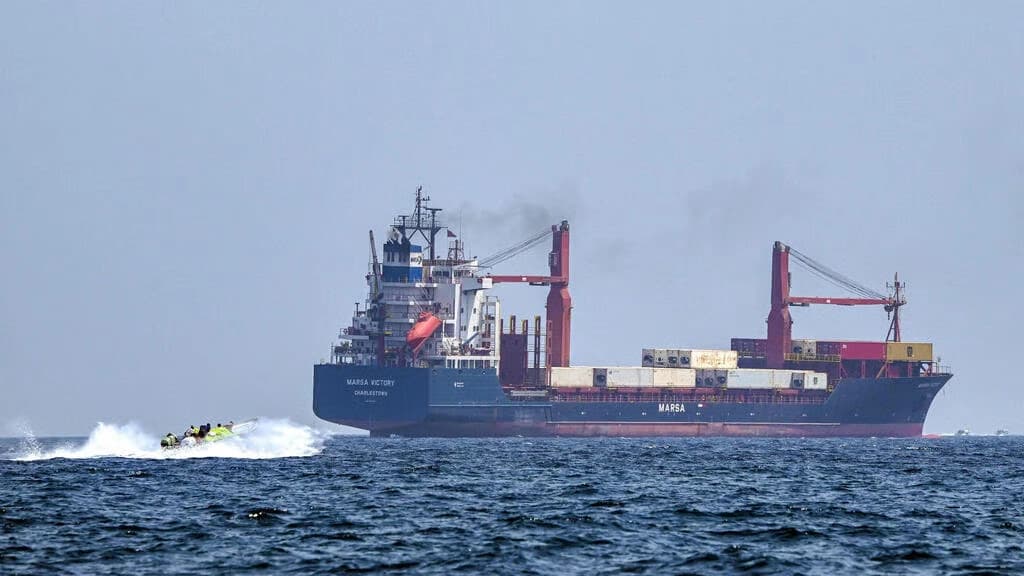
ERBIL, Kurdistan Region - Reopening the Strait of Hormuz “is not possible” under the current US naval blockade on Iran, Tehran’s Parliament Speaker Mohammad Bagher Ghalibaf said on Wednesday, accusing Washington of violating the two-week ceasefire brokered by Pakistan between the two sides by enforcing the embargo.
The remarks come as US forces on the same day stated that they had turned back more than two dozen vessels bound for Iranian ports as part of the blockade initiated 10 days ago.
In a statement on X, Ghalibaf said that “reopening the Strait of Hormuz is not possible” in light of what he described as “the flagrant breach of the ceasefire,” adding that a ceasefire “only makes sense if it is not violated by the maritime blockade and the hostage-taking of the world’s economy, and if the Zionist [Israeli] warmongering across all fronts is halted.”
He further claimed that the US and Israel “did not achieve their goals through military aggression, nor will they through bullying,” adding that “the only way forward is to recognize the rights of the Iranian people.”
A day earlier, the Iranian parliament speaker had accused US President Donald Trump of attempting, through the naval blockade, to “turn the negotiating table” with Iran into “a table of surrender or to justify renewed warmongering.”
“We do not accept negotiations under the shadow of threats, and in the past two weeks we have prepared to reveal new cards on the battlefield,” Ghalibaf said.
On Tuesday, Iranian Foreign Minister Abbas Araghchi also described the “blockading” of Iranian ports as “an act of war.” Iran “knows how to neutralize restrictions, how to defend its interests, and how to resist bullying,” the senior Iranian diplomat and key member of Tehran’s negotiation team with the US said.
The US and Israel launched a preemptive air campaign against Iran on February 28, targeting more than 17,000 sites across the country over six weeks of hostilities before the warring sides agreed to a Pakistan-mediated ceasefire on April 8, which halted fighting for two weeks and paved the way for talks.
While the first round of discussions ended without a final agreement on April 11, Islamabad has in recent days stepped up efforts to host a second round of talks on Wednesday, ahead of the expiry of the truce. However, those efforts did not yield any tangible results.
Further complicating the situation are apparent tit-for-tat maritime restrictions imposed by the US and Iran in the strategic Strait of Hormuz, in parallel to the talks.
The Iranian government, primarily through the Islamic Revolutionary Guard Corps (IRGC), has on several occasions declared the closure of the Strait, citing defensive measures against what it describes as Western aggression and targeting vessels linked to the United States, Israel, or their regional partners.
Meanwhile, Washington on April 13 initiated a maritime blockade on Iranian ports aimed at pressuring Iran’s economy.
The US Central Command reported on Wednesday that its forces “have directed 29 vessels to turn around or return to port” as part of the embargo, denying Iranian media reports that “several commercial ships had evaded the blockade.”
For his part, US President Trump on Tuesday announced an extension to the ceasefire with Iran at Pakistan’s request. In a post on his Truth Social platform, he said that “upon the request of [Army Chief of Staff] Field Marshal Asim Munir and Prime Minister Shehbaz Sharif of Pakistan, we have been asked to hold our attack on the country of Iran until such time as their leaders and representatives can come up with a unified proposal.”
Nonetheless, the US president added that he had directed his country’s military “to continue the blockade and, in all other respects, remain ready and able,” and would extend the ceasefire until a proposal is submitted and discussions are concluded “one way or the other.”
Earlier on Tuesday, a media outlet close to the Iranian military reported that Tehran’s negotiating team would not attend a second round of talks with Washington.
Tasnim News Agency, an outlet linked to the IRGC, quoted a well-placed source citing the “continued hostile US actions, including the naval blockade” on Iran as the reason, adding that Iranian negotiators view “attending further talks under current conditions” as “a waste of time.”
Iranian President Masoud Pezeshkian said Wednesday that while Iran “has welcomed dialogue and agreement and continues to do so,” the “breach of commitments, blockade and threats” remain “the main obstacles to genuine negotiations.” He added that “the world sees your endless hypocritical rhetoric and contradiction between claims and actions,” indirectly referring to the US administration.
.webp&w=3840&q=75)