
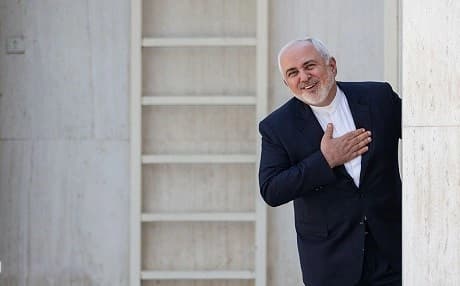

“Iran’s Foreign Ministry is not merely the diplomatic arm of the Islamic Republic but also a means of advancing many of the Supreme Leader’s destabilizing policies,” US Secretary of State Mike Pompeo said on Wednesday announcing the sanctions.
Zarif is Iran’s top diplomat and acted as the main negotiator for the 2015 Iran nuclear deal.
The decision to sanction Zarif comes after US President Donald Trump issued an executive order on June 24 imposing sanctions on Iran’s ultimate decision maker, the supreme leader Ali Khamenei and his office.
Pompeo said that Zarif has acted as an “apologist” and has been complicit in the Iranian regime’s malign activities such as terrorism, jailing and torturing innocent Iranians and fuelling conflict in the region.
“Foreign Minister Zarif is a key enabler of Ayatollah Khamenei’s policies throughout the region and around the world. The designation of Javad Zarif today reflects this reality,” said Pompeo.
Iran’s President Hassan Rouhani described sanctioning Zarif as “childish,” saying “everyday they say we want to negotiate with Iran without preconditions…but they sanction Iran’s minister of foreign affairs. They made bigger errors in the past and sanctioned the Supreme Leader of the Revolution.”
“The path to negotiation is the ministry of foreign affairs and the head of this ministry is the person of Foreign Minister.”
The foreign minister reacted to the news himself on social media.
“The US' reason for designating me is that I am Iran's ‘primary spokesperson around the world’ Is the truth really that painful? It has no effect on me or my family, as I have no property or interests outside of Iran. Thank you for considering me such a huge threat to your agenda,” Zarif tweeted following the US government announcement.
US Secretary of the Treasury Steven Mnuchin criticized Zarif’s use of social media to articulate his message, since this medium is restricted in Iran.
“Javad Zarif implements the reckless agenda of Iran’s Supreme Leader…” said Mnuchin. “At the same time the Iranian regime denies Iranian citizens’ access to social media, Foreign Minister Javad Zarif spreads the regime’s propaganda and disinformation around the world through these mediums.”
AFP reported today that the European Union (EU) will continue to work with Zarif, despite the US sanctions.
Some officials from the former US President Barack Obama era lashed out at the news. Wendy Sherman, the former US State Department official who acted as the chief US negotiator with Zarif on the nuclear deal, criticized the move to sanction Zarif on Twitter.
“Sanctioning FM Zarif belies @realDonaldTrump call for talks with no preconditions. Clearly the sop to the hawks since nuclear waivers continued for 90 days. Sanctioning FMs never helps diplomacy. Believe only other is Venezuela. No NK, no Syria, no other.”
“The apex of the American leaders hypocrisy and stupidity is that they repeatedly see Dr. Zarif as not relevant in Iranian politics but they resort to sanctioning him with clear foolishness,” said Mohammad Abbas Mousavi, the Iranian Foreign Ministry spokesman. “The Americans seriously fear the logic of Dr. Zarif and his diplomatic skills.”
However, despite sanctioning the top Iranian diplomat, US National Security Advisor John Bolton announced on Wednesday that the US government would renew nuclear waivers for another 90 days allowing Iran to work with Russia, China, and the European countries on its civilian nuclear program.
“The action today will help preserve oversight of Iran’s civil nuclear program, reduce proliferation risks, constrain Iran’s ability to shorten its ‘breakout time’ to a nuclear weapon, and prevent the regime from reconstituting sites for proliferation-sensitive purposes,” the US State Department said in a press statement. “As long as the Iranian regime continues to reject diplomacy and expand its nuclear program, the economic pressure and diplomatic isolation will intensify.”
The tension between Iran and the US have been on the rise since President Donald Trump unilaterally withdrew from the 2015 nuclear deal, for which Foreign Minister Zarif acted as the main Iranian negotiator.
In November, Trump re-imposed sanctions that had been lifted or waived under the agreement, dealing a blow to the landmark deal and leaving the Europeans, China and Russia to deal with the consequences.
“The United States is engaged in a campaign of maximum financial pressure on the Iranian regime and intends to enforce aggressively these sanctions that have come back into effect,” the US Treasury said last year.
Iran has said that it will not budge under US economic pressure, despite high inflation of 35 to 40 percent and the closure of a large number of small businesses as a result of the crippling sanctions.
Tehran has scaled back on its commitments under the nuclear deal, increasing its level of enriched uranium and raising fears in European capitals that this could be the end of the nuclear deal.
Tehran has said that if European countries do not take practical steps in alleviating the US pressure on its oil sector, Tehran will take the next step in scaling back on its commitment, without specifying the details.
“The actions the Europeans have taken do not correspond with their commitments. The sale of oil, the transport of oil and the return of the oil revenue, are amongst the commitment of the European countries,” Zarif said on Wednesday following a cabinet meeting in Tehran. “For the time being we pass on their other commitments such as investment in Iran… but we want them to fulfill these basic commitments meaning the sale of Iranian oil and the return of the oil revenues.”
Iran’s oil exports officially dropped to around 100,000 barrels per day in July according to tanker data and an industry source quoted by Reuters. Iran exported over 2.7 million barrels per day in April 2018, just before Washington withdrew from the nuclear deal.
However, Iranian officials claim that, while the sanctions have had an impact, they have not prevented Tehran from selling oil in large quantities.
Zarif has been under pressure from hardliners in Iran. He recently wrote a letter to the Supreme Leader Khamenei complaining about his depiction in a spy series on state-run TV that depicts the foreign ministry as a den of incompetent diplomats infested with questionable characters and spies.
However, the latest US move is bound to increase Zarif’s popularity in Iran and perhaps offer some relief from the hardliners.

_(1).webp&w=3840&q=75)