


Iraq

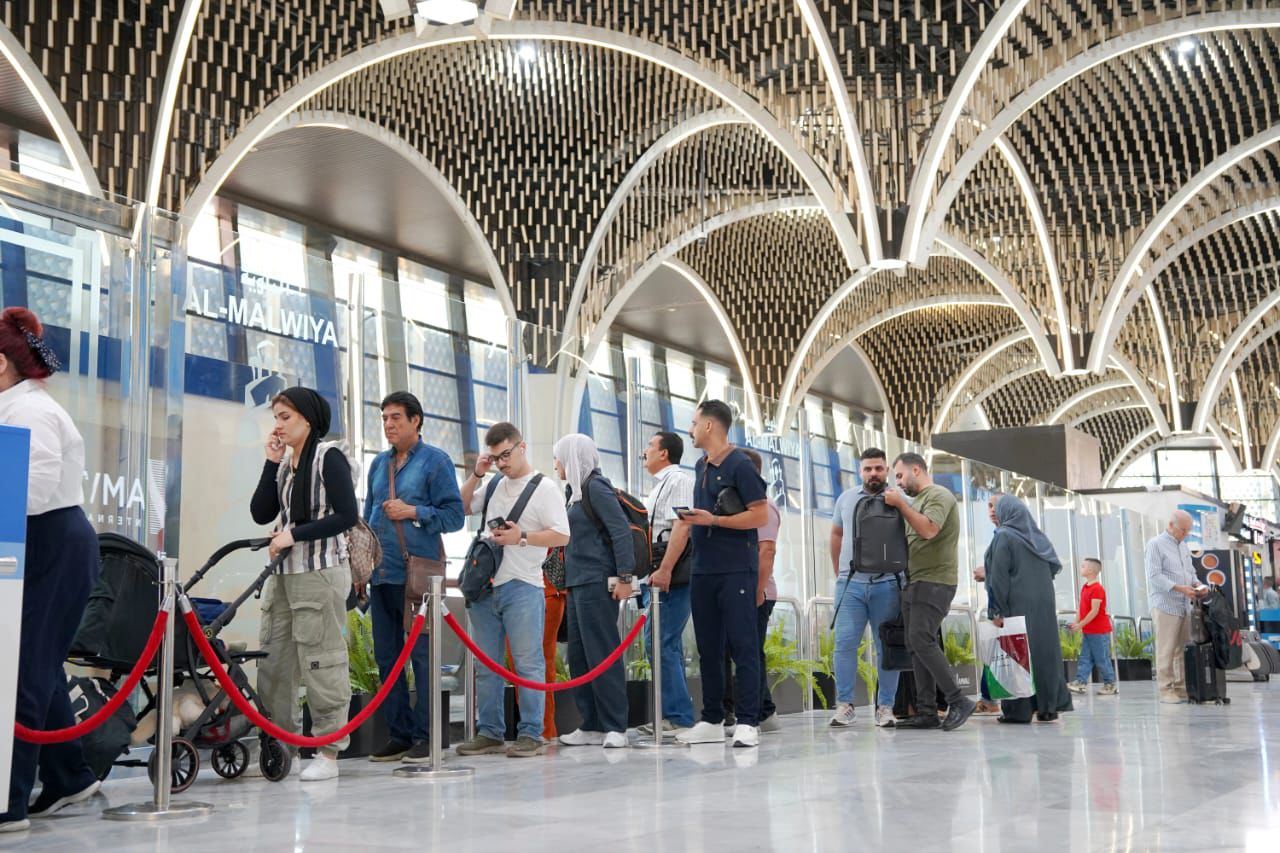
Passengers line up for passport control at Baghdad International Airport on July 27, 2025. Photo: Transport Ministry/Facebook
ERBIL, Kurdistan Region - Iraq’s airspace and airports will remain fully operational, with air traffic expected to operate normally throughout the election period, between November 9 and 11, Baghdad’s transport ministry said on Saturday.
“All airports in the country will operate normally and air navigation is continuing without interruption,” said Maytham al-Safi, spokesperson for the transport ministry, as quoted by the state-run Iraqi News Agency (INA).
The national carrier, Iraqi Airways, “is proceeding with its scheduled domestic and international flights during the election period and afterward, with complete seamlessness and order, under the supervision of Transport Minister Razzaq al-Saadawi,” he added.
"The transport ministry has not yet received any official notification from the relevant authorities regarding the closure of airspace,” Safi said, noting that "the continuation of regular air traffic reflects the high readiness of the infrastructure of Iraqi airports, and the efficiency of the technical, engineering and navigational personnel working there."
Flights to the Kurdistan Region will also continue as usual on election day.
“We have yet to receive any instructions to stop flights on election day,” Ahmed Hoshyar, director of Erbil International Airport (EIA), told Rudaw in October.
It is similarly business as usual at Kurdistan Region’s land borders.
“Traffic at the border crossing is normal” and there has been no official decision to close it on election day, Sirwan Hussein, spokesperson for the Haji Omaran border crossing - one of the nine official land border points in the Kurdistan Region - told Rudaw also in October.
“So far, the situation at the crossings is normal and they were open during previous voting days, but they are awaiting a decision for this time,” he added.
For the 2021 election, Iraq shut down its airspace and put restrictions on travel.
Iraq’s parliamentary elections are scheduled for November 11, with special voting set to take place on November 9.
According to the Independent High Electoral Commission (IHEC), around 21.4 million eligible voters have renewed their biometric cards, signaling their intention to participate in the vote.
A total of 31 alliances, 38 parties, 23 independent candidates, and 56 quota candidates will compete for 329 parliamentary seats, including nine reserved for minority groups.
More than 7,700 candidates are registered to run, with over 39,000 polling stations set to open across 8,703 centers, in addition to special voting and stations for displaced voters.


Comments
Rudaw moderates all comments submitted on our website. We welcome comments which are relevant to the article and encourage further discussion about the issues that matter to you. We also welcome constructive criticism about Rudaw.
To be approved for publication, however, your comments must meet our community guidelines.
We will not tolerate the following: profanity, threats, personal attacks, vulgarity, abuse (such as sexism, racism, homophobia or xenophobia), or commercial or personal promotion.
Comments that do not meet our guidelines will be rejected. Comments are not edited – they are either approved or rejected.
Post a comment