


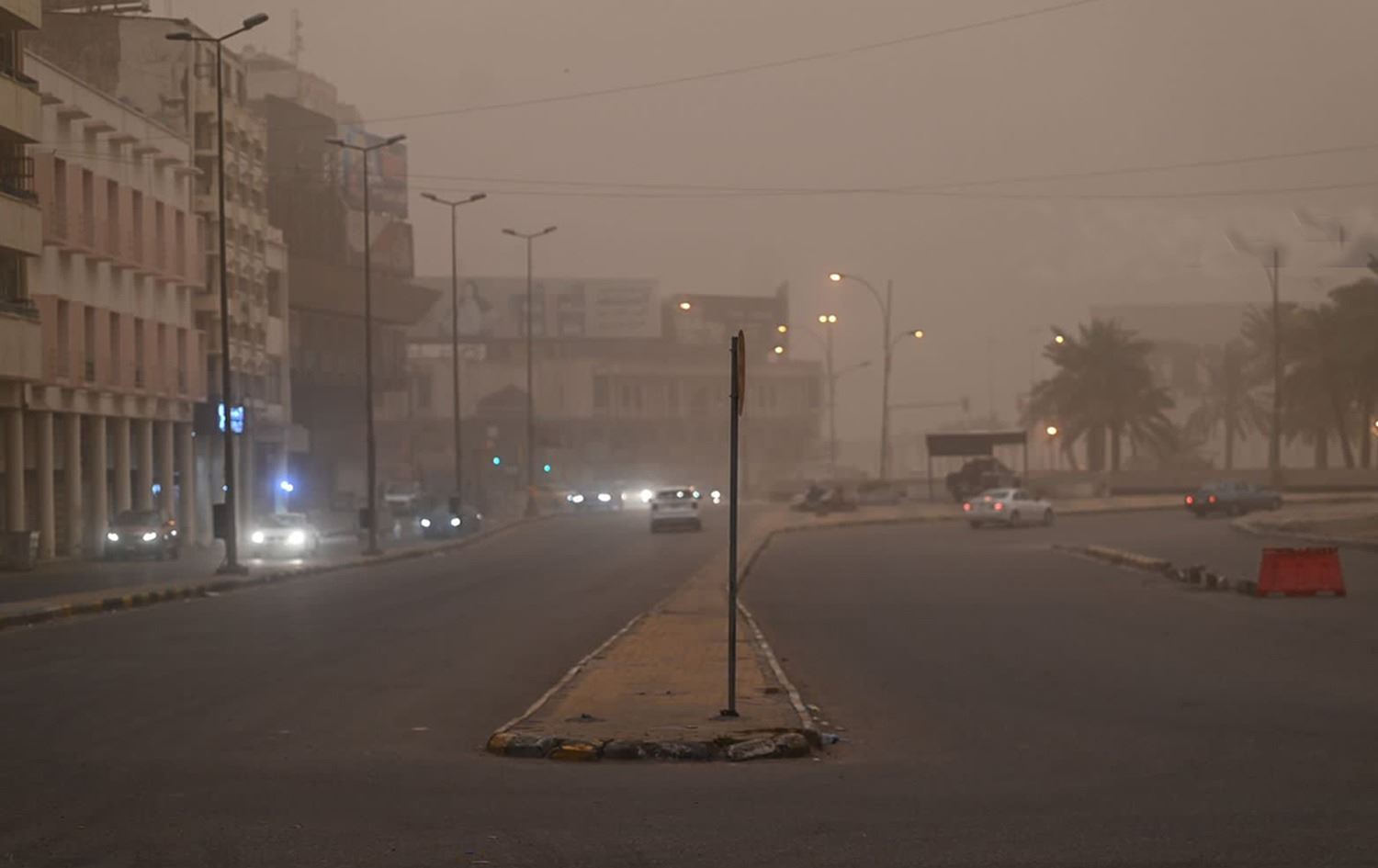
ERBIL, Kurdistan Region - The dense blanket of grey smog that has engulfed Baghdad in recent days is caused by trapped emissions and a seasonal thermal inversion, an Iraqi environment ministry confirmed to Rudaw on Wednesday, warning against non-adherence to international emission standards.
“Smog is related to a thermal inversion, which usually occurs during the transition periods between seasons,” said Luay al-Mukhtar, the ministry’s spokesperson, elaborating that “gases and emissions resulting from cars, generators, factories, and various industries remain trapped and confined at a level close to the Earth's surface."
Mukhtar said the smog is “harmful, but to mitigate its severity, all entities must comply with the national emissions standards issued in 2012.”
Baghdad residents have recently expressed wide frustration on social media after observing dark clouds enveloping the city and reporting foul, sulfur-like odors.
The environment ministry official clarified, however, that the smell is "not of sulfur but rather smog that completely covered the city of Baghdad."
Mukhtar stressed that the poor air quality underscores a lack of regulatory compliance among industrial and commercial sectors, saying, “The solution, in order for this phenomenon not to be so severe, is for all parties to adhere to the National Emission Limit Instructions issued in 2012 as much as possible.”
The instructions refer to the landmark US Environmental Protection Agency (EPA) regulation known as the Mercury and Air Toxics Standards (MATS). Finalized in February 2012, these instructions aim to protect public health by limiting hazardous substances that can cause developmental and neurological problems and are considered one of the most significant environmental regulations affecting the US power sector.
To mitigate the risks, the Iraqi environment ministry has stepped up action against “violators,” especially industrial ones, who “are either punished with a fine or punished with temporary or permanent closure,” Mukhtar said.
The main polluters cited include oil refineries, power stations, asphalt and brick factories, and illegal waste-burning sites.
According to IQAir - a real-time air quality platform - Baghdad ranked as the world’s second-most polluted major city in early September.
The Iraqi capital’s Air Quality Index (AQI) reached approximately 150 - a level considered ‘unhealthy’ and particularly hazardous for children, the elderly, and individuals with respiratory or heart conditions.
Mushtaq Ramadan contributed to this article from Erbil.


Comments
Rudaw moderates all comments submitted on our website. We welcome comments which are relevant to the article and encourage further discussion about the issues that matter to you. We also welcome constructive criticism about Rudaw.
To be approved for publication, however, your comments must meet our community guidelines.
We will not tolerate the following: profanity, threats, personal attacks, vulgarity, abuse (such as sexism, racism, homophobia or xenophobia), or commercial or personal promotion.
Comments that do not meet our guidelines will be rejected. Comments are not edited – they are either approved or rejected.
Post a comment