
QAMISHLI, Syria - Dozens of Syrian government-affiliated internal security forces entered Kurdish-controlled areas in northeast Syria (Rojava) on Monday, marking the first phase of an internationally brokered agreement between Damascus and the Kurds.
The deployment coincided with what Rudaw understands is the transfer of a new batch of Islamic State (ISIS) prisoners - previously held by the Kurdish-led Syrian Democratic Forces (SDF) in Rojava - from Syria to Iraq.
‘Limited’ Syrian presence
Around 100 personnel from Damascus’ internal security forces were sent to Hasaka city in eastern Rojava, security officials on the ground told Rudaw, without any major incidents recorded.
Marwan al-Ali, the newly appointed head of Hasaka’s Internal Security - affiliated with Damascus - was cited by the state-run Syrian Arab News Agency (SANA) instructing his personnel ahead of deployment to “carry out security tasks according to established strategies, comply with laws and regulations, follow procedures systematically, maintain public safety and order, and protect citizens and property."
Speaking to Rudaw in Hasaka, Ali said, “We are here to implement the [internationally brokered] agreement and ensure security and safety for the people.” In a video shared by SANA on X, Ali also said that the deployment came “in coordination with the [Kurdish Internal Security] forces (Asayish) in Hasaka, which will be integrated under the Syrian interior ministry.”
“We have deployed a limited number of forces,” the newly appointed head of Hasaka’s security elaborated, noting that a “similarly numbered deployment” is planned for the Kurdish city of Qamishli in northern Syria on Tuesday, and that “more provisions of the agreement will be implemented, including the integration of forces.”
Rudaw’s cameras captured Ali’s arrival at Hasaka’s Traffic Directorate, where he posed for photos with commanders from the Syrian forces and the Asayish - affiliated with the SDF - including Siamand Afrin, a senior commander of the Kurdish Internal Security Forces who was appointed as Ali’s deputy in Hasaka.
Afrin corroborated Ali’s remarks that the presence of Syrian forces in the city would be limited. “They have come to stay for a while, and afterward they will leave,” he told Rudaw.
ISIS detainees in transit
Crucially, Hasaka is home to the notorious Ghuwayran prison, which Iraqi security sources told Rudaw in late January houses some of ISIS’s “most dangerous” members, including members of the group’s top echelon.
Ghuwayran is a high-security facility that drew international attention in January 2022, when ISIS launched a massive operation to free thousands of its fighters, including hundreds of minors raised under the extremist group’s so-called “Cubs of the Caliphate.” After a brutal 10-day battle, the US-backed SDF regained control, though the facility is still described as a ticking time bomb.
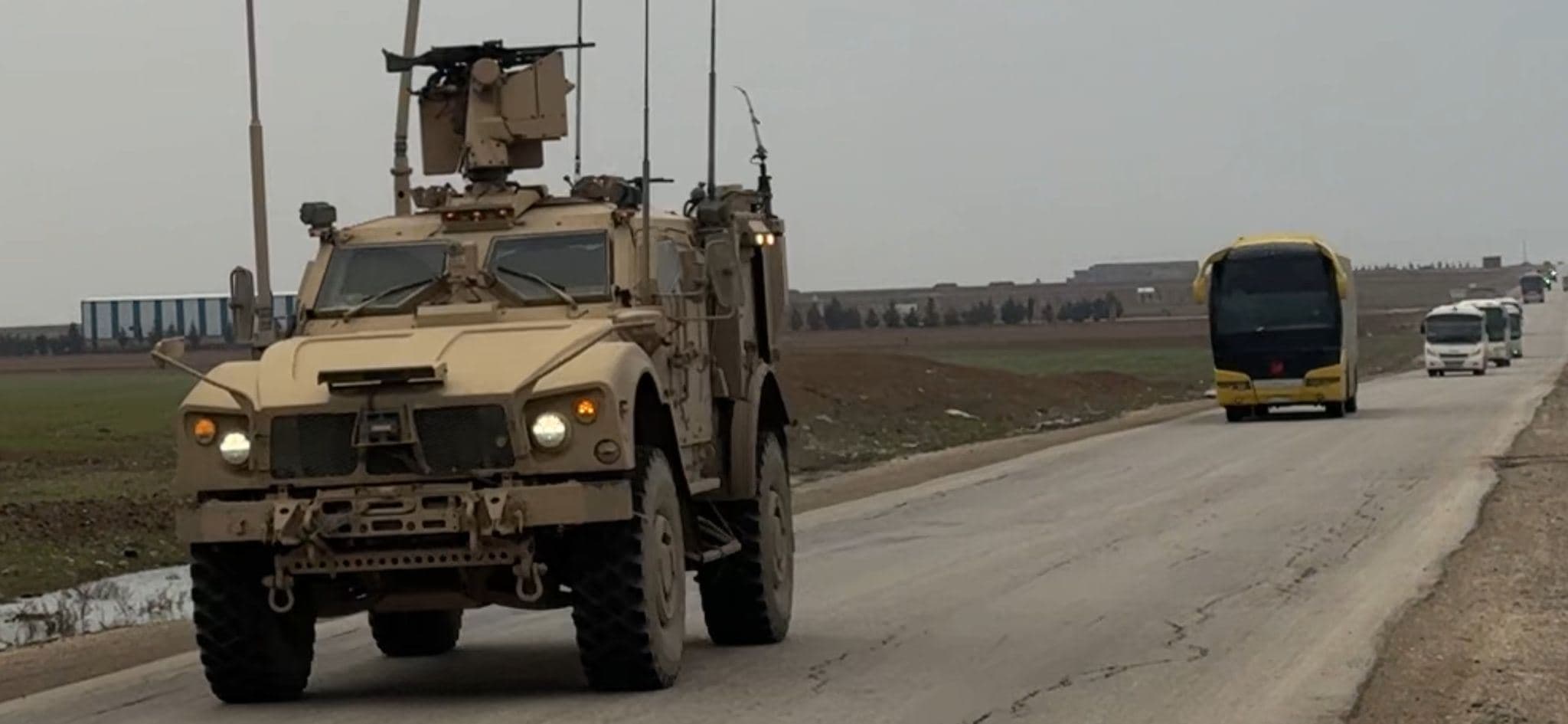
On Monday, as Damascus security forces prepared to enter Hasaka, Rudaw observed several US armored vehicles escorting five coaches from Qamishli toward the Iraqi border. The buses, Rudaw understands, carried dozens of ISIS detainees previously held by the SDF.
The US Central Command (CENTCOM) announced on January 21 that “U.S. forces successfully transported 150 ISIS fighters held at a detention facility in Hasaka, Syria, to a secure location in Iraq,” adding that “ultimately, up to 7,000 ISIS detainees” from multiple detention facilities in Rojava “could be transferred to Iraqi-controlled facilities.”
As of late January, two well-placed Iraqi security sources speaking anonymously due to the sensitivity of the matter told Rudaw that four convoys carrying 475 Islamic State (ISIS) detainees have been transferred from prisons previously held by the SDF in Rojava, noting that the suspects were primarily held in facilities in Hasaka.
The SDF, which serve as the de facto military force in Rojava, are a key on-the-ground ally of the US-led Global Coalition to Defeat ISIS and played a crucial role in the extremist group’s territorial defeat in Syria in 2019. The Kurdish-led forces also acted as wardens for thousands of ISIS militants and their family members held in detention facilities across Rojava.
In mid-January, Syrian government forces and affiliated armed groups launched a large-scale offensive to retake areas previously held by the SDF after they were liberated from ISIS. These regions include parts of eastern Aleppo, Deir ez-Zor, and Raqqa provinces, as well as areas near Hasaka.
Amid the offensive, the SDF announced that it had lost control of several facilities holding ISIS detainees, including the al-Shaddadi prison in southern Hasaka, with reports indicating that between 120 and 1,500 detainees may have escaped during the violence.
Hope amid uncertainty
Some Kurdish security forces tasked with guarding the convoy of ISIS detainees as it passed through Qamishli to the Iraqi border spoke to Rudaw, expressing a mix of hope and unease over the latest ceasefire agreement.

“I don’t trust this enemy, but we have our political leaders, and they know what is best for us,” said Bahoz Habash, 42, holding an AK-47 at a checkpoint in Girke Lege town east of Qamishli.
Habash, who has been a fighter for seven years and has lost several friends fighting various extremist groups, told Rudaw he does not believe the current ceasefire will hold.
Another fighter, Adam, cautious about the ceasefire, said the Kurds do not want war. “All we want is peace and equality,” said the 45-year-old father of two.
The internationally brokered Damascus-SDF deal, announced Friday, includes a comprehensive ceasefire and a phased plan for integrating military and administrative forces. It calls for the formation of a military division composed of three SDF brigades, along with a special brigade for forces in the Kurdish city of Kobane in northern Syria, under a division affiliated with Aleppo province.
The agreement also outlines the integration of the institutions of the Kurdish-led Democratic Autonomous Administration of North and East Syria (DAANES), which governs Rojava, into Syrian state institutions. It ensures the preservation of civilian employees’ status, safeguards the civil and educational rights of the Kurdish people, and facilitates the return of displaced residents to their homes.
Meanwhile, Abu Welat, a 54-year-old father of four, told Rudaw he hopes the ceasefire will hold.
“We want to have our rights under the government [led by Syrian interim President Ahmed al-Sharaa] and for them to accept us as we are,” said the volunteer, who, along with several of his neighbors, has taken up arms to guard their village of Khana Sor in northern Hasaka, near the Iraqi border.
Hogir, another volunteer from Qamishli who has taken up arms and is guarding a checkpoint, says people remain weary and fear being subjected ot a genocide like the one carried out by ISIS against the Yazidi community in Shingal (Sinjar) in 2014, “because the other side is considered a terrorist,” he said.
The 27-year-old, who had spent several years in the Kurdistan Region as a refugee, believes the involvement of the international community and Kurdish leaders from the Kurdistan Region is crucial to ensure any deal between Rojava and Damascus holds.
“What President Masoud Barzani did to end the clashes in Rojava, 22 Arab countries could not do for the Gaza Strip,” he said, praising the Kurdish leader’s recent efforts, in coordination with international and regional allies and the Syrian leadership represented by Sharaa, to achieve a ceasefire in the Kurdish enclave.
For 57-year-old business owner Abdulmajid Ibrahim, who spent most of his life without citizenship rights because his family was among 120,000 Kurds stripped of their rights in a controversial 1962 census, the deal brings hope.
“We lived as laborers because we were considered Ajnabi [foreigners in Arabic] without any rights,” Ibrahim said, referring to the label given to Kurds without citizenship. He added that he works alongside Arab residents of the city, who are also hopeful.
“We are hoping, God willing, that peace and security will return to this land.”