


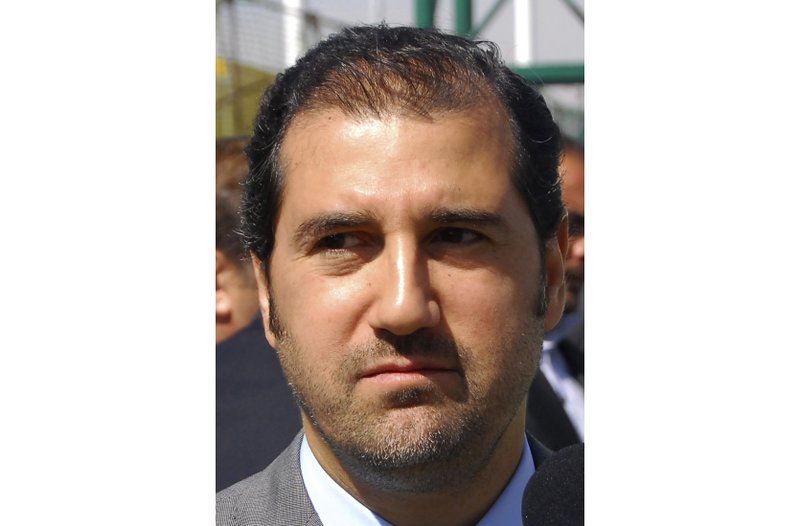
BEIRUT — Syria’s stock market on Tuesday suspended trading for the largest cellular company in the country, owned by a cousin of the president and one of Syria’s richest businessmen.
The decision by the Syrian Commission of Financial Markets and Securities marked another development in a deepening financial dispute within the Assad family, which has ruled Syria for five decades. The company, Syriatel, is one of the country’s largest employers, with thousands of staff and 11 million subscribers.
The commission said its measure aims to protect shareholders and that the suspension would last until further notice. It did not elaborate further.
Businessman Rami Makhlouf, a maternal cousin of President Bashar Assad, said in an online post after the decision late on Monday that the situation was a “farce.” He said that over the past 10 years, 70 percent of the company’s profits were spent on charity.
“No one will be able to prevent this money from reaching” those in need, he vowed.
Last month, a Syrian court imposed a travel ban on Makhlouf until a dispute over outstanding financial dues is settled. The ban was one in a recent quick succession of government measures against Makhlouf, including confiscating his assets and those of his wife and children, and warning that more financial claims would be made against the man once believed to be at the heart of the economy of Syria.
Makhlouf’s latest posting is in line with what has been an unusually widely publicized family rift. He has defiantly challenged the financial claims made against him, saying they are unjust and called for Assad to be an arbiter.
Assad has made no public statements about the affair — the most visible split in the tight-knit family since Assad succeeded his father in 2000.
A telecommunications regulatory body had said Makhlouf owes the government some $180 million in outstanding operational fees. Makhlouf challenged the claims that Syriatel owed the state any money in statements and videos posted online.
Syria, already under Western sanctions, is entering a new phase of economic hardship, its currency in a down spiral that sent prices of basic commodities soaring. Economic activity is also being hurt by restrictions imposed to combat the coronavirus, following austerity measures taken during the war that has displaced nearly half the population.
The decision by the Syrian Commission of Financial Markets and Securities marked another development in a deepening financial dispute within the Assad family, which has ruled Syria for five decades. The company, Syriatel, is one of the country’s largest employers, with thousands of staff and 11 million subscribers.
The commission said its measure aims to protect shareholders and that the suspension would last until further notice. It did not elaborate further.
Businessman Rami Makhlouf, a maternal cousin of President Bashar Assad, said in an online post after the decision late on Monday that the situation was a “farce.” He said that over the past 10 years, 70 percent of the company’s profits were spent on charity.
“No one will be able to prevent this money from reaching” those in need, he vowed.
Last month, a Syrian court imposed a travel ban on Makhlouf until a dispute over outstanding financial dues is settled. The ban was one in a recent quick succession of government measures against Makhlouf, including confiscating his assets and those of his wife and children, and warning that more financial claims would be made against the man once believed to be at the heart of the economy of Syria.
Makhlouf’s latest posting is in line with what has been an unusually widely publicized family rift. He has defiantly challenged the financial claims made against him, saying they are unjust and called for Assad to be an arbiter.
Assad has made no public statements about the affair — the most visible split in the tight-knit family since Assad succeeded his father in 2000.
A telecommunications regulatory body had said Makhlouf owes the government some $180 million in outstanding operational fees. Makhlouf challenged the claims that Syriatel owed the state any money in statements and videos posted online.
Syria, already under Western sanctions, is entering a new phase of economic hardship, its currency in a down spiral that sent prices of basic commodities soaring. Economic activity is also being hurt by restrictions imposed to combat the coronavirus, following austerity measures taken during the war that has displaced nearly half the population.


Comments
Rudaw moderates all comments submitted on our website. We welcome comments which are relevant to the article and encourage further discussion about the issues that matter to you. We also welcome constructive criticism about Rudaw.
To be approved for publication, however, your comments must meet our community guidelines.
We will not tolerate the following: profanity, threats, personal attacks, vulgarity, abuse (such as sexism, racism, homophobia or xenophobia), or commercial or personal promotion.
Comments that do not meet our guidelines will be rejected. Comments are not edited – they are either approved or rejected.
Post a comment