


Syria

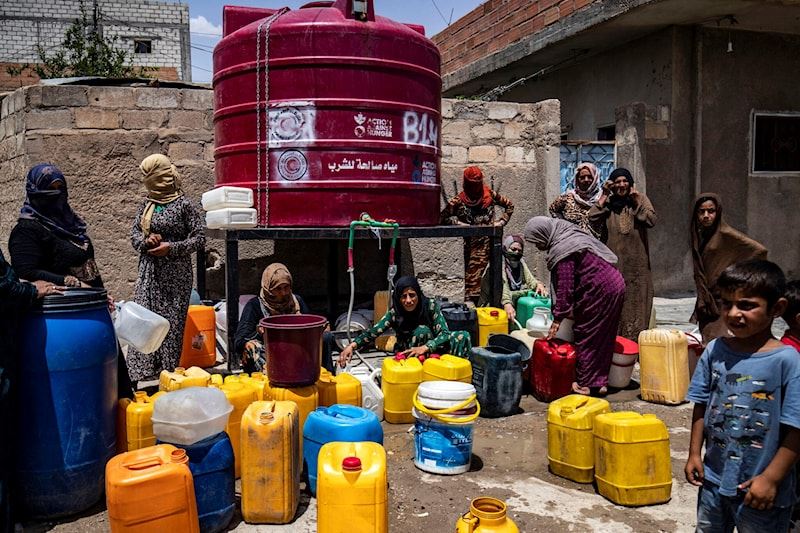
Women and children fill jugs of water at a neighborhood water tank in northeast Syria's (Rojava) Hasaka city on June 11, 2023. Photo: AFP
ERBIL, Kurdistan Region - A joint mission by the United Nations Children’s Fund (UNICEF) and the International Committee of the Red Cross (ICRC) has carried out a critical technical assessment in northeast Syria’s (Rojava) Hasaka province, where more than a million people are enduring a severe water crisis due to prolonged disruptions in water access.
The convoy visited the Alouk water station on Tuesday to evaluate its condition and explore prospects for restoring it to full operational capacity.
In a statement on X, UNICEF emphasized on Wednesday that the station “is essential to public health,” underscoring that “reliable access to water is particularly crucial for children and families, who suffer most when services fail.”
The ICRC, in a parallel statement, highlighted the significance of engaging with the new government in Damascus, particularly the energy ministry, calling their participation a reflection of “a shared recognition of the urgent humanitarian needs.”
Located in Sari Kani (Ras al-Ain), the Alouk water station has been at the center of a deepening humanitarian crisis since its capture by Turkish forces and Turkish-backed armed factions in 2019 during the so-called Operation Peace Spring. The seizure disrupted water access to Hasaka and nearby areas, cutting off critical supply to civilians and displacement camps in the south.
Efforts by local authorities to draw water from wells have fallen short of meeting the region’s needs. While Turkish officials blame Kurdish authorities for power cuts to Sari Kani and Gire Spi (Tal Abyad), Kurdish leaders point to the original damage caused by the Turkish offensive and the ongoing restriction of access to Alouk station.
The ongoing water shortage has forced many to rely on expensive and often unsafe water alternatives. A UNICEF cholera report in November 2022 noted that at least 500,000 people in Hasaka lacked access to “sufficient quantities of safe water.”
Hawar News Agency (ANHA), affiliated with the Kurdish authorities in Rojava, reported on Thursday that ongoing water scarcity in Hasaka is taking a serious toll on public health and daily life - particularly for women and children. Many are forced to walk long distances and endure lengthy waits to collect water, while the high cost of privately-supplied tanker water places an additional economic burden on most families.
According to ANHA, Hasaka faces a severe daily water shortage, requiring more than 130,000 cubic meters of water. This demand is only partially met through mobile tankers and limited aid distributions.
Tuesday’s assessment focused on the technical and infrastructure requirements needed to secure a stable electricity supply to the Alouk station - without which it cannot operate effectively. The mission also included planning with local authorities for both emergency interventions and long-term solutions to prevent future disruptions.
UNICEF and the ICRC reiterated on Wednesday their commitment to ongoing collaboration, stressing that reestablishing water infrastructure is essential to the health, dignity, and stability of communities across Hasaka.


Comments
Rudaw moderates all comments submitted on our website. We welcome comments which are relevant to the article and encourage further discussion about the issues that matter to you. We also welcome constructive criticism about Rudaw.
To be approved for publication, however, your comments must meet our community guidelines.
We will not tolerate the following: profanity, threats, personal attacks, vulgarity, abuse (such as sexism, racism, homophobia or xenophobia), or commercial or personal promotion.
Comments that do not meet our guidelines will be rejected. Comments are not edited – they are either approved or rejected.
Post a comment