Syria
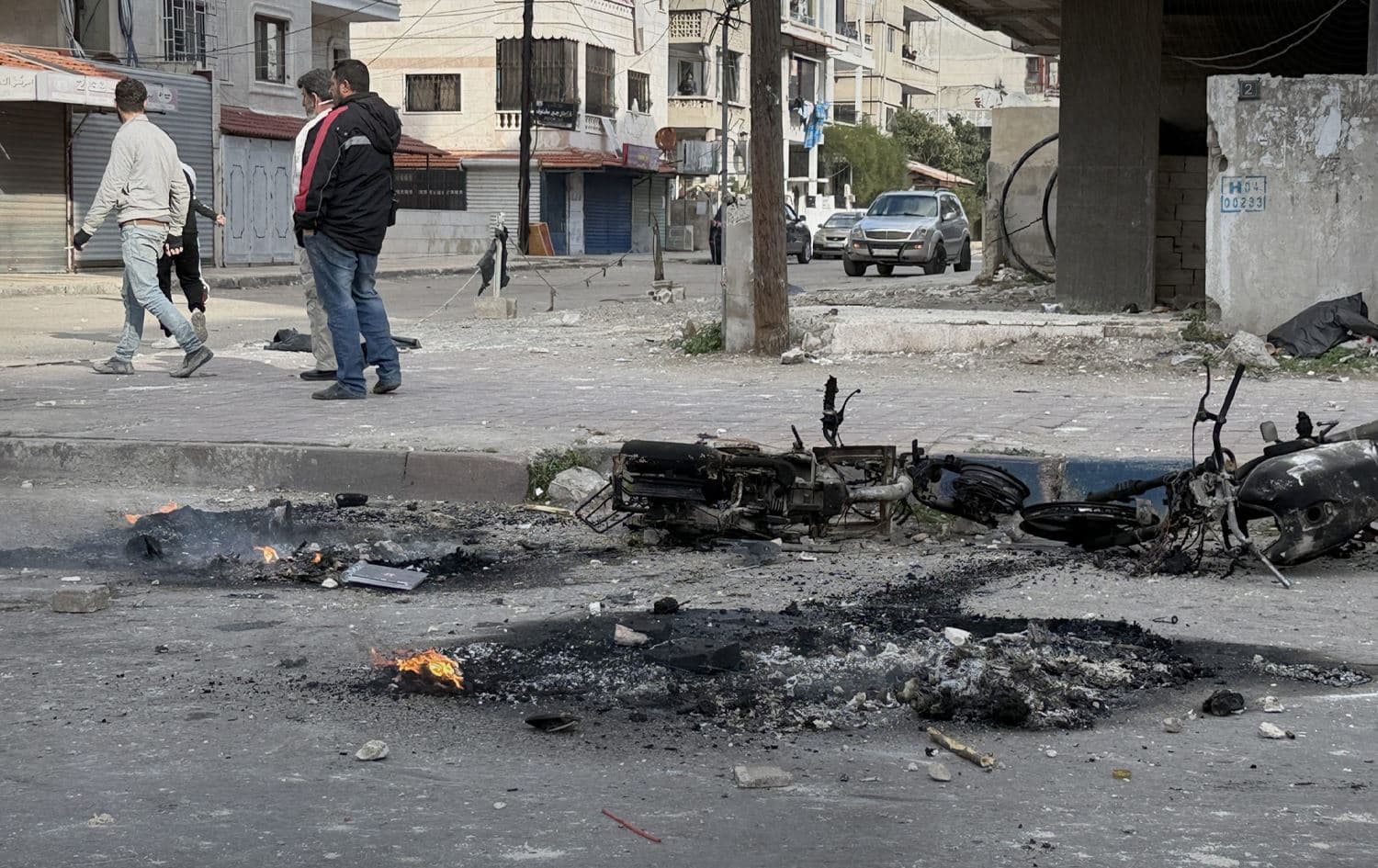
Residents standing close to a destroyed motorcycle on a street amid protests in Syria’s coastal areas: Photo: SANA
ERBIL, Kurdistan Region - At least two civilians were killed and nearly 50 injured in violence tied to Alawite protests in Syria’s coastal province of Latakia, a war monitor said on Sunday, while the country’s interior ministry reported that one security member was killed and several others were injured.
The interior ministry said it had announced “the martyrdom of one of the internal security elements and the injury of several elements while performing their national duty in maintaining security and securing the protests” in Latakia.
The demonstrations followed a call by Ghazal Ghazal, a leader of Syria’s Alawite community, a day earlier, as well as a deadly attack on an Alawite mosque on Friday.
The ministry said that “security elements tasked with securing today's protests were subjected to direct attacks in the city of Latakia,” adding that forces were also attacked in the Tartus countryside “by groups linked to remnants of the [Assad] regime.”
Meanwhile, the UK-based Syrian Observatory for Human Rights (SOHR) said on Sunday that “two people died in Latakia from gunshot wounds, and 48 others were injured in Latakia, Jableh, and Tartus, some critically.”
Earlier in the day, SOHR reported that protesters were “attacked with live gunfire and bladed weapons” by Damascus security forces and their affiliated groups.
“We condemn this in the strongest possible terms and consider it a flagrant violation of Syrians’ right to peacefully express their opinions and legitimate demands,” the Democratic Autonomous Administration of North and East Syria (DAANES) said in a statement, adding that it “holds those responsible within the Syrian Transitional Government accountable for these practices.”
In his call for protests, Ghazal said the Alawite community does not seek a civil war but “political federalism.”
“We want our right to self-determination,” he said in an apparent message to the transitional government in Damascus, led by Islamist figures. “Our appointment is tomorrow from twelve o'clock until five o'clock in the afternoon, Sunday.”
Protesters called for federalism during the demonstrations.
Ghazal’s call came after an explosion struck an Alawite mosque on Friday, killing at least eight people and wounding around 20 others. A radical Sunni Islamist militant group, Saraya Ansar al-Sunna, claimed responsibility, saying the attack was carried out “in cooperation with mujahideen [jihadists] from another group.”
No arrests have been announced in connection with the blast.
Violence has persisted in parts of Syria since the ouster of longtime ruler Bashar al-Assad by the now-dissolved jihadist group Hay’at Tahrir al-Sham (HTS). Its former leader, Ahmed al-Sharaa, now serves as interim president.
The interim authorities have faced growing criticism over their centralized style of governance. In March, Sharaa signed a constitutional declaration emphasizing Islamic jurisprudence, drawing backlash from Alawite, Christian, Druze, and Kurdish communities, who viewed it as exclusionary.
Calls for decentralization or federalism have intensified among Alawites, Druze, and Kurds following repeated waves of violence, particularly after clashes left nearly 800 people dead in the Druze-majority Suwayda province in mid-July and nearly 2,000 dead in Alawite-majority coastal regions in March, according to war monitors.
The interior ministry said it had announced “the martyrdom of one of the internal security elements and the injury of several elements while performing their national duty in maintaining security and securing the protests” in Latakia.
The demonstrations followed a call by Ghazal Ghazal, a leader of Syria’s Alawite community, a day earlier, as well as a deadly attack on an Alawite mosque on Friday.
The ministry said that “security elements tasked with securing today's protests were subjected to direct attacks in the city of Latakia,” adding that forces were also attacked in the Tartus countryside “by groups linked to remnants of the [Assad] regime.”
Meanwhile, the UK-based Syrian Observatory for Human Rights (SOHR) said on Sunday that “two people died in Latakia from gunshot wounds, and 48 others were injured in Latakia, Jableh, and Tartus, some critically.”
Earlier in the day, SOHR reported that protesters were “attacked with live gunfire and bladed weapons” by Damascus security forces and their affiliated groups.
“We condemn this in the strongest possible terms and consider it a flagrant violation of Syrians’ right to peacefully express their opinions and legitimate demands,” the Democratic Autonomous Administration of North and East Syria (DAANES) said in a statement, adding that it “holds those responsible within the Syrian Transitional Government accountable for these practices.”
In his call for protests, Ghazal said the Alawite community does not seek a civil war but “political federalism.”
“We want our right to self-determination,” he said in an apparent message to the transitional government in Damascus, led by Islamist figures. “Our appointment is tomorrow from twelve o'clock until five o'clock in the afternoon, Sunday.”
Protesters called for federalism during the demonstrations.
Ghazal’s call came after an explosion struck an Alawite mosque on Friday, killing at least eight people and wounding around 20 others. A radical Sunni Islamist militant group, Saraya Ansar al-Sunna, claimed responsibility, saying the attack was carried out “in cooperation with mujahideen [jihadists] from another group.”
No arrests have been announced in connection with the blast.
Violence has persisted in parts of Syria since the ouster of longtime ruler Bashar al-Assad by the now-dissolved jihadist group Hay’at Tahrir al-Sham (HTS). Its former leader, Ahmed al-Sharaa, now serves as interim president.
The interim authorities have faced growing criticism over their centralized style of governance. In March, Sharaa signed a constitutional declaration emphasizing Islamic jurisprudence, drawing backlash from Alawite, Christian, Druze, and Kurdish communities, who viewed it as exclusionary.
Calls for decentralization or federalism have intensified among Alawites, Druze, and Kurds following repeated waves of violence, particularly after clashes left nearly 800 people dead in the Druze-majority Suwayda province in mid-July and nearly 2,000 dead in Alawite-majority coastal regions in March, according to war monitors.
Comments
Rudaw moderates all comments submitted on our website. We welcome comments which are relevant to the article and encourage further discussion about the issues that matter to you. We also welcome constructive criticism about Rudaw.
To be approved for publication, however, your comments must meet our community guidelines.
We will not tolerate the following: profanity, threats, personal attacks, vulgarity, abuse (such as sexism, racism, homophobia or xenophobia), or commercial or personal promotion.
Comments that do not meet our guidelines will be rejected. Comments are not edited – they are either approved or rejected.
Post a comment