



Error occured during this request! Please try again later.
Turkey

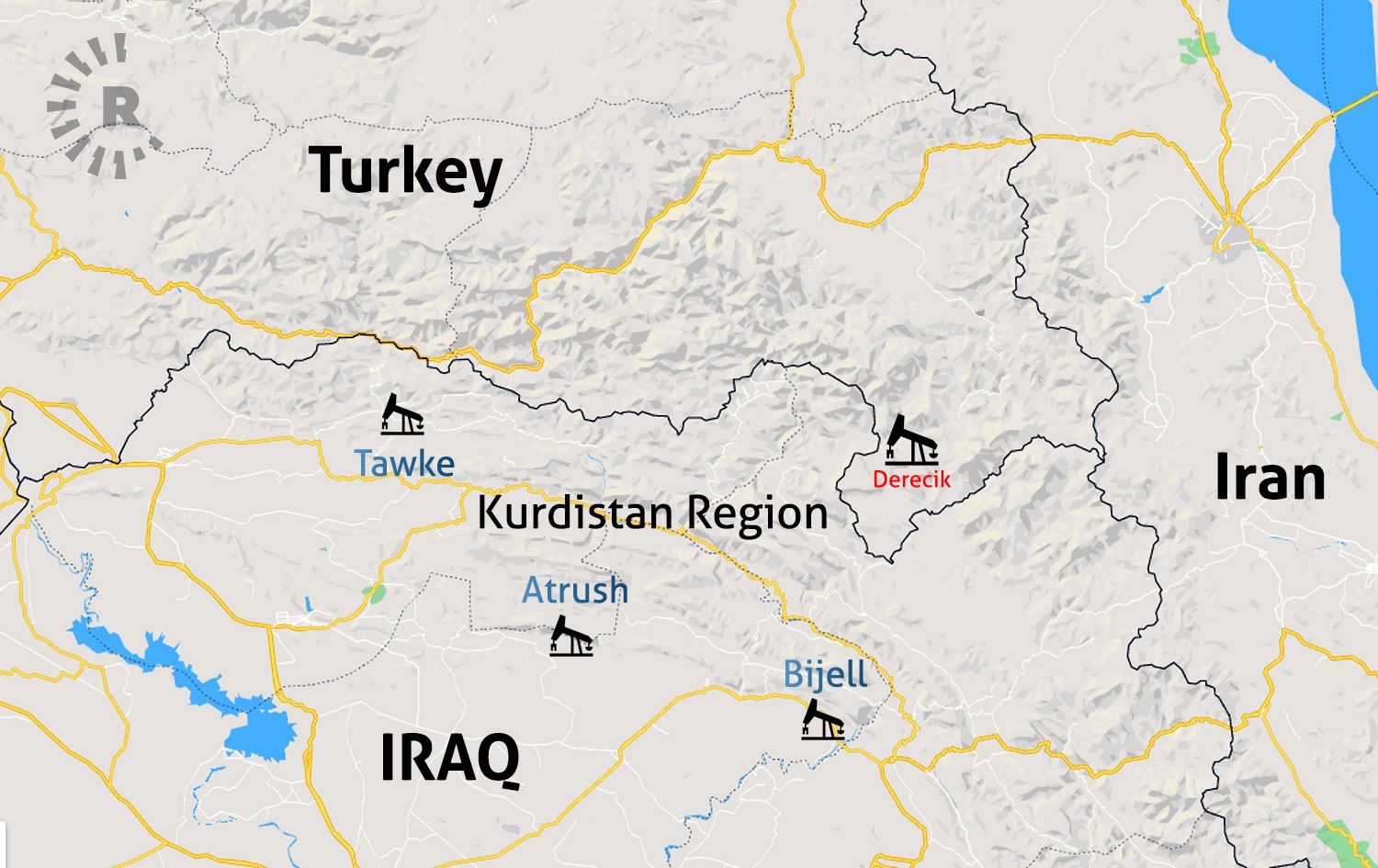
Google map shows Trillion Energy’s block in Derecik, and some of the Kurdistan Region's fields
ERBIL, Kurdistan Region — A Canadian oil company has found two drill ready conventional oil sites in the Derecik district of Turkey’s Hakkari province, part of an area where Turkey and the Kurdistan Workers’ Party (PKK) have clashed for decades.
The Vancouver-based Trillion Energy company said in a statement Tuesday that it was “pleased to report that the evaluation of the Zagros Basin Derecik Exploration Licenses in the Hakkari area of Turkey is complete and yielded promising results.”
The rugged Turkey-Iraq border area has been subject to clashes between Ankara and the PKK for decades, and the former has set up several military bases on both sides of the border with the stated aim of creating a buffer zone.
The PKK is an armed group fighting for the political and cultural rights of Kurds in Turkey.
Turkey has launched a fresh offensive against alleged PKK positions on its borders with the Kurdistan Region since June 15. The focus of the latest operations have been in the Kurdistan Region of Iraq’s Duhok province, rather than the areas of Derecik. However, clashes have occurred in the district in the past.
The company notes that the newly evaluated oil fields - which they own in their 42,833 hectare entirety - are close to “several world class oil fields” in the Kurdistan Region.

The site is located 45 kilometers south of Bijell field, 75 kilometers away from the Swara Tika field, 60 kilometers away the Swara Tika East field and 65 kilometers away from the Atrush field, according to the company, all of which are located in the province of Duhok.
“As the Derecik Licenses are located just where Turkey extends into the Iraq Zagros basin, we have determined the stratigraphy on the Derecik License is identical to what is found in several Iraq producing fields,” said Trillion Energy in their statement.
Turkey heavily depends on Iraq and the Kurdistan Region for its oil imports.
In April, it imported 2.93 million tonnes of oil from Iraq, Russia and Norway. Most of it, 1.46 million tonnes, was imported from Iraq and Kurdistan Region, according to data from Turkey's Energy Market Regulatory Authority (EMRA), reported the state-owned media outlet Anadolu Agency (AA).
The Vancouver-based Trillion Energy company said in a statement Tuesday that it was “pleased to report that the evaluation of the Zagros Basin Derecik Exploration Licenses in the Hakkari area of Turkey is complete and yielded promising results.”
The rugged Turkey-Iraq border area has been subject to clashes between Ankara and the PKK for decades, and the former has set up several military bases on both sides of the border with the stated aim of creating a buffer zone.
The PKK is an armed group fighting for the political and cultural rights of Kurds in Turkey.
Turkey has launched a fresh offensive against alleged PKK positions on its borders with the Kurdistan Region since June 15. The focus of the latest operations have been in the Kurdistan Region of Iraq’s Duhok province, rather than the areas of Derecik. However, clashes have occurred in the district in the past.
The company notes that the newly evaluated oil fields - which they own in their 42,833 hectare entirety - are close to “several world class oil fields” in the Kurdistan Region.
The site is located 45 kilometers south of Bijell field, 75 kilometers away from the Swara Tika field, 60 kilometers away the Swara Tika East field and 65 kilometers away from the Atrush field, according to the company, all of which are located in the province of Duhok.
“As the Derecik Licenses are located just where Turkey extends into the Iraq Zagros basin, we have determined the stratigraphy on the Derecik License is identical to what is found in several Iraq producing fields,” said Trillion Energy in their statement.
Turkey heavily depends on Iraq and the Kurdistan Region for its oil imports.
In April, it imported 2.93 million tonnes of oil from Iraq, Russia and Norway. Most of it, 1.46 million tonnes, was imported from Iraq and Kurdistan Region, according to data from Turkey's Energy Market Regulatory Authority (EMRA), reported the state-owned media outlet Anadolu Agency (AA).


Comments
Rudaw moderates all comments submitted on our website. We welcome comments which are relevant to the article and encourage further discussion about the issues that matter to you. We also welcome constructive criticism about Rudaw.
To be approved for publication, however, your comments must meet our community guidelines.
We will not tolerate the following: profanity, threats, personal attacks, vulgarity, abuse (such as sexism, racism, homophobia or xenophobia), or commercial or personal promotion.
Comments that do not meet our guidelines will be rejected. Comments are not edited – they are either approved or rejected.
Post a comment