



Error occured during this request! Please try again later.
Opinions

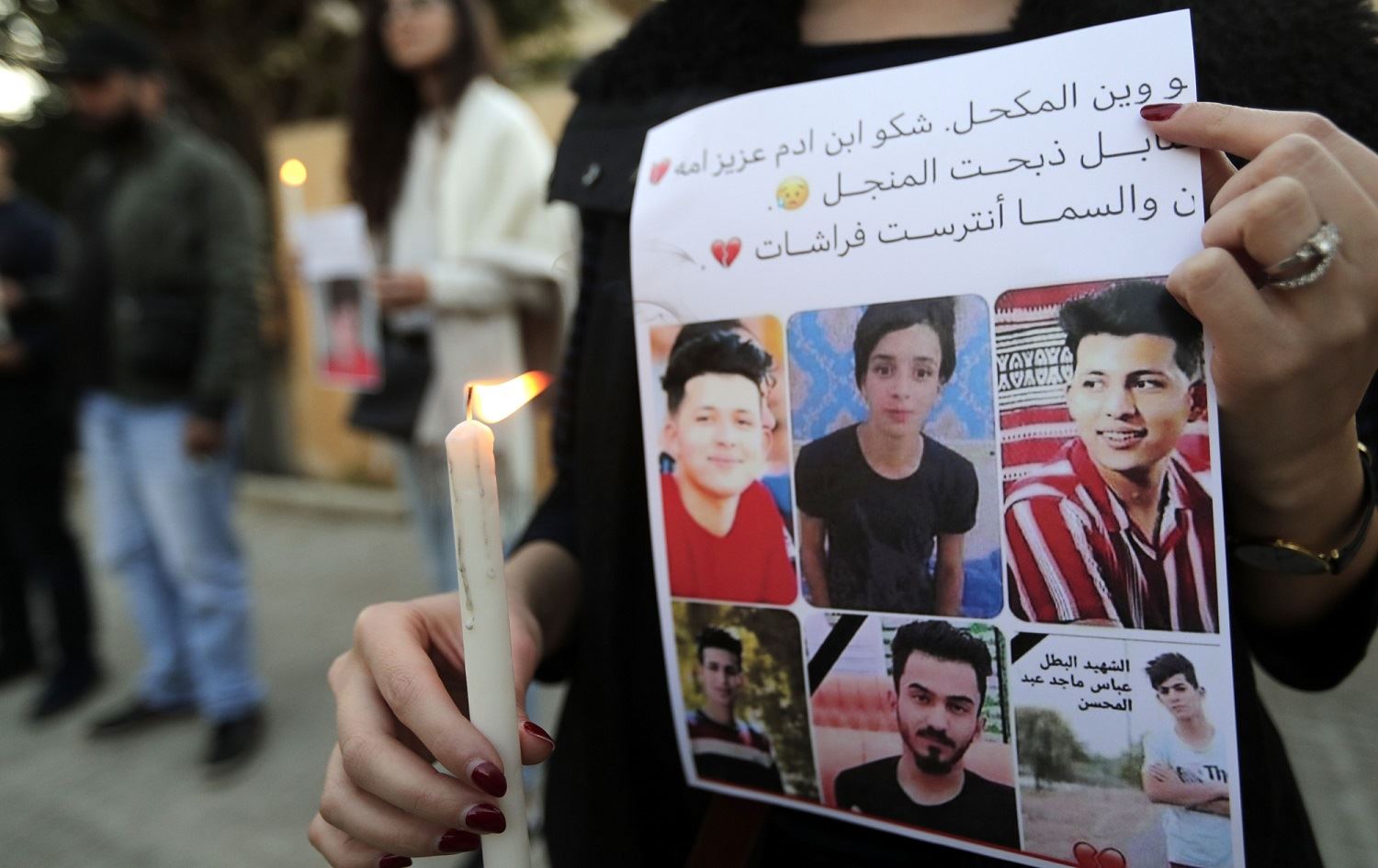
A Lebanese demonstrator holds a picture of Iraqis killed during protests as she takes part in a candlelight vigil outside Iraq's embassy in Beirut, November 30, 2019. Photo: Anwar Amro / AFP
Max Weber is widely viewed as one of the grandfathers of modern political science. His definition of a state (a human community that successfully claims a monopoly on the use of legitimate force within a territory) remains the most widely cited one in the field. Some of Weber’s other concepts, about how states maintain their rule, can also help us understand the protests roiling Iraq, Iran and other parts of the Middle East.
The most effective means of ordering society and mobilizing the population behind the government, according to Weber, stems from legitimacy. Legitimacy appears remarkably cost-effective, leading people to consent to their rulers’ decrees willingly. The population might even prove willing to sacrifice a lot on behalf of a government they view as their own and believe in.
State legitimacy can come from tradition, as is common with monarchies, or from other sources such as charismatic leaders or a rational-legal code. Tradition does not stand up well to change, however, placing this source of legitimacy under growing strain in an increasingly complex and fast paced world. Charismatic leadership likewise proves rare and ephemeral, ending with the death of the revered leader.
Legitimacy derived from a rational-legal code typically involves religion or a democratic constitution – a social covenant of sorts between the people and those who will lead them. Laws under such systems must appear fair and applicable to everyone. If the rule of law or a religion suffers too much warping and abuse in the service of reigning political interests, the systems loses legitimacy. Average Iranians, for instance, may become cynical after seeing Islam twisted to fit the interests of regime elites for the last 40 years. Similarly, Iraqis or Lebanese may lose faith in a constitution and nice-sound legal strictures that their leaders rarely seem to abide by.
Governments lacking legitimacy and unable to elicit the willing obedience of their population can always move down Weber’s hierarchy of sources of state power to the next best thing, however: patronage. As most of the rentier oil producing Gulf States demonstrate, buying the population off can be very effective. Loyal subjects get living allowances, medical care, housing, jobs and more, while dissidents are sanctioned into poverty. This logic even applies to democratic states, as electoral districts of winning political parties get paved roads, infrastructure and other goodies while opposition strongholds wither on the vine.
Systems based on patronage do not produce the most powerful states, however. Resources do not get apportioned in the most effective manner, and people on the receiving end of government largesse always seem to want more and more. Patronage thus quickly morphs into unbridled corruption, enriching a select few and leaving little more than crumbs to the vast majority of the people.
Protesters in Iran, Iraq and Lebanon seem most upset with the amount of crumbs doled out to them. After years of war, they were initially willing to accord their governments legitimacy – based on Islam or democratic promises of their respective regimes. When the legitimacy waned and the electricity grid, the jobs, and even basic services such as garbage removal failed, they took to the streets.
Which takes us to the absolute minimal basis upon which all state power rests according to Weber: the use of, or threat of, force. This applies to both liberal democratic states and more authoritarian regimes (if anyone in Western Europe or North America questions whether their governments rely upon force as well, they need only decide to stop paying their taxes and cease obeying the laws to get a reminder about the issue).
European and North Americans rarely have to see their governments brandish force, so sometimes they forget the truth of state power’s essential basis. Most of those residing in the Middle East – including, in particular, long-oppressed groups like the Kurds – have no such luxury of forgetting.
With Iran’s country-wide shutdown of the internet now receding, more images of the extreme force used to quell the most recent protests there are coming out. In Iraq, Prime Minister Abdul-Mahdi just offered his resignation after yet more protesters were killed this week. The government of Lebanon teeters on the edge of collapse. A state that must resort to force too often becomes brittle and loses what little legitimacy remained. Force is also even more expensive than patronage – gaining the population’s acquiescence only through the barrel of a gun stands out as the least cost-effective method of getting things done and running a country.
Regimes in the throes of violence and corruption will find it extremely difficult to reform themselves. Money that could have been used to provide jobs and services will be used up repressing the populace, while investments decline and capital flight worsens the economy further. Unless some outside threat serves to rally the populace behind the regime once more, civil war or revolution looms. Following peace accords or revolution, some new regime will get enough legitimacy for a time to try and get things right – before the whole cycle begins anew.
David Romano has been a Rudaw columnist since 2010. He holds the Thomas G. Strong Professor of Middle East Politics at Missouri State University and is the author of numerous publications on the Kurds and the Middle East.
The views expressed in this article are those of the author and do not necessarily reflect the position of Rudaw.
The most effective means of ordering society and mobilizing the population behind the government, according to Weber, stems from legitimacy. Legitimacy appears remarkably cost-effective, leading people to consent to their rulers’ decrees willingly. The population might even prove willing to sacrifice a lot on behalf of a government they view as their own and believe in.
State legitimacy can come from tradition, as is common with monarchies, or from other sources such as charismatic leaders or a rational-legal code. Tradition does not stand up well to change, however, placing this source of legitimacy under growing strain in an increasingly complex and fast paced world. Charismatic leadership likewise proves rare and ephemeral, ending with the death of the revered leader.
Legitimacy derived from a rational-legal code typically involves religion or a democratic constitution – a social covenant of sorts between the people and those who will lead them. Laws under such systems must appear fair and applicable to everyone. If the rule of law or a religion suffers too much warping and abuse in the service of reigning political interests, the systems loses legitimacy. Average Iranians, for instance, may become cynical after seeing Islam twisted to fit the interests of regime elites for the last 40 years. Similarly, Iraqis or Lebanese may lose faith in a constitution and nice-sound legal strictures that their leaders rarely seem to abide by.
Governments lacking legitimacy and unable to elicit the willing obedience of their population can always move down Weber’s hierarchy of sources of state power to the next best thing, however: patronage. As most of the rentier oil producing Gulf States demonstrate, buying the population off can be very effective. Loyal subjects get living allowances, medical care, housing, jobs and more, while dissidents are sanctioned into poverty. This logic even applies to democratic states, as electoral districts of winning political parties get paved roads, infrastructure and other goodies while opposition strongholds wither on the vine.
Systems based on patronage do not produce the most powerful states, however. Resources do not get apportioned in the most effective manner, and people on the receiving end of government largesse always seem to want more and more. Patronage thus quickly morphs into unbridled corruption, enriching a select few and leaving little more than crumbs to the vast majority of the people.
Protesters in Iran, Iraq and Lebanon seem most upset with the amount of crumbs doled out to them. After years of war, they were initially willing to accord their governments legitimacy – based on Islam or democratic promises of their respective regimes. When the legitimacy waned and the electricity grid, the jobs, and even basic services such as garbage removal failed, they took to the streets.
Which takes us to the absolute minimal basis upon which all state power rests according to Weber: the use of, or threat of, force. This applies to both liberal democratic states and more authoritarian regimes (if anyone in Western Europe or North America questions whether their governments rely upon force as well, they need only decide to stop paying their taxes and cease obeying the laws to get a reminder about the issue).
European and North Americans rarely have to see their governments brandish force, so sometimes they forget the truth of state power’s essential basis. Most of those residing in the Middle East – including, in particular, long-oppressed groups like the Kurds – have no such luxury of forgetting.
With Iran’s country-wide shutdown of the internet now receding, more images of the extreme force used to quell the most recent protests there are coming out. In Iraq, Prime Minister Abdul-Mahdi just offered his resignation after yet more protesters were killed this week. The government of Lebanon teeters on the edge of collapse. A state that must resort to force too often becomes brittle and loses what little legitimacy remained. Force is also even more expensive than patronage – gaining the population’s acquiescence only through the barrel of a gun stands out as the least cost-effective method of getting things done and running a country.
Regimes in the throes of violence and corruption will find it extremely difficult to reform themselves. Money that could have been used to provide jobs and services will be used up repressing the populace, while investments decline and capital flight worsens the economy further. Unless some outside threat serves to rally the populace behind the regime once more, civil war or revolution looms. Following peace accords or revolution, some new regime will get enough legitimacy for a time to try and get things right – before the whole cycle begins anew.
David Romano has been a Rudaw columnist since 2010. He holds the Thomas G. Strong Professor of Middle East Politics at Missouri State University and is the author of numerous publications on the Kurds and the Middle East.
The views expressed in this article are those of the author and do not necessarily reflect the position of Rudaw.


Comments
Rudaw moderates all comments submitted on our website. We welcome comments which are relevant to the article and encourage further discussion about the issues that matter to you. We also welcome constructive criticism about Rudaw.
To be approved for publication, however, your comments must meet our community guidelines.
We will not tolerate the following: profanity, threats, personal attacks, vulgarity, abuse (such as sexism, racism, homophobia or xenophobia), or commercial or personal promotion.
Comments that do not meet our guidelines will be rejected. Comments are not edited – they are either approved or rejected.
Post a comment