



The attack on the Khor Mor gas field, located in the Kurdistan Region’s eastern Sulaimani province, on the night of November 26, targeted the facility’s newest 65,000-barrel liquefied petroleum gas (LPG) storage tank and halted the flow of natural gas from the field. This facility generates nearly 80 percent of the Kurdistan Region’s electricity and supplies 1,200 megawatts of power to regions in federal Iraq.
The damage extends far beyond the millions of dollars lost in the destruction of the facility or the widespread blackout across the Kurdistan Region. This incident will have both immediate and long-term consequences for the oil and gas sectors of the Kurdistan Region and Iraq more broadly.
The short-term damages are substantial. They include the complete halt of daily production - 520 million cubic feet of natural gas, 1,500 tons of liquefied petroleum gas (LPG), and more than 15,000 barrels of condensate. Additional short-term losses include the decline in the share prices of the investing companies listed on the Abu Dhabi Securities Exchange, the material and technical costs of reconstruction, and the time required to rebuild the damaged LPG facility.
The long-term damages, however, are far more consequential. They affect the overall investment climate, the ability to guarantee the safety of technical teams in the oil and gas sector, and the confidence of foreign companies operating in the Kurdistan Region. They also influence whether new investors will be willing to enter the sector at all.
This raises a critical question about the operating environment for the Kurdistan Region’s energy and industrial sectors: Does the Region need a strategic gas reservoir? A strategic gas reservoir is a large, naturally occurring underground formation that holds gas of major long-term importance for energy security. Another question is whether anti-drone, missile, and rocket defense systems should be installed to protect oil and gas fields, electricity generation stations, and other key industrial sites. Alternatively, should the focus be on addressing the root cause by dismantling the extra-legal militias operating in Iraq?
Direct costs and damages from the Khor Mor attack
One of the most significant direct damages from the attack on the Khor Mor gas field was the destruction of the new liquefied petroleum gas (LPG) facility, which had only recently been completed using state-of-the-art equipment and technology. The facility included strategic storage capacity designed to stabilize supply and ensure uninterrupted production during market fluctuations or operational challenges.
At the time of the attack, the tanks were a little over 10 percent full (around 6,500 barrels). The incident completely destroyed the storage unit, and all advanced instruments and control systems installed on-site were burned beyond recovery. What remains is only debris, none of which is salvageable. The financial losses from this destruction amount to several million dollars for the operating company - the UAE-based Dana Gas.
Importantly, the situation could have been far worse, as the storage was only slightly above 10 percent capacity at the moment of impact, meaning the damage was largely limited to physical infrastructure. Had the tanks been half full - or more - the explosion would likely have triggered a chain reaction, causing a widespread fire, extensive material losses, potential casualties, and significant environmental damage.
Another dimension of the damage involves the loss of time, technical capacity, and the challenges associated with importing replacement equipment from abroad. According to Dana Gas’s 2008 report, it took two years from the start of gas production to establish the liquefied petroleum gas (LPG) production units - illustrating how long, complex, and capital-intensive such installations are.
Moreover, the financial losses resulting from the halt in production following the attack are significantly greater than the direct economic cost of the explosion itself. In the three days after the incident, one of the company’s most severe setbacks was the complete shutdown of natural gas production and associated outputs.
According to the US Energy Information Administration, one thousand cubic feet of natural gas sells for approximately $4.21, one ton of LPG for around $453, and a barrel of condensate for more than $60. Based on these prices, the company’s daily losses exceed $2.2 million for natural gas, roughly $1 million for condensate, and approximately $670,000 for LPG.
Now, as the operating company requests written guarantees from the Iraqi government to safeguard the lives of its employees and protect its investment in order to maintain gas production, it is asking for the most basic commitment any state should provide. Ensuring the security of critical energy infrastructure - and the people who operate it - is a fundamental responsibility of the government, particularly when such facilities are essential to regional electricity supply and broader economic stability.
Share and technical damages: Long-term investment risks
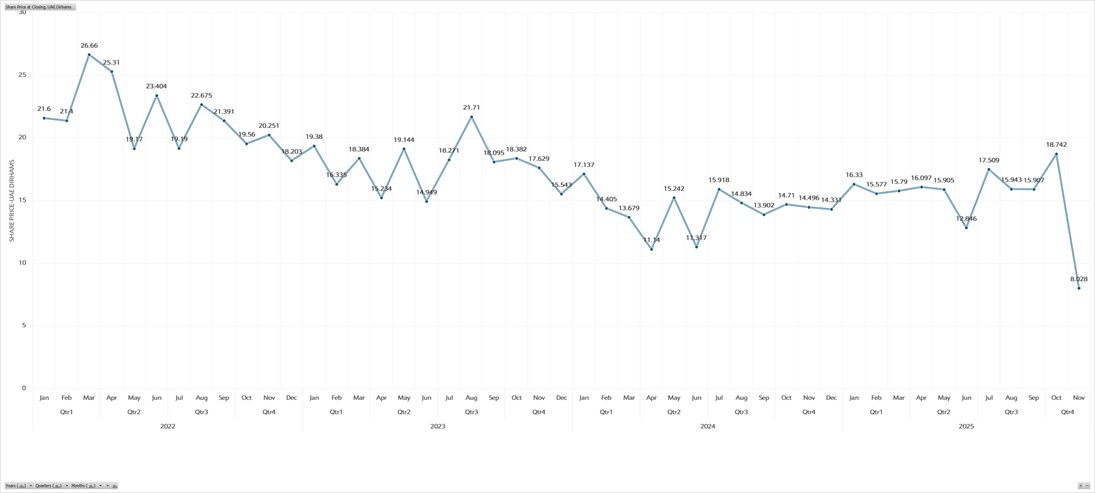
As attacks on the Khor Mor field have intensified - eleven incidents recorded between 2022 and 2025, two of which caused major human and material losses - their impact becomes clear when examining Dana Gas’s performance on the Abu Dhabi Securities Exchange.
In May 2022, the company’s share price stood at 1.80 Arab Emirati Dirhams (aed), roughly $0.49. Following a drone attack on July 25, 2022, the share price fell sharply to 1.00 aed (around $0.27). As the attacks continued, culminating in the April 26, 2024, incident that killed four workers, the share price dropped further to 0.662 aed (around $0.18).
On the market opening day of November 27, 2024, Dana Gas shares declined by another 2.26 percent, trading at 0.772 AED (about $0.21), as shown in the graph below.
A notable contrast occurred on November 15, when the company announced that the KM250 expansion project had been completed eight months ahead of schedule and that production levels were expected to rise by 50 percent in the first quarter of 2026. Following the announcement, the share price increased from 0.761 to 0.842 aed (approximately $0.207 to $0.229).
Dana Gas had planned to begin exporting gas from the KM250 expansion project to power generation stations in the Kurdistan Region by the middle of next month. However, following the latest attack, the company is now focused on restoring initial production, repairing damaged infrastructure, and rebuilding the affected facilities.
The incident has also noticeably impacted the company’s share price on the Abu Dhabi Securities Exchange. Such disruptions create significant uncertainty for investors and market participants, as repeated attacks introduce a level of unpredictability that directly affects day-to-day share price movements.
In addition to elevating investment risks and discouraging companies from entering the market, Iraq’s Foreign Direct Investment (FDI) Index has remained below zero - and in negative territory - for more than three years. Another challenge is the rising cost of production, driven by heightened risks to employee safety and the need for stronger security measures. These costs are expected to continue increasing, given the high likelihood of repeated incidents at the Khor Mor field.
Strategic reservoirs and air defense systems vs. armed non-state actors
Following the attack, several potential solutions have been discussed, including creating a strategic reservoir system and installing anti-missile and anti-drone defenses for the field.
However, the situation regarding a strategic reservoir is not as straightforward as it might seem. The Khor Mor gas field has already received more than $4 billion in investment and includes the largest strategic reservoir facility in the region. Proposals to produce gas in one field and reinject it underground in another are not considered practical or logical. The reason is simple: the volume of gas produced each day is enormous - equivalent in surface area to about 24 soccer fields. No land-based facility could possibly accommodate that amount of gas on a daily basis. This challenge will only grow, as production is expected to reach 750 million cubic feet per day by the middle of next month.
In reality, what are often referred to as “state-funded militias” operating outside the legal framework - and their growing access to drones and explosive materials - must be addressed. The Kurdistan Region’s oil and gas sites cannot be allowed to transform into militarized frontlines, where engineers, technicians and civilians carry out their daily work under the threat of armed assaults. Ensuring a secure, depoliticized environment for the energy sector is essential to the stability and economic future of the region.
Conclusion
Last year, during Iraq’s fifth and sixth rounds of oil and gas licensing, Crescent Petroleum and HKN Energy secured contracts to develop oil and gas fields in Kurdish-populated areas located outside the Kurdistan Region’s administrative boundaries. For instance, Dana Gas and its partners were awarded a profit-sharing contract for the Diyala gas field, while the US-based HKN Energy obtained a similar contract for the Hamrin oil and gas field.
These developments were widely interpreted as creating shared Iraqi economic interests with these companies, potentially easing tensions between Erbil and Baghdad and reducing the likelihood that their operations would be targeted. Yet the attacks have continued.
This raises a pressing question: Are these companies being targeted wherever they invest in Iraq, or are the attacks concentrated specifically within the Kurdistan Region?
Mahmood Baban is a research fellow at the Rudaw Research Center.
The views expressed in this article are those of the authors and do not necessarily reflect the position of Rudaw.


Comments
Rudaw moderates all comments submitted on our website. We welcome comments which are relevant to the article and encourage further discussion about the issues that matter to you. We also welcome constructive criticism about Rudaw.
To be approved for publication, however, your comments must meet our community guidelines.
We will not tolerate the following: profanity, threats, personal attacks, vulgarity, abuse (such as sexism, racism, homophobia or xenophobia), or commercial or personal promotion.
Comments that do not meet our guidelines will be rejected. Comments are not edited – they are either approved or rejected.
Post a comment