



Error occured during this request! Please try again later.
Opinions

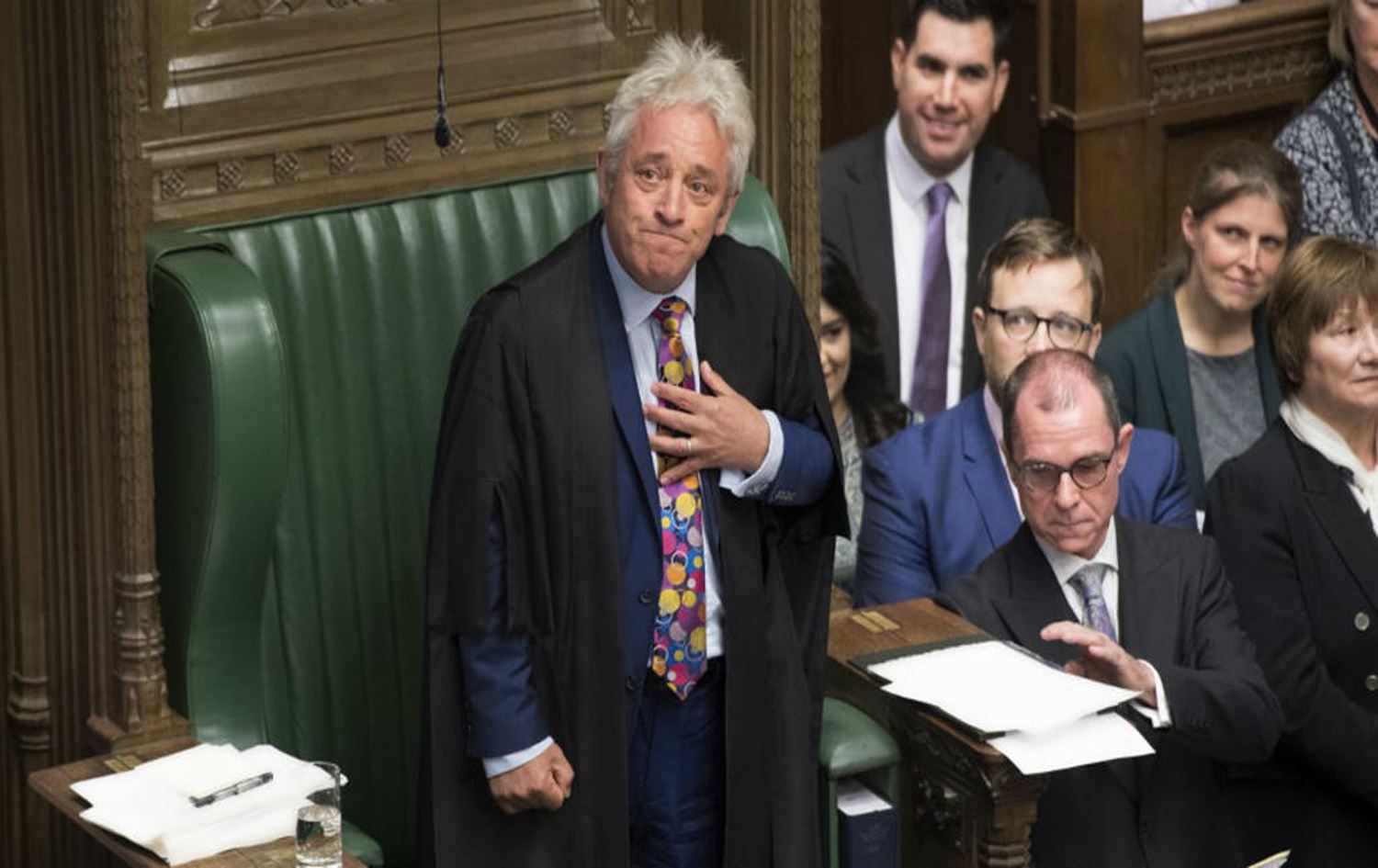
Parliament speaker John Bercow at the House of Commons in London, England. Photo: AFP / Jessica Taylor / UK Parliament
The blockbuster film-to-be about Brexit keeps accruing dramatic twists, large characters, and intrigues against scenes of angry demonstrations near and inside parliament that could tempt director Quentin Tarantino to turn his hand to Once Upon a Time in Westminsterwood.
Events have moved with speed and anger. Westminster defied new Prime Minister Boris Johnson in critical votes, wrestling control from him and his Machiavellian adviser Dominic Cummings.
The “Rebel Alliance” included 21 respected Conservatives such as Winston Churchill’s grandson Nicholas Soames, former Chancellor Phillip Hammond, and Alistair Burt, with over 200 years of collective service. Conservative MP Phillip Lee ostentatiously defected to the Liberal Democrats as Johnson was mid-speech, and Johnson lost his majority.
A sad scene in any film would be Johnson’s own brother quitting as a minister and MP. Leading lady Amber Rudd resigned from both the cabinet and the party because she doubted Johnson was serious about doing a deal with the EU. She famously said in the 2016 referendum campaign that Johnson may be the life and soul of the party, but that you wouldn’t want him to drive you home afterwards. Ouch.
Cummings is a key but self-sabotaging player. An anonymous minister said that “Cummings is talented, but he’s just like the Bond villain who needs everybody to know how good he is. So he ties them up, boasts about his evil plan, then Bond escapes and wrecks it.”
And that’s where the screenplay is currently paused. Johnson failed to win the necessary support of opposition MPs for an early election and seems boxed in. If he fails to win a new deal with the EU at its summit meeting in mid-October, he is legally bound to reject no-deal and seek a delay until the end of January. Further delay also requires the unanimous assent of the EU.
Parliament has been suspended for five weeks - although that may be reversed judicially. Its globally famous Speaker John Bercow would figure in any film, with an interesting backstory as a hard-right activist who morphed into a liberal, who pre-announced his own resignation, and damned the suspension.
The world is watching. A Kurdistani friend stays up to watch the BBC’s flagship Newsnight programme, aired from 1.30am Erbil time. Some see the UK as trashing its reputation for moderation, while some Americans hail “Britain’s Trump” and the UK’s national liberation – perhaps Brexiteers should throw tea into the English Channel?
With Johnson meeting the Irish Prime Minister in Dublin where Johnson conceded that no-deal would be a failure of statecraft, there now seems to be more energy in seeking a deal. Dublin is a key capital because it is the EU member most affected by the backstop, a theoretical insurance policy that keeps Northern Ireland in the single market and the UK in an EU customs territory if there is no long-term trading deal, but it also denies the unilateral right of the UK to leave.
Originally, it applied only to Northern Ireland, geographically separate from Great Britain and home to a land border with the Republic of Ireland. Its application became pan-UK as a concession to Northern Ireland’s Democratic Unionist Party, whose ten votes were then crucial to the Conservatives.
A growing possibility is that the backstop will only apply to Northern Ireland, given its major inter-Irish trade, the importance of the open border to its peoples feeling safe within current political jurisdictions, and the need to maintain the peace.
I once worked with unionists and others to secure and implement the Good Friday Agreement of 1998, which ended the conflict and the principle that they should not be coerced into a united Ireland. Unionists initially baulked at cross-border bodies, but accepted economic benefits provided they carried no political consequences. One unionist rejected such bodies politically, but welcomed them as a businessman. The former unionist leader Ian Paisley said the cows were Irish but his voters were British. Northern Ireland may one day endorse a united Ireland, although it is not clear the south would accept change akin to absorbing East Germany into the new Germany.
The paradox is that a hard border – one all parties wish to avoid and for which there are feasible alternatives – could accelerate unification, but recognizing different geo-economic realities of Northern Ireland might avert that and enable it more easily remain part of the UK’s political union – let’s call this The Ulster Divergence. Some variant of an EU/UK border in the Irish Sea could unlock a deal.
If not, we come to an election. A Johnson victory could be a dramatic pivot, but it is perilous. He will have to overcome the threat from the hardline Brexit Party, who, with accommodation, could highlight failure to achieve Brexit on time and mobilise Brexit voters. One option is that the Conservatives give the Brexit party a free run in Labour seats where it came second at the last election.
Johnson could run as an underdog, with a single-minded campaign to stop voters being cheated and major on “the people’s priorities” – increased spending on policing, health and education, helping to erase memories of a decade of austerity.
Irish Poet WB Yeats penned in different circumstances, the famous lines that “The best lack all conviction, while the worst are full of passionate intensity.” Those who want Brexit are slightly more numerous but are more determined than opposition voters who want to Remain, avoid no-deal, or do a new deal. Some Remainers accept the need to implement Brexit in case the UK enters a bitter and tribal dispute about this for a generation.
Labour is the biggest alternative party. Its leader Jeremy Corbyn wants to unite Leavers and Remainers, while others prefer a clear Remain position in line with the wishes of party members and voters. It was superbly ironic to see Peter Mandelson, once Tony Blair’s cunning strategist, warn Corbyn of all people that those in the middle of the road get run over.
Labour’s line is that a Labour government would negotiate a new Brexit deal and put that to the people in a referendum alongside the option to remain. This begs the question of the incentives for them and the EU to reach a good deal if Remain is possible. Labour is unable to simply summarise its policy, leaving it vulnerable to mockery.
Corbyn did well in the 2017 election as the underdog who surprised many, with a better than expected campaign that also benefitted from the implosion of May’s pitch. Some voters would see Corbyn as a bigger danger than no-deal, although a semi-Maoist regime in Downing Street may make Corbyn less toxic by comparison. Kenneth Clarke, a Tory grandee expelled after 49 years in parliament, wonders whether Corbyn would be worse than no-deal. How much Corbyn is seen as a danger on economics, security, and antisemitism in this case is unclear.
We would face a four-way battle between Conservatives, Labour, Liberal Democrats, and the Brexit Party, plus the SNP in Scotland where the resignation of the charismatic Conservative leader Ruth Davidson could endanger the crucial 12 seats the party gained at the last election and where Labour is a minor party. Narrow margins mean that small transfers in individual constituencies could be decisive and make prediction impossible.
Brexit is box office gold for the inhabitants of the bubble of political activism and a media hungry for conflict and colour. But many people are fed up and want to end it in one way or another. There could be relief for any deal that Johnson comes up with and a growing number of MPs think that May’s deal, with tweaks and an amended backstop in time and space, could pass the Commons. There would be no new referendum, and an election could wait for a few months.
A damp squib for a film perhaps, but better for the long-term governance of the UK whose institutions and unwritten constitution are at breaking point thanks to the gambles and gambits of its main actors. The denouement of Brexit drama is yet to be known.
Gary Kent is the Secretary of the All Party Parliamentary Group (APPG) and a Fellow of Soran University. He writes this column for Rudaw in a personal capacity. The address for the all-party group is appgkurdistan@gmail.com.
The views expressed in this article are those of the author and do not necessarily reflect the position of Rudaw.


Comments
Rudaw moderates all comments submitted on our website. We welcome comments which are relevant to the article and encourage further discussion about the issues that matter to you. We also welcome constructive criticism about Rudaw.
To be approved for publication, however, your comments must meet our community guidelines.
We will not tolerate the following: profanity, threats, personal attacks, vulgarity, abuse (such as sexism, racism, homophobia or xenophobia), or commercial or personal promotion.
Comments that do not meet our guidelines will be rejected. Comments are not edited – they are either approved or rejected.
Post a comment