


Opinions

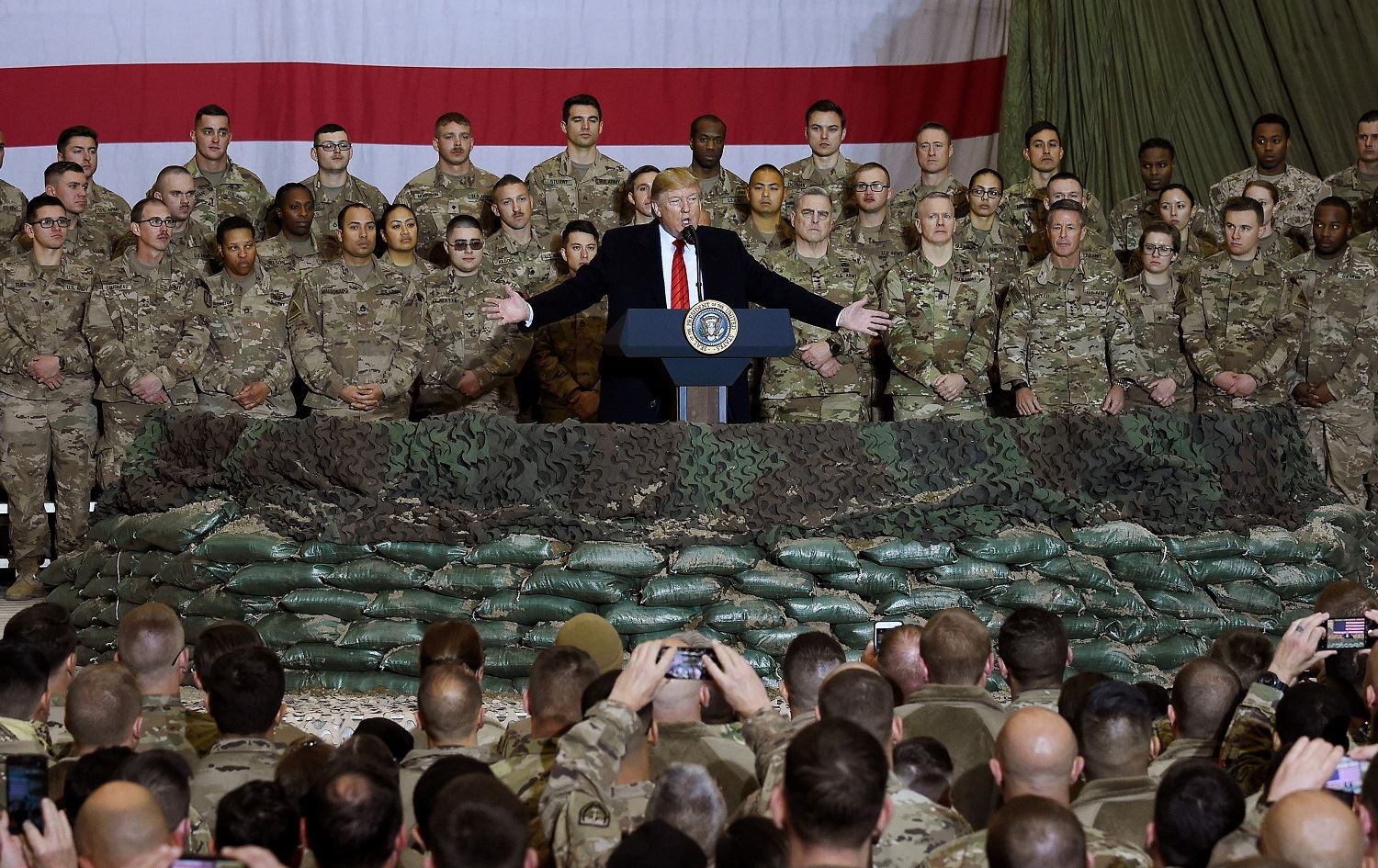
US President Donald Trump speaks to troops during a surprise Thanksgiving Day visit to Bagram Air Field, Afghanistan, November 28, 2019. File photo: Olivier Douliery / AFP
After 2001, the US liberated village after village from the Taliban’s grasp, only to find them re-taken each time they left. American units conducted a changing-of-the-guard every nine months in their areas of operation. New leaders, eager to make names for themselves, dwelled on fresh tactics and ambitious counter-insurgency objectives. Afghan commanders cooperated with some while finding themselves unable to compromise with others. For the Afghan people, this came with frustration and confusion.
Villages were promised new things, but those who made the promises left before those things were delivered. Those who replaced them often failed to respect old arrangements.
If the US wanted a better understanding of its mission in the hope of creating a stable Afghanistan, they should have done a better job supporting the neglected Pashtun groups. Instead, they chose to sideline them.
Pashtuns are Afghanistan’s dominant ethnic group. Mullah Omar, the Taliban’s founder, was an ethnic Pashtun. His followers were overwhelmingly pulled from rural, conservative Pashtun regions. Pashtuns, free from the Taliban’s rule, continue to abide by their edicts.
The post-9/11 Afghan government that the United States helped establish was ineffective in rallying Pashtun support. Its leader, Hamid Karzai, failed to act as a Pashtun torchbearer. Karzai’s corruption and inept governance was known to US officials. He was unwilling to reform and they were in no position to force it.
Click here to watch Rudaw’s feature length documentary – Afghanistan: The Missing Peace
The United States, even after Obama’s 2009 surge, never invested the resources required for stable nation-building. The 2003 Iraq invasion diverted attention and manpower east; allowing the Taliban to monopolize a crucial window for re-mobilization. The US’s unwillingness to confront Pakistan over its support for the Taliban gave fighters endless passage, support, and sanctuary. Meanwhile, rural Pashtun regions had their security and economic concerns ignored.
There are interesting takeaways when comparing US strategies in Afghanistan and Syria. Aside from elites and minority groups, the US did not have local partners in Afghanistan. The Pashtun masses were not as quick to disavow the Taliban as their Uzbek and Tajik counterparts. The US found similar problems in their efforts against the Islamic State group (ISIS). They utilized Turkish-backed Syrian-Arab fighters in an expensive, failed counter-insurgency effort. Some fled, while others joined jihadist groups.
The US found its only successful local partners in the Kurdish forces of Rojava. Today, the Kurdish mission against ISIS is one of the few positive outcomes in a failed repertoire of US counter-insurgency. The Kurds did not possess the connections with ISIS that exist between many fighters in the Free Syrian Army (FSA) or the Pashtuns with the Taliban. Instead, they were the largest contributor to the defeat of ISIS. The US backed the winning horse in Syria while ignoring it in Afghanistan.
Afghans today are more likely to blame the US for their security concerns than the Taliban. That sentiment can now be shared by Rojava’s Kurds who have paid a heavy price for the US withdrawal in October 2019. There is no outcome in Afghanistan that does not include the Taliban’s seat at the table. They will have a say in the future of their former emirate. US foreign policy officials would be wise to reflect on the failures of Afghanistan.
For the Pashtuns, the Taliban is not just an Islamic group, but a mythomoteur for Pashtun identity. The duality behind the Taliban’s twin pillars of Islam and ethnic entrepreneurship made the US mission of nation-building in Afghanistan a failure from the start. Now, its mission against ISIS, its only counter-insurgency success to date, is threatened by its own negligence.
The US failed in Afghanistan, and then they failed the Kurds.
Timothy Griffin holds a graduate degree in political science from Missouri State University. He is a US army veteran with eight years of experience in counterterrorism and military intelligence.
The views expressed in this article are those of the author and do not necessarily reflect the position of Rudaw.


Comments
Rudaw moderates all comments submitted on our website. We welcome comments which are relevant to the article and encourage further discussion about the issues that matter to you. We also welcome constructive criticism about Rudaw.
To be approved for publication, however, your comments must meet our community guidelines.
We will not tolerate the following: profanity, threats, personal attacks, vulgarity, abuse (such as sexism, racism, homophobia or xenophobia), or commercial or personal promotion.
Comments that do not meet our guidelines will be rejected. Comments are not edited – they are either approved or rejected.
Post a comment