


Opinions

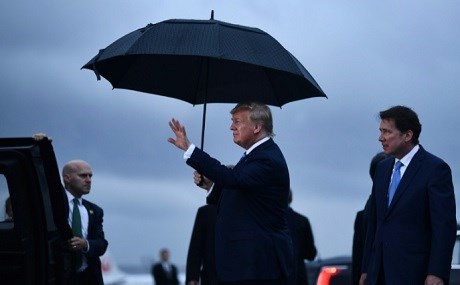
US President Donald Trump arrives in Osaka, Japan for the G20 summit, June 27, 2019. Photo: Brendan Smialowski / AFP
US President Donald Trump issued new economic sanctions on Monday, this time targeting Iran’s supreme leader Ayatollah Ali Khamenei and eight senior commanders in the Iranian military and the Islamic Revolutionary Guard Corps (IRGC).
Why did Trump approve these new sanctions while also threatening possible military action? And why did Trump say he does not need congressional approval to strike Iran?
These questions can be answered in the framework of “smart power” theory.
Smart power is a theory that believes in the simultaneous application of hard and soft power against an enemy. It should be noted that, in the framework of “smart power”, the use of soft power – economic warfare – is Trump’s priority for dealing with Iran.
In fact, the policy of pressuring Iran has had two effects. On the domestic side, the economy faces a crisis. In the external dimension, Iran’s foreign policy has become more aggressive.
It should be noted that there is a direct link between these internal pressures and Iran’s threatening behaviors in the region. In other words, the crisis in the domestic economy and the threatening behaviors of Iran in the region are both consequences of US geo-economic and economic warfare against Iran.
Geo-economic warfare as a foreign policy strategy refers to the application of economic means of power by states in order to compete with rivals and enemies. In addition, Iran’s threat to close off the Strait of Hormuz is the consequence of US geo-economic and economic warfare in order to weaken the domestic economy of Iran.
In this regard, we need to point out that US sanctions have increased and expanded popular protests in recent months as many of Iran’s industrial and business enterprises have closed down or are on the brink of bankruptcy. Many workers have not received a salary for several years.
Concerns about rising inflation, high unemployment, and corruption are also factors. The fall in the value of the Rial has had a profoundly negative impact on the economy and the livelihoods of the Iranian people and has lowered their purchasing power.
Findings show that people’s living conditions have worsened since the imposition of sanctions, with their purchasing power and income declining. People’s access to certain goods has fallen, as has the quality of healthcare available. The rising cost of meat protein, for example, has led millions of Iranian citizens to drop this from their diet.
Sanctions have even affected the people’s mental well-being. People are spending less quality time with family as they try to earn a living. The sense of satisfaction with their lives has diminished and they have a great deal of concern about the future, their jobs, and their financial situation. Generally, the feeling of deprivation, marginalization, disappointment, and the lack of a vision to improve the current situation are the expected effects of this economic warfare.
Therefore, economic sanctions impact the economy, industry, and everyday life, especially for workers and the societally marginalized. Their concern grows as the possibility of a military strike by the US and its allies against Iran looms.
One of the main results of economic warfare is its impact on civil society and the middle class, so that Iranian society will face increasing crisis, violence, and disparity between social classes. Although the continuation of economic sanctions weakens the government, it also deals a hard blow to the trends of democracy and reform.
As a consequence of sanctions, oil production and GDP growth are collapsing, Iran’s currency is weakening, and the rate of inflation is rising.
Although the war is primarily economic and sanctions are designed to weaken and change Iran’s behavior, the US is simultaneously using military threats in parallel for psychological effect.
It can be concluded that the effects of economic sanctions – increasing public mistrust of the government, social disparities, moral corruption, embezzlement by authority figures, divorce among young couples, rising property and food prices, suicides, unemployment, a brain drain as scientific elites flee the country, and mismanagement during natural disasters – have seeped right the way through Iranian society.
Loghman Ghanabri holds a Ph.D. in Political Science from Razi University in Kermanshah, Iranian Kurdistan. He has worked as a journalist for Voice of Kurdistan and writes on geo-economics.
The views expressed in this article are those of the author and do not necessarily reflect the position of Rudaw.
Why did Trump approve these new sanctions while also threatening possible military action? And why did Trump say he does not need congressional approval to strike Iran?
These questions can be answered in the framework of “smart power” theory.
Smart power is a theory that believes in the simultaneous application of hard and soft power against an enemy. It should be noted that, in the framework of “smart power”, the use of soft power – economic warfare – is Trump’s priority for dealing with Iran.
In fact, the policy of pressuring Iran has had two effects. On the domestic side, the economy faces a crisis. In the external dimension, Iran’s foreign policy has become more aggressive.
It should be noted that there is a direct link between these internal pressures and Iran’s threatening behaviors in the region. In other words, the crisis in the domestic economy and the threatening behaviors of Iran in the region are both consequences of US geo-economic and economic warfare against Iran.
Geo-economic warfare as a foreign policy strategy refers to the application of economic means of power by states in order to compete with rivals and enemies. In addition, Iran’s threat to close off the Strait of Hormuz is the consequence of US geo-economic and economic warfare in order to weaken the domestic economy of Iran.
In this regard, we need to point out that US sanctions have increased and expanded popular protests in recent months as many of Iran’s industrial and business enterprises have closed down or are on the brink of bankruptcy. Many workers have not received a salary for several years.
Concerns about rising inflation, high unemployment, and corruption are also factors. The fall in the value of the Rial has had a profoundly negative impact on the economy and the livelihoods of the Iranian people and has lowered their purchasing power.
Findings show that people’s living conditions have worsened since the imposition of sanctions, with their purchasing power and income declining. People’s access to certain goods has fallen, as has the quality of healthcare available. The rising cost of meat protein, for example, has led millions of Iranian citizens to drop this from their diet.
Sanctions have even affected the people’s mental well-being. People are spending less quality time with family as they try to earn a living. The sense of satisfaction with their lives has diminished and they have a great deal of concern about the future, their jobs, and their financial situation. Generally, the feeling of deprivation, marginalization, disappointment, and the lack of a vision to improve the current situation are the expected effects of this economic warfare.
Therefore, economic sanctions impact the economy, industry, and everyday life, especially for workers and the societally marginalized. Their concern grows as the possibility of a military strike by the US and its allies against Iran looms.
One of the main results of economic warfare is its impact on civil society and the middle class, so that Iranian society will face increasing crisis, violence, and disparity between social classes. Although the continuation of economic sanctions weakens the government, it also deals a hard blow to the trends of democracy and reform.
As a consequence of sanctions, oil production and GDP growth are collapsing, Iran’s currency is weakening, and the rate of inflation is rising.
Although the war is primarily economic and sanctions are designed to weaken and change Iran’s behavior, the US is simultaneously using military threats in parallel for psychological effect.
It can be concluded that the effects of economic sanctions – increasing public mistrust of the government, social disparities, moral corruption, embezzlement by authority figures, divorce among young couples, rising property and food prices, suicides, unemployment, a brain drain as scientific elites flee the country, and mismanagement during natural disasters – have seeped right the way through Iranian society.
Loghman Ghanabri holds a Ph.D. in Political Science from Razi University in Kermanshah, Iranian Kurdistan. He has worked as a journalist for Voice of Kurdistan and writes on geo-economics.
The views expressed in this article are those of the author and do not necessarily reflect the position of Rudaw.


Comments
Rudaw moderates all comments submitted on our website. We welcome comments which are relevant to the article and encourage further discussion about the issues that matter to you. We also welcome constructive criticism about Rudaw.
To be approved for publication, however, your comments must meet our community guidelines.
We will not tolerate the following: profanity, threats, personal attacks, vulgarity, abuse (such as sexism, racism, homophobia or xenophobia), or commercial or personal promotion.
Comments that do not meet our guidelines will be rejected. Comments are not edited – they are either approved or rejected.
Post a comment