


Opinions

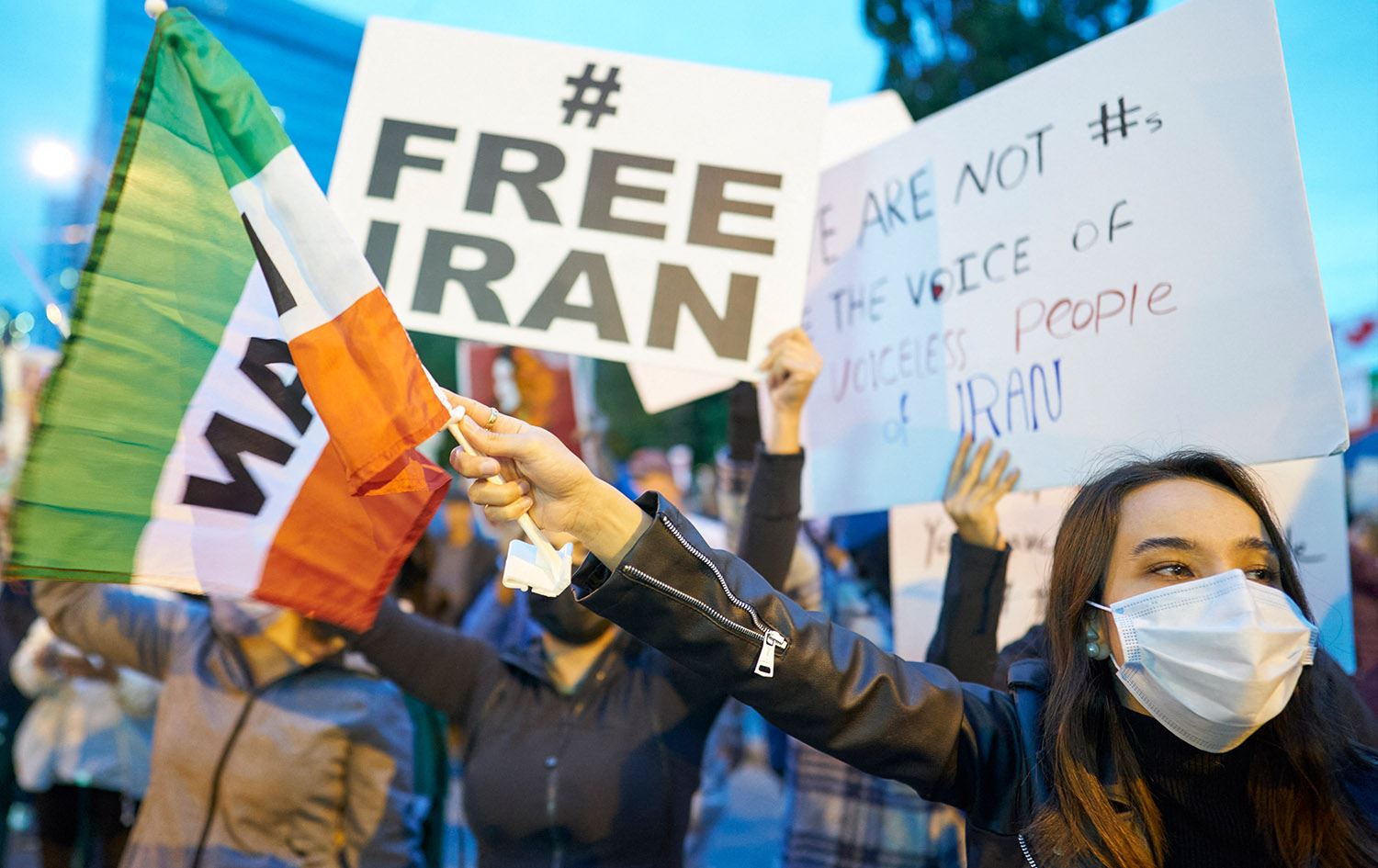
People demonstrate against the Iranian regime during a protest at Mel Lastman Square in Toronto, Ontario, September 24, 2022. Photo: Geoff Robins/AFP
The ongoing demonstrations in Iran kicked off following the death of Mahsa (Zhina) Amini, but they are not just about mandatory hijab. It is misleading to depict these protests as though they are framed around one singular topic, when they are a manifestation of a much wider and bigger problem.
For the past 11 days of demonstrations in Iran, at least 76 people have died according to the Iran Human Rights (IHR) group and hundreds have been arrested. But whether these demonstrations will lead to any actionable results will remain to be seen because the scale of the protests is unclear, one single video can be broadcast online and within minutes it could be seen by millions of people, and while this amplification keeps the spirits of protesters going, it does not give us a clear idea of how many people are protesting.
Those protesting on the streets are doing so for multiple reasons, all of which was sparked by the death of the young Kurdish woman Amini, but it is too early to tell whether they will create the momentum for change because the Iranian authorities have become very accustomed to quelling dissident in the country.
Women in Iran face discrimination when it comes to inheritance, marriage, divorce and custody of children. Married women require permission from their husbands for basic life measures, including traveling outside the country and renewing their passports.
Iran does not have a law on domestic abuse despite the high number of women facing domestic violence, and the rampant cases of so-called honor-based killings. Earlier in the year, 17-year-old Mona Heydari, and mother to a three-year-old was beheaded by her husband as he walked in the streets, smiling and parading her severed head leading to outrage across Iran. According to a BBC Persian report, 39% of murders committed between 2013 and 2017 in Iran were honor-based.
Thousands of human rights activists and civil society advocates languish in Iranian jails, among them are Kurdish and other minority political activists. Iran routinely executives people on charges of moharebeh, which means enmity against God, or Afsad-i fil Arz, meaning sowing corruption of earth and baghi, which is used for those supposedly leading an armed rebellion.
Activists often face lengthy prison sentences, and those who participate in demonstrations face severe penalties. Amirhossein Moradi, Saeed Tamjidi and Mohammad Rajabi were sentenced to death by Iran’s high court for their role in the November 2019 protests. All three of them are under the age of 30, but another court later revised this decision to life imprisonment.
According to the Human Rights Watch, Iranian courts “regularly fall far short of providing fair trials” and often use torture to obtain confessions. Minority groups such as the Kurds face systematic discrimination from restricted language rights to inability in registering some Kurdish names for their children. Names such as Peshawa, Kurdistan, Komar, Qazi, Awara and Zrebar are among those banned. The extent of barriers on language rights extends to schools, where Kurdish language is not taught, and those teaching Kurdish language run the risk of imprisonment. Zahra Mohammadi is a prime example of this, where she is currently serving a lengthy prison sentence for teaching Kurdish language to children.
The Kurdish provinces in Iran have the highest number of unemployment rates, and often lack services, investment, which affects access to basic services. Iran restricts Kurdish language publications and cultural activities. This is why when we look at the anger pouring out of Kurdish provinces in Iran, and in particular across the country - the demonstrations are not just about mandatory hijabs. It is about systematic discrimination against minority groups, the lack of women rights, and the ultra-religious doctrine that has been forced on the public for decades.
Since protests erupted, over a dozen young people have been killed, most under the age of 30. These young protesters are very much connected to world outside of Iran on social media, and they look at other countries that afford its youth opportunity, means, and freedom.
There is a growing rage against the Iranian government, which has restricted the rights of its own constituents, and this rage is led by technology-savvy young people. Iran restricted access to WhatsApp, Instagram, Twitter and Facebook as protests swept the country. NetBlocks has called this the most severe outage since the internet was shut down during the 2019 fuel protests.
The demonstrations are not just about mandatory hijab and deeming it as such would be a reduction of the grievances many people face, including minorities, and in particular women. But while these protests are important and have captured the headlines around the world, whether they will lead to a shift in morality police remains to be seen.
Ruwayda Mustafah is a British-Kurdish political commentator, and advocate for women’s rights
The views expressed in this article are those of the author and do not necessarily reflect the position of Rudaw


Comments
Rudaw moderates all comments submitted on our website. We welcome comments which are relevant to the article and encourage further discussion about the issues that matter to you. We also welcome constructive criticism about Rudaw.
To be approved for publication, however, your comments must meet our community guidelines.
We will not tolerate the following: profanity, threats, personal attacks, vulgarity, abuse (such as sexism, racism, homophobia or xenophobia), or commercial or personal promotion.
Comments that do not meet our guidelines will be rejected. Comments are not edited – they are either approved or rejected.
Post a comment