


Opinions

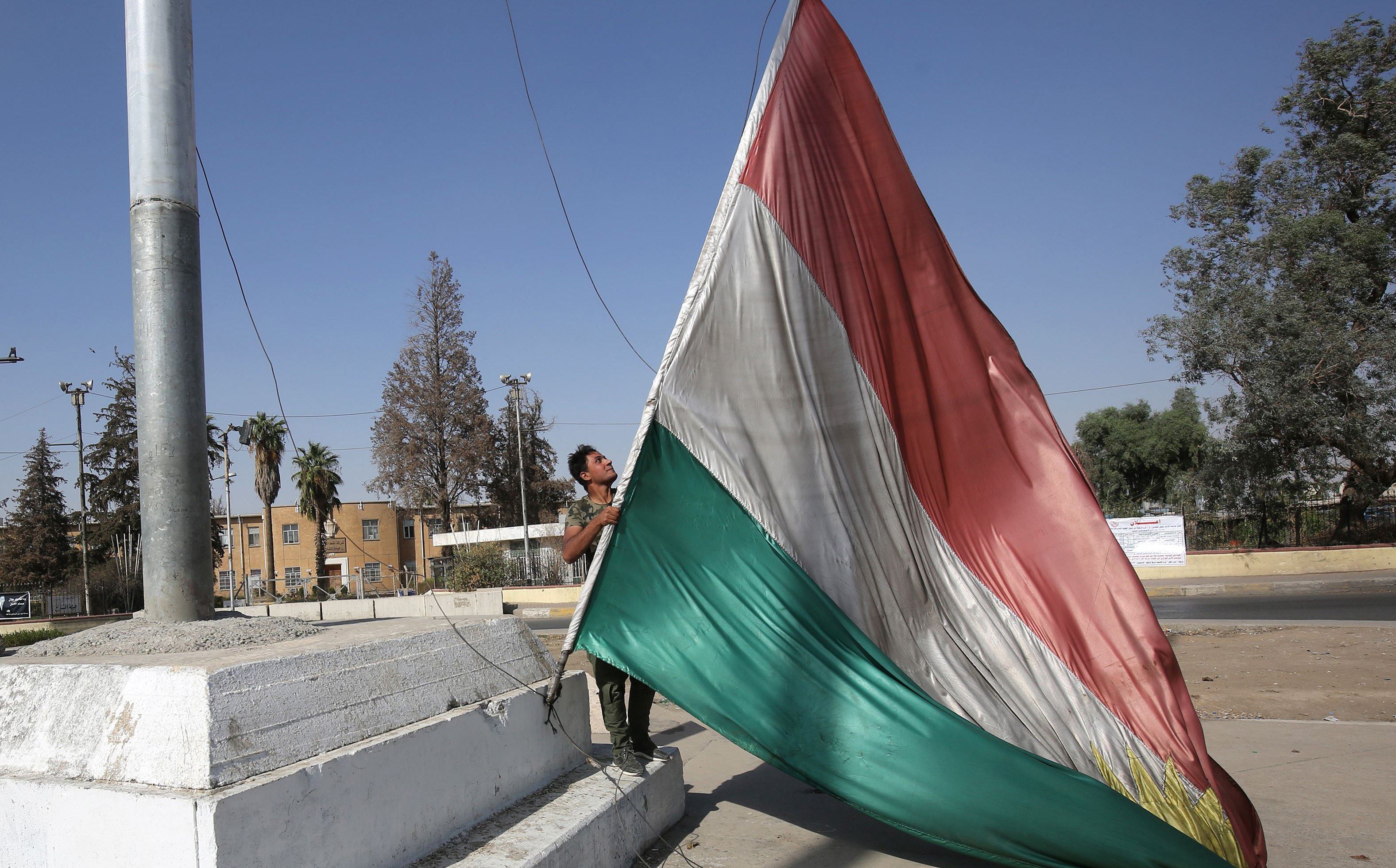
A member of the Iraqi forces takes down a Kurdistan flag in the center of Kirkuk in November 2017. Photo: Ahmad al-Rubaye/AFP
Nationalism, like any ideology, is a tool. Its effectiveness depends on who is using it, why, and with what historical understanding.
In the hands of Erdogan, Putin, Trump, and the populist leaders of European and Arab states, nationalism is a dangerous weapon, wielded to mesmerize and stupefy their own populations against perceived outside enemies. Conservative and nationalistic ideas are a distraction used by rulers so that they can go about their business uninterrupted.
What happens when one asks questions about the Turkish soldiers dying on foreign soil? President Erdogan uses nationalism. What happens when a journalist in the US asks about Trump's war-mongering policies? President Trump uses nationalism. When a state is established, nationalism and pride in one’s history ceases to become a force for good and becomes a tool for tyrants and dictators. For it is tyrants who shout the most about our ancestors when they are pressed about their failed politics.
In Russia, homophobia and sexism are state policy, as advances in women's rights are once again threatened and ethnic minorities are oppressed. Turkey is the world’s largest prison for journalists, and us Kurds know very well about the situation for our siblings up north.
What use, then, do we Kurds have for nationalism?
Mohammed Kamaran has written in Rudaw that Kurds need to “look to the past to carve out a future”. I disagree — doing so not only clouds our judgment, but is ultimately a road to certain failure. Indeed we see a rise in nationalism in, to take Mr. Kamaran’s examples, Turkey and Russia. This era will be defined by the decline of liberalism as the principle ideology of mankind and instead being replaced by nationalism and more fascistic tendencies.
Erdogan's policies in Syria are proof of today's more rampant nationalism, as is Putin’s land-grabbing in Ukraine. Mr. Kamaran then makes the case that us Kurds should follow a similar path and embrace nationalism based on pride and blood and because our history is unknown to many of us our aspirations of a nation-state cannot be achieved. Here, Mr. Kamaran, I do not agree.
Like any self-respecting Kurd, I believe that we should have our independence in the form of a state. But I don’t agree with the idea that nationalism should “carve out our future”. Nationalism should be considered a tool for nation-building — and no more. After an independent Kurdistan is established, what is the need for nationalism then? To fuel our eventual shortcomings? To become more like our enemies, those who prize nationalism over all else? Looking at the past is not for carving out a future, but to remind us of what not to become once more.
The decline of democracy in, to take Mr. Kamarans example, Turkey and Russia, is the result of basing one's national policy in looking to the past for unity, instead of looking to the future. Conservatism and nostalgic nationalism is the cause for much pain, oppression and general backwardness in this world.
Sadly, we Kurds are not very well versed in our own history. Is our history a source of pride? Maybe.
It is important for us to know about our own history, but not to base our future upon it. For a people seeking to become independent history should be a means to remind ourselves what we were, not an end goal.
History is never a straight path; what one historian conceives as a victory might be seen as a defeat by another historian. We see in our history tales of Kurdish heroes and their valiant and glorious defeats against tyrants; yet the same heroes are villains for other nations.
Simko Shikak, a Kurdish chieftain did indeed fight for his people’s rights in eastern Kurdistan against the Persian empire in the early 20th century. He is a figure revered for his bravery — but that history is not without its own unpleasant truths, which we must also learn from. Simko murdered an Assyrian priest — seemingly unprovoked. Kurdish clans in the north participated in the Armenian genocide, where millions of Assyrians, Syriacs, Greeks, Armenians and other Christian populations were slaughtered by the Turks — and us Kurds. By the same token, we should remember that many Armenians owe their lives to other Kurdish clans who helped them flee this atrocity.
This is a part of history that we must acknowledge, accepting both the favorable parts and the parts we would rather leave out and forget.
History ought to teach us lessons, not be used as a tool to fool and manipulate.
Mr. Kamaran shares a story which is well known among many academics, namely the greek historian Herodotus' story of Cyaxares, king of the Medes, the most favourable among our Kurdish ancestors, and his war with the kingdom of Lydia: the story can be summarized as a reason why two ancient kingdoms during the Iron Age, Lydia and Media, went to war with each other.
The Scythians, an ancient nomadic people, murdered a “Kurdish teenager”, as Mr. Kamaran wrote, and then fled to Lydia and Cyaxares for this murder waged a war against the Lydians whom harbored these perceived criminals.
What Mr. Kamaran overlooked was that these Scythians lived under oppressive Median rule and that Cyaxares wanted vengeance for the death of a noble – not any teenager as it would seem you have written.
Did the Medes wage war against the Lydians because of the murder of nobility? Or were they outraged because the Scythians served the Median nobles the young boy as if his meat were that of game?
It was more revenge for an insult than a humanitarian mission. What else do we learn from this story that we can use to carve out a future? Monarchy? War? The fact that the war ended because the warring armies thought that a solar eclipse was a symbol from the Gods? No, we learn nothing but the superstition of that particular age. Besides, did the Medes truly see themselves as Kurds? Not at that point, no.
Kurds are a heterogenous population, a mix between several tribes and cultures that have inhabited what we today call "Kurdistan." That name is derived from one of the most ancient tribes that inhabited the area, which the Sumerians called Qardu or Karda. To choose only one of our ancestors, the Medes, and then base our ancestral pride on them is to forget all other tribes and peoples who are our ancestors as much or even more so than the Medes. There is only one reason our own nationalists take to the Medes when describing our history; the extent of their empire and their ferociousness in battle. What does this mean for a future Kurdistan? More war and bloodshed because that’s what our ancestors did? To invade another nation because a few lords were humiliated? There are countless of stories from our other ancestors; the Mitanni, the Guti, the Elamites and yes, even the Scythians, those murderers in this story, whom are the ancestors of many Kurds originating from Rojhilat (Eastern Kurdistan).
The history of the Kurds cannot be based upon these stories and used as guides for how we should go about with our nation-building.
Our history, and indeed the history of every nation, is more complex than some would believe. It is also dangerous to use history for contemporary politics. Today we hear Trump shouting about “make America great again”. When was America ever great, and for whom? When the indigenous people were slaughtered? During slavery? During the Jim Crow Laws, which enshrined segregation and racial apartheid? When women did not have the right to vote?
And for whom was the Ottoman Empire great? Only the rich and wealthy, since civil rights were practically non-existent.
Chaining oneself to history is not the way forward for any people who seek to establish a free and democratic society, where freedom of religion, expression and the press is highly valued, and homophobia, transphobia, sexism and racism is kept at bay. A society where all people of Kurdistan, whether they be Kurds or Assyrians, Turks or Turkmens, Persians or Azeris, Chaldeans or Arabs have an equal say in our future, independent country and have a right to retain and develop their culture and tradition.
What is the answer then? How do we establish independence and freedom for all Kurds and all of Kurdistan? That’s the thing — there is no “right” answer and I certainly don’t claim to have it.
The PKK and PYD seek to become independent by unconventional means: through democratic confederalism. The KRG chose a traditional approach, by building a modern nation-state and holding a referendum.
PDKI and PAK seem to be a mix of the two, since they both uphold more socialist values than the KRG. But we cannot claim to know how they would go about building a society, since they are currently only fighting for survival.
But what we certainly can deduce is that nostalgic nationalism and conservatism is failing in those countries which are currently using them.
What good has nostalgic nationalism ever done to the world except ending in dictatorships and genocides?
We may look to our past to learn from it – but never to seek to become it once more; for as the old Median empire once fell, so would our beloved Kurdistan, would we be based on the same principles as our dead ancestors.
Rebar Alnazar is a postgraduate student of history in the University of Gothenburg. He previously worked with UNHCR in Sweden and has been an active politician in both the Social Democrats and currently in the Left Party.
The views expressed in this article are those of the author and do not necessarily reflect the position of Rudaw.


Comments
Rudaw moderates all comments submitted on our website. We welcome comments which are relevant to the article and encourage further discussion about the issues that matter to you. We also welcome constructive criticism about Rudaw.
To be approved for publication, however, your comments must meet our community guidelines.
We will not tolerate the following: profanity, threats, personal attacks, vulgarity, abuse (such as sexism, racism, homophobia or xenophobia), or commercial or personal promotion.
Comments that do not meet our guidelines will be rejected. Comments are not edited – they are either approved or rejected.
Post a comment