


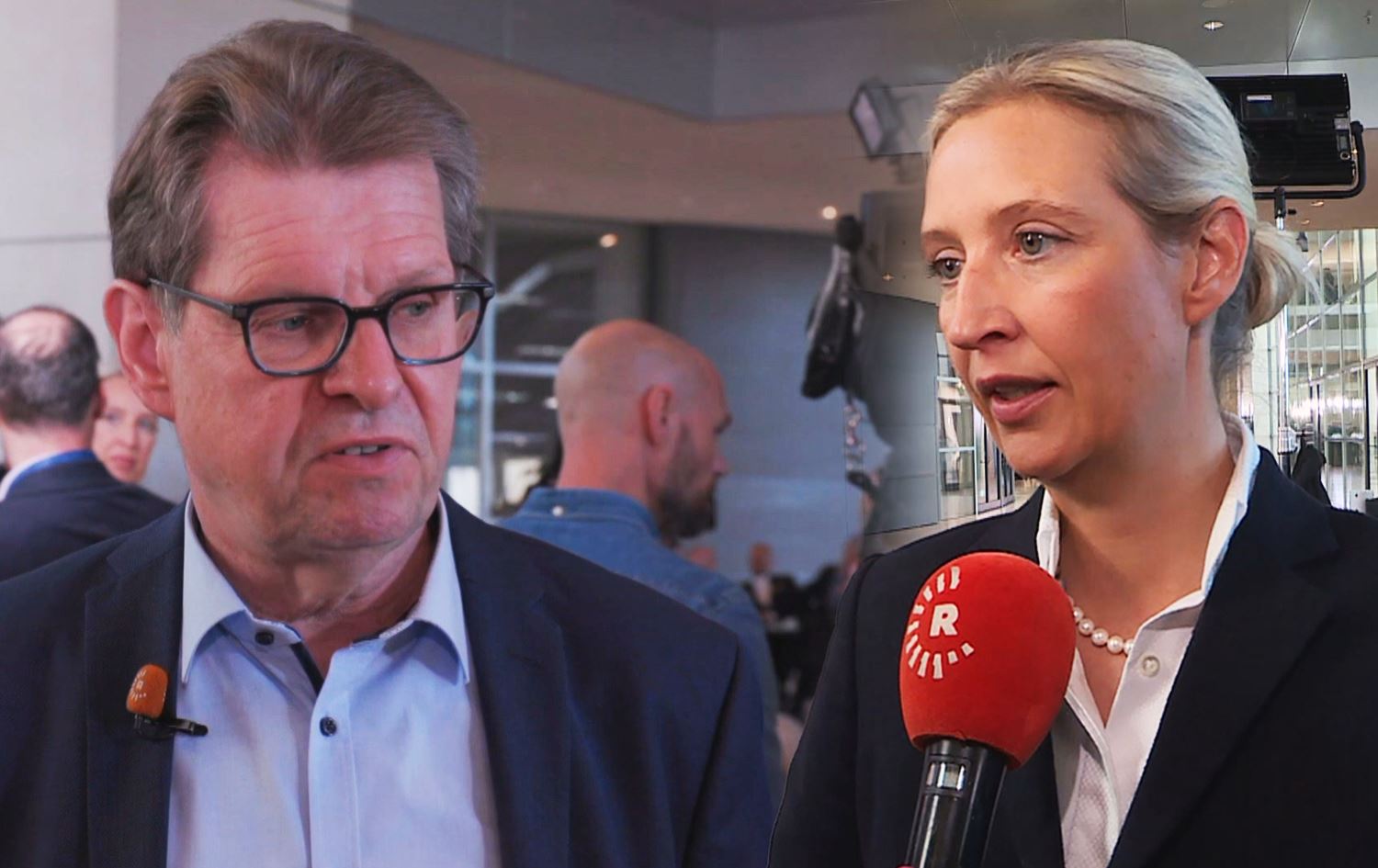
ERBIL, Kurdistan Region - Far-right Alternative for Germany (AfD) lawmaker Alice Weidel on Tuesday called for sweeping economic and immigration reforms, including halving taxes, reviving nuclear energy, and mass deportations of migrants, while the Social Democrat Ralf Stegner emphasized the need for economic stability and strong governance.
“This government doesn't have the capability [to make changes], because the Social Democratic Party determines the agenda,” Weidel told Rudaw.
The AfD lawmaker stressed halving taxes, curbing immigration, reviving nuclear energy, and cutting bureaucracy to prevent economic decline and the departure of companies from the country.
“What this country needs is lower tax rates. In my opinion, taxes should be halved, both corporate and income taxes. You need to reduce spending significantly. We need to reduce illegal immigration, remove illegal immigrants from our country,” Weidel said.
She further emphasized the importance of implementing “appropriate energy policy” as the current situation is harming the economy.
“We are destroying our economy; people will be on the streets in the future, German companies are leaving this country. So, we must lower taxes, lower energy prices, we need to return to nuclear energy, we need to return to providing energy that has a base load capacity, we need to reduce bureaucracy,” she added.
She further criticized the agendas of the current ruling parties in government, the Christian Democratic Union (CDU), its Bavarian sister party the Christian Social Union (CSU), and the center-left Social Democratic Party (SPD) - holding a majority of 328 seats.
“So this socialist-communist network that has been created here under the CDU must go. We need liberal politics. Everyone should be free to decide what to buy. Every company should be free to decide what to produce. Above all, we need to restore internal security in our country. That certainly cannot be ensured in any way due to open borders,” Weidel added.
The AfD is a far-right party that opposes German integration and migration. The party also publicly condones mass deportations.
Stable economy
However, SPD’s Stegner told Rudaw that improving the country's economy must be a priority.
“I think we must, above all, start growth and work from the economic situation; we must ensure that in a world of crises… Europe is always stable,” Stegner said, mentioning the Ukraine-Russia war, tensions in the Middle East and change in US policy.
He further emphasized that Germany is the largest country in the European Union and it needs “a stable government.”
Germany’s federal legislature, the Bundestag, elected Friedrich Merz, CDU leader, as chancellor on Tuesday after failing to garner enough support in the first round.
The CDU/CSU bloc emerged as the largest faction with 28.5 of the votes in Germany’s February national parliamentary elections, followed by the AfD with 20.8 percent, and the SPD with 16.4 percent.
Key campaign issues included immigration, economic stability, and public trust in democratic institutions.
In late January, the Bundestag passed a controversial motion to tighten enforcement against illegal immigration. The proposal—backed by the CDU, CSU, and the AfD - marked an unusual cross-party alignment that drew criticism from civil society groups and some SPD members.


Comments
Rudaw moderates all comments submitted on our website. We welcome comments which are relevant to the article and encourage further discussion about the issues that matter to you. We also welcome constructive criticism about Rudaw.
To be approved for publication, however, your comments must meet our community guidelines.
We will not tolerate the following: profanity, threats, personal attacks, vulgarity, abuse (such as sexism, racism, homophobia or xenophobia), or commercial or personal promotion.
Comments that do not meet our guidelines will be rejected. Comments are not edited – they are either approved or rejected.
Post a comment