


World

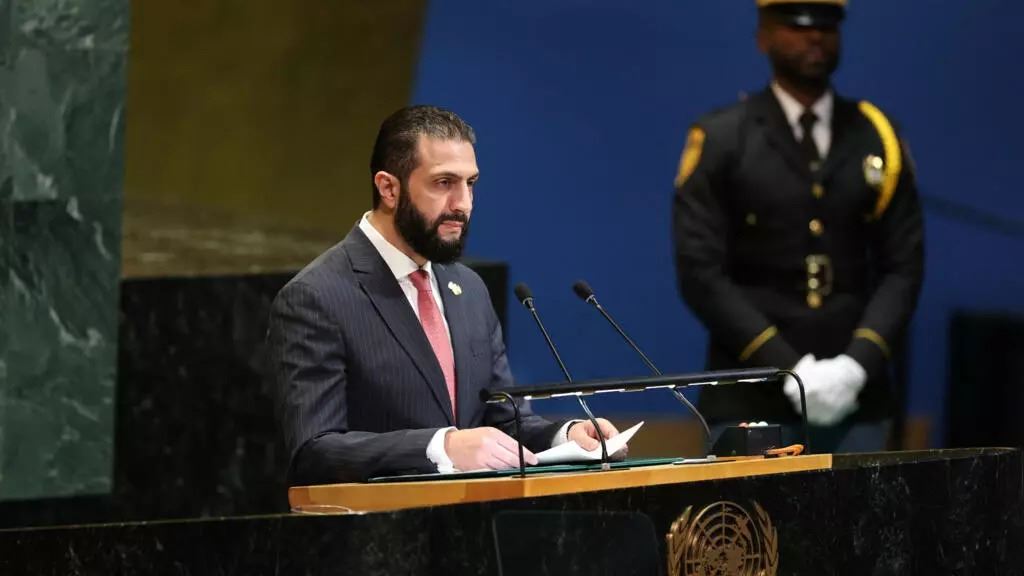
Syrian interim President Ahmed al-Sharaa addresses world leaders at the United Nations General Assembly's 80th meeting in New York on September 24, 2025. Photo: AFP
ERBIL, Kurdistan Region - Ahmed al-Sharaa took the podium at the 80th meeting of the United Nations General Assembly on Wednesday, as the first Syrian president to do so since 1967. He vowed to hold accountable those responsible for Syrian bloodshed, committed to diplomacy and abiding by a 1974 ceasefire deal with Israel and warned against attempts to divide his country.
In the historic address, Sharaa, declared victory over the Ba’ath regime - led by Bashar al-Assad and previously by his father, Hafez al-Assad - which ruled Syria for over six decades.
The ousted regime “used the most brutal torture methods against our people,” Sharaa said, including launching “more than 200 documented chemical attacks … killing around one million [Syrians], destroying about two million homes … and displacing around 14 million people.”
In a swift offensive in early December, a coalition of opposition forces led by the now dissolved Hay’at Tahrir al-Sham (HTS) - then led by Sharaa - toppled the Assad regime.
Appointed interim president in January, Sharaa described the uprising as a victory that “transformed Syria from a country that exports crises” into one that “represents an opportunity for peace and prosperity in the entire region.”
Indirectly addressing the intercommunal violence that rocked Syria in recent months, the Syrian interim president accused “some parties” of trying “to stir up sectarian strife” to “advance projects of division and tear up the country.”
He further pledged to “bring all those whose hands are stained with the blood of the innocent to justice.”
In early March, loyalists of ousted Syrian dictator Assad launched an attack on security forces aligned with the interim authorities in Syria’s Alawite-majority western coastal regions.
The UK-based Syrian Observatory for Human Rights (SOHR) reported that the clashes killed about 1,700 people, most of them Alawite civilians. The war monitor attributed much of the casualties to government or pro-government forces.
In mid-July, clashes broke out between Druze fighters and Bedouin tribes in Syria’s southern Suwayda province The conflict escalated with the involvement of Syrian government forces before a ceasefire was announced by Sharaa on July 19.
SOHR reported in mid-September that the death toll had reached around 2,047 individuals - 979 of them Druze civilians.
Amid the Suwayda violence, Israel conducted airstrikes targeting Syrian military and government sites.
Tel Aviv’s stated reason for the strikes - which included the bombing of a Syrian defense ministry building in Damascus - was to protect the Druze community, citing deep cultural and familial ties between Israeli and Syrian Druze.
However, beyond humanitarian concerns, Israel's intervention seems to have also been driven by long-standing strategic interests in Syria - particularly its aim to maintain a demilitarized buffer zone in southern Syria near its borders.
Sharaa on Wednesday censured the “Israeli threats” against Syria that “have not subsided since [the fall of Assad on] December 8.” He warned that Israel’s policies undermine international support for Syria and risk plunging the region into "a new cycle of conflicts with an unknown end."
Israel captured most of the Golan Heights from Syria during the 1967 Six-Day War. In 1974, a US-brokered Disengagement Agreement created a UN-monitored buffer zone to reduce tensions by delineating separation lines between Syrian and Israeli forces without establishing formal peace.
Sharaa reaffirmed to world leaders at the UNGA that Syria is committed to “dialogue and diplomacy,” emphasizing adherence to the 1974 Disengagement Agreement.


Comments
Rudaw moderates all comments submitted on our website. We welcome comments which are relevant to the article and encourage further discussion about the issues that matter to you. We also welcome constructive criticism about Rudaw.
To be approved for publication, however, your comments must meet our community guidelines.
We will not tolerate the following: profanity, threats, personal attacks, vulgarity, abuse (such as sexism, racism, homophobia or xenophobia), or commercial or personal promotion.
Comments that do not meet our guidelines will be rejected. Comments are not edited – they are either approved or rejected.
Post a comment