


World

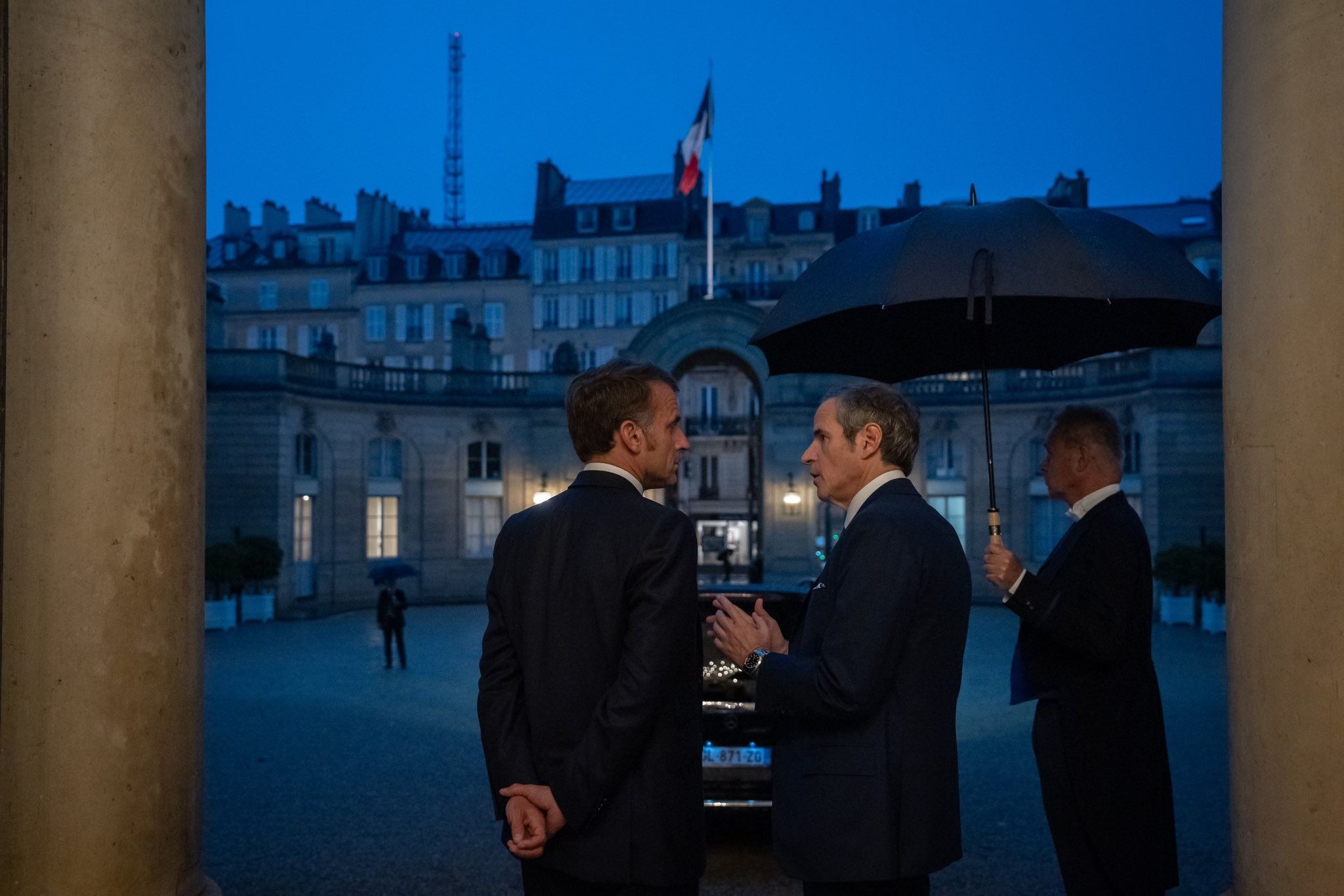
French President Emmanuel Macron recieves IAEA chief Rafael Grossi at the Elysee Palace in Paris on June 25, 2025. Photo: EmmanuelMacron/X
ERBIL, Kurdistan Region - French President Emmanuel Macron has issued an urgent call for Tehran to allow the United Nations’ nuclear watchdog to resume its oversight mission in Iran, following the Iranian parliament’s decision to suspend cooperation with the International Atomic Energy Agency (IAEA).
In a Wednesday statement on X, Macron reaffirmed France’s strong support for the IAEA, describing the agency’s work as “vital for nuclear safety and security.” He emphasized that “it is urgent that the Agency be allowed to resume its mission in Iran.”
The French president’s remarks came a day after Iran’s parliament on Wednesday approved a bill to suspend the country’s cooperation with the agency. Under the new legislation, IAEA inspectors will be barred from entering Iran unless the security of the country's nuclear facilities and its peaceful nuclear activities is guaranteed.
Iran's highest authority, Guardian Council, ratified the decision on Thursday.
A day prior, Iranian Parliament Speaker Mohammad Bagher Ghalibaf was cited by Iranian state media as accusing the IAEA had become “a political instrument” and blamed the agency for the escalation of hostilities between Israel and Iran, which have also drawn the United States.
On June 13, Israel launched airstrikes on Iranian territory, targeting nuclear facilities and killing senior military officials and nuclear scientists. Iran retaliated with a barrage of missiles and drones directed at Israeli targets.
Tensions spiked further when, on Sunday, the United States struck three key Iranian nuclear sites - Fordow, Isfahan, and Natanz. In response, Tehran launched ballistic missiles at al-Udeid Air Base in Qatar, the largest US military installation in the region.
Macron’s comments on Thursday followed a meeting in Paris with IAEA Director-General Rafael Grossi. According to the Elysee Palace, the two discussed “the state of the [Iranian nuclear] program, the radiological risks, and the agency's role and how to ensure full compliance with non-proliferation standards.”
Grossi also posted on X, describing his exchange with Macron as “fruitful and timely,” and emphasized the “real possibility of diplomacy and dialogue on Iran.” He urged all parties to “engage constructively and resolutely.”
In an earlier interview with France 2 television, Grossi stressed that Iran’s cooperation with the IAEA is not voluntary but a legal requirement under the Nuclear Non-Proliferation Treaty (NPT). “It is an obligation,” he said. “As soon as hostilities cease - especially given the sensitivity surrounding this equipment - it’s in everyone’s interest for us to resume our activities as soon as possible.”
Grossi also expressed serious concern about Iran’s stockpile of enriched uranium. Before the conflict with Israel erupted, Iran possessed approximately 400 kilograms of uranium enriched to 60 percent purity, a level considered dangerously close to weapons-grade material.
“This material exists somewhere, but the agency lost track of it after hostilities began,” Grossi warned. “Iran is obliged in any case to show the agency inspectors where the material is located.”
Possession of 60 percent enriched uranium is widely regarded as a major proliferation risk, as it significantly shortens the time required to produce weapons-grade fissile material-effectively placing Iran on the threshold of becoming a nuclear-armed state.
For its part, Tehran has consistently maintained that its nuclear program is for peaceful purposes and that the development of nuclear weapons contradicts the principles of the Islamic Republic.
In mid-May, Ali Shamkhani, a senior advisor to Iran’s Supreme Leader, expressed Tehran’s willingness to give up weapon-grade uranium in exchange for sanctions relief. However, the latest conflict appears to have hardened attitudes in Tehran, with increasing calls from Iranian officials and commentators suggesting that acquiring nuclear weapons may be necessary to restore deterrence against foreign attacks.


Comments
Rudaw moderates all comments submitted on our website. We welcome comments which are relevant to the article and encourage further discussion about the issues that matter to you. We also welcome constructive criticism about Rudaw.
To be approved for publication, however, your comments must meet our community guidelines.
We will not tolerate the following: profanity, threats, personal attacks, vulgarity, abuse (such as sexism, racism, homophobia or xenophobia), or commercial or personal promotion.
Comments that do not meet our guidelines will be rejected. Comments are not edited – they are either approved or rejected.
Post a comment