


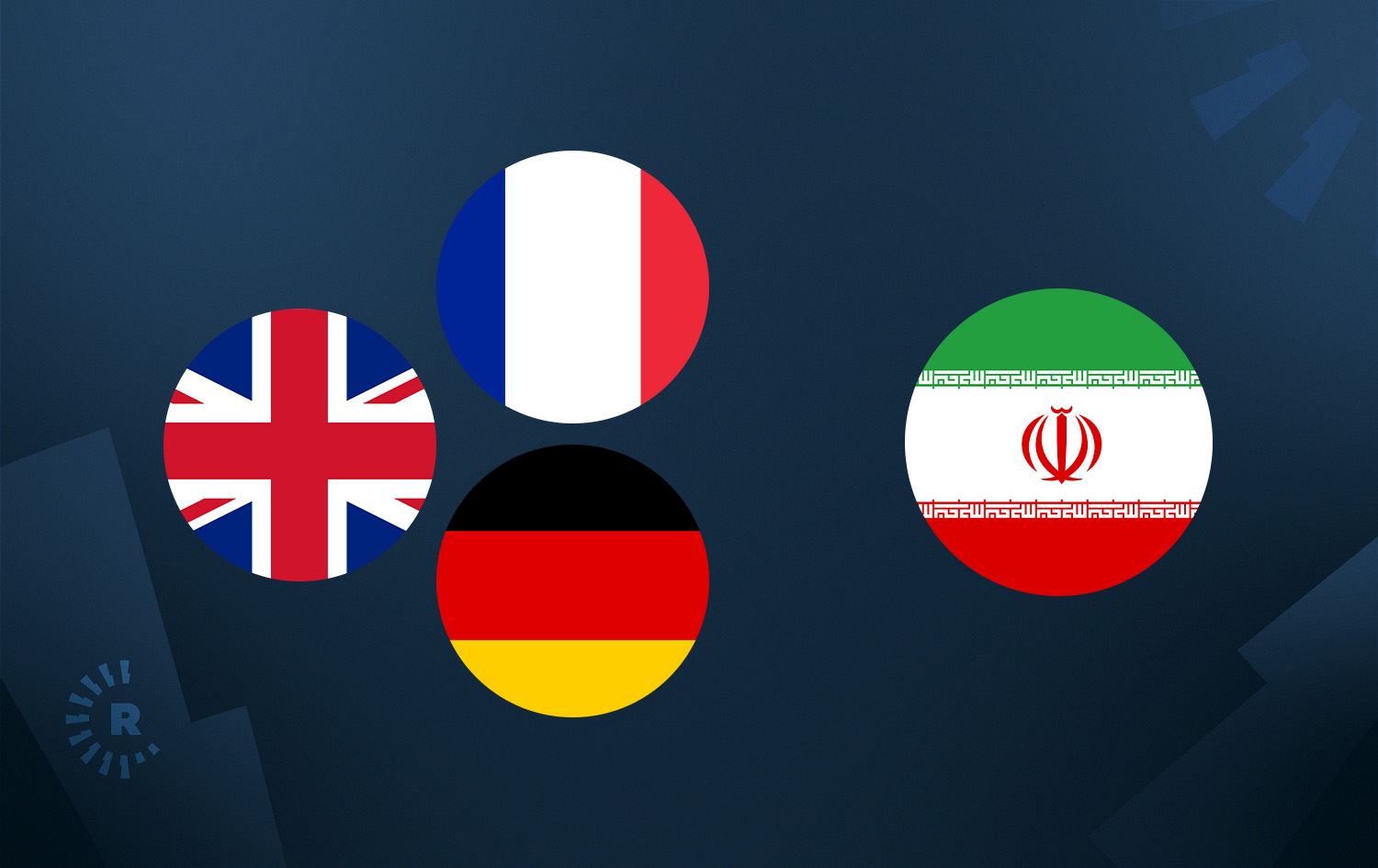
ERBIL, Kurdistan Region - Britain, France, and Germany have formally notified the United Nations Security Council (UNSC) that they will move to reimpose UN sanctions on Iran within 30 days if the Council fails to adopt a resolution to extend the suspension of sanctions on Tehran.
In a joint statement released Thursday, the three European countries - collectively known as the E3 - said, "We recall that if the UNSC does not adopt within 30 days a resolution to continue the lifting of UNSC resolutions on Iran, six Security Council resolutions, including on sanctions, will be restored."
The move is part of the snapback mechanism embedded in the 2015 nuclear deal between Iran and world powers - formally known as the Joint Comprehensive Plan of Action (JCPOA). The mechanism allows for the automatic reimposition of UN sanctions if Iran is found to be in violation of its nuclear obligations.
Notably, the European countries’ decision came only weeks before the snapback mechanism was set to expire on October 18.
The E3 attributed their decision to what they described as Iran’s “clear and deliberate” non-compliance with the JCPOA, elaborating that “sites of major proliferation concern in Iran” remain outside of the oversight of the UN’s nuclear watchdog - the International Atomic Energy Agency (IAEA).
A major diplomatic rift erupted in late June between Iran and the IAEA that saw Tehran formally suspend cooperation with the agency. Tehran alleged that the agency had become “a political instrument” and blamed it for the flare up of the 12-day conflict between Iran and Israel in mid-July. That conflict, which also drew in the United States, saw strikes on Tehran’s three main nuclear sites - Fordow, Isfahan, and Natanz.
IAEA Director-General Rafael Grossi in late June censured Iran for suspending its cooperation with the agency, asserting that it is not voluntary, but a legal obligation under the Nuclear Non-Proliferation Treaty (NPT). The NPT, which Iran has been a signatory to since 1970, aims to prevent the spread of nuclear weapons and promote peaceful uses of nuclear energy.
Grossi also expressed serious concern about Iran’s stockpile of enriched uranium. Before the conflict with Israel erupted, Iran possessed approximately 400 kilograms of uranium enriched to 60 percent purity - a level considered dangerously close to weapons-grade material.
“This material exists somewhere, but the agency lost track of it after hostilities began,” he then warned, stressing that “Iran is obliged in any case to show the agency inspectors where the material is located.”
On Thursday, the E3 reiterated these concerns stating that Tehran “has no civilian justification for its high enriched uranium stockpile... which is also unaccounted for by the IAEA.”
As a result, the troika said they have formally notified the Security Council of Iran’s “significant non-performance” under the JCPOA, thereby triggering the snapback mechanism.
Of note, despite the tensions, a senior IAEA official visited Iran earlier this month to discuss a new framework for cooperation between the two sides.
Despite their Thursday notification, the E3 emphasized that the 30-day window remains open for continued diplomatic engagement “on any serious diplomatic efforts to restore Iran’s compliance with its commitments.”
However, they confirmed that if the UNSC fails to act within the timeframe, “six Security Council resolutions, including sanctions, will be restored.”
Iran responds
In a strongly worded statement, the Iranian foreign ministry on Thursday said it "firmly rejects and condemns in the strongest possible terms the illegal notification" submitted by the E3 to the UNSC. It warned that the move "will severely weaken the ongoing process of interactions and cooperation" between Iran and the IAEA.
The statement emphasized that the E3 "neither has the legal nor the moral authority" to initiate such action, rendering their notification "invalid, null, and devoid of any legal effect."
The foreign ministry warned that the European countries’ "provocative and unnecessary escalation will be met with appropriate responses," adding that “the path they chose… if left unchecked, will have severe consequences for the credibility and structure of the Security Council.”
The state-run Iranian news agency IRNA also cited Iranian Foreign Minister Abbas Araghchi as stating on Thursday that his country "has acted responsibly and in good faith," emphasizing that Tehran “will defend its national rights and interests” in response to what it called the E3 “unlawful and unjustified” attempt to reinstate UNSC sanctions.
Araghchi reportedly made the remarks during a phone conversation with the E3 foreign ministers and the European Union’s High Representative for Foreign Affairs. IRNA cited the European foreign ministers as expressing their “readiness to pursue a diplomatic solution within the next 30 days to resolve the issues and prevent the reimposition of UN sanctions.”
Meanwhile, Kazem Gharibabadi, Iranian deputy foreign minister, issued a warning on Wednesday, stating that any move to trigger the snapback mechanism would result in a "complete halt" of Tehran’s cooperation with the IAEA. “In such circumstances, continuing this interactive process would be meaningless,” he said.
Gharibabadi further noted that such a move would mean that “Europe will essentially exclude itself from the diplomatic track and dialogue with Iran,” adding that “from that point onward, negotiations will be conducted solely within the framework of the Security Council and its members. We will no longer engage in any dialogue with Europe on this matter.”
International reactions
In a Thursday statement on X, US Secretary of State Marco Rubio was quick to welcome the E3’s push to initiate the process of reimposing UN sanctions on Iran, stating that “snapback sanctions are a direct response to Iran’s continuing defiance of its nuclear commitments.”
Rubio reiterated Washington’s support for the E3’s decision and called on Tehran to “engage in serious diplomatic negotiations to resolve the nuclear issue.”
Of note, the JCPOA began to unravel in 2018 when US President Donald Trump, during his first term in office, unilaterally withdrew Washington from the accord and reimposed biting sanctions on Iran. In response, Tehran began rolling back on its nuclear commitments.
Similarly, Israel’s representative to the United Nations welcomed the E3’s decision stating, “Israel has already shown its commitment to fight the radical regime in Tehran.” Danny Danon added that “it is about time that the international community continues to apply more pressure and more sanctions” against Tehran.”
In contrast, Russia criticized the E3’s move.
On Thursday, Russia’s First Deputy Permanent Representative to the UN, Dmitry Polyansky, stated that the decision to reimpose snapback sanctions on Iran has “no legal effect.” He told reporters in New York, “We believe that the E3’s decision cannot and should not entail any legal or procedural consequences. It is merely an escalatory step.”
Notably, on the previous day, Polyansky had announced Russia's push to extend the validity of UN Security Council Resolution 2231 - which underpins the Iran nuclear deal - by six months, until April 2026.
“Russia and China, as responsible participants in the JCPOA, wish to provide some room for diplomacy and opportunities to seek a compromise to this issue,” he said, according to Russia’s state-run news agency TASS.
As of the time of this report, China had not issued an official response to the E3’s decision. However, in mid-August, Beijing reiterated its “commitment to resolving the Iranian nuclear issue through peaceful and diplomatic means,” reaffirming that it “opposes invoking” the snapback mechanism.


Comments
Rudaw moderates all comments submitted on our website. We welcome comments which are relevant to the article and encourage further discussion about the issues that matter to you. We also welcome constructive criticism about Rudaw.
To be approved for publication, however, your comments must meet our community guidelines.
We will not tolerate the following: profanity, threats, personal attacks, vulgarity, abuse (such as sexism, racism, homophobia or xenophobia), or commercial or personal promotion.
Comments that do not meet our guidelines will be rejected. Comments are not edited – they are either approved or rejected.
Post a comment