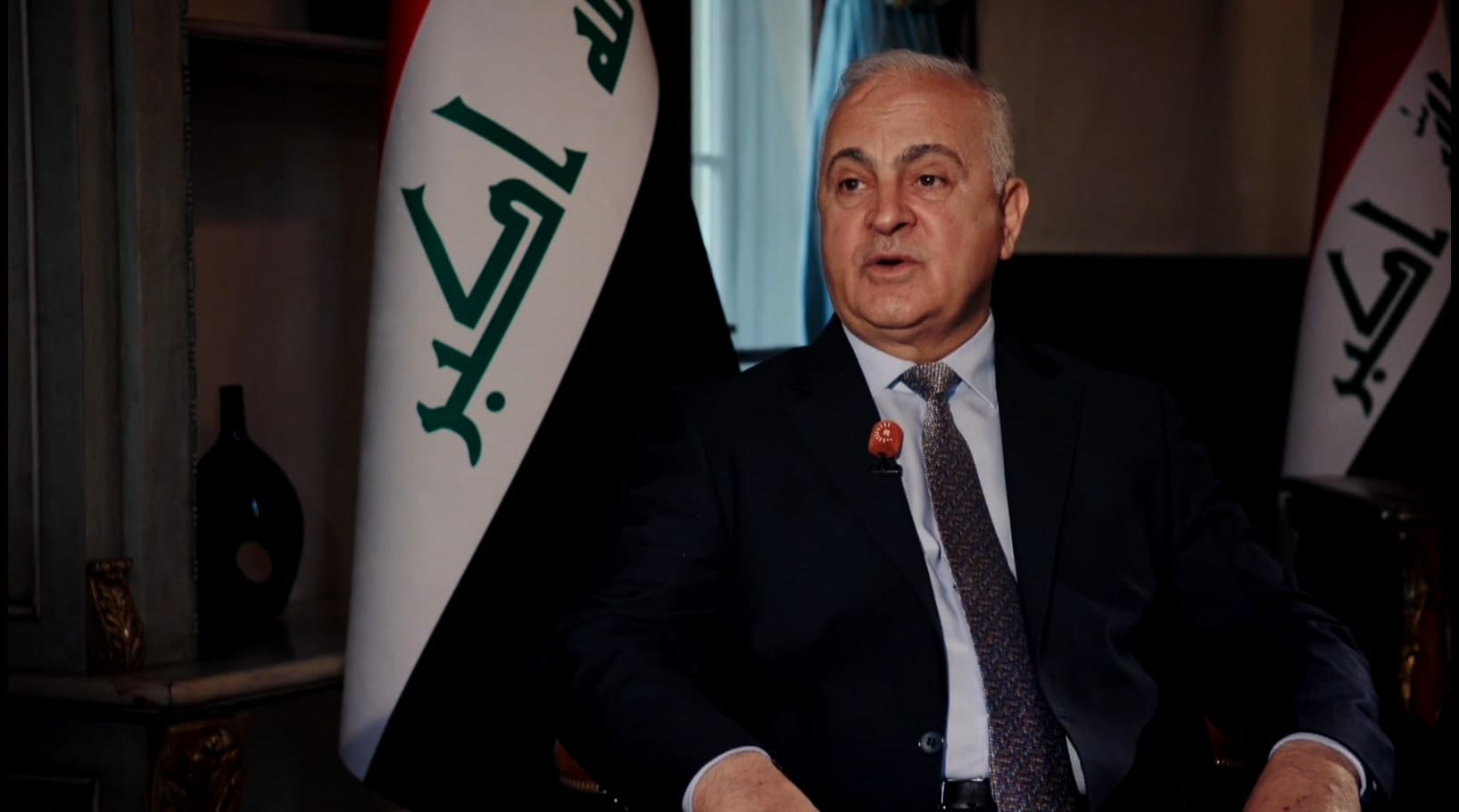
ERBIL, Kurdistan Region - Italy is pushing to expand its business footprint in Iraq and the Kurdistan Region beyond oil and energy, the country’s ambassador to Iraq told Rudaw in an exclusive interview on Tuesday, as Baghdad and Erbil’s growing stability and developments across all sectors draw renewed interests from European investors.
“We started our cooperation decades ago, and the two main sectors were infrastructure, construction, and energy sector, so oil and gas mainly,” Italy’s Ambassador to Iraq Niccolo Fontana told Rudaw, adding Rome’s diplomatic missions in Iraq are currently focused on diversifying cooperation into non-oil fields.
Rome and Erbil enjoy good ties and last year Italy upgraded its consulate in Erbil to a consulate general.
Italy is a member of the global coalition against the Islamic State (ISIS) that was formed by the United States in 2014 when the terror group seized control of a swath of Iraqi and Syrian land. Italian forces have had a key role in training Kurdish Peshmerga forces.
A year into office in Iraq, the Italian ambassador said he had witnessed clear signs of transformation and economic momentum.
“I saw a transformed city for the better, notably in terms of infrastructure. But I see a lot of construction works going on, both in Baghdad and Erbil,” he said, adding that “We say in Italy that when there is construction going on, it means there's a push towards social economic development.”
“What we as an embassy and with the consulate general in Erbil, are trying to do right now is to attract more companies in non-oil sectors,” the ambassador said, adding Rome is encouraging companies to work in the “agro industrial sector” to work in Kurdistan, underscoring the safety and security in the Region.
Fontana described “stability” as “the right word to describe what's going on now in the country,” crediting both Baghdad and Erbil for playing “a role as a stabilizing factor in the region.”
The ambassador noted that his country is “committed to working alongside Iraq and Kurdistan to enhance furthermore this development,” highlighting a shared interest in stability and economic diversification.
“Together with the Kurdish government, we organized a mission to Rome last July, and apparently we succeeded in convincing an important Italian group to come here,” the ambassador revealed, adding that “they are coming in mid-October here to check, really in person, if those opportunities are real, and how to cooperate with local partners.”
As Iraq and Kurdistan seek to attract broader foreign investment, Italy’s strategy aligns with their vision of diversifying the economy, strengthening local industries and deepening regional ties.
Below is the full transcript of the interview with Niccolo Fontana.
Rudaw: Mr. Ambassador, welcome to Rudaw.
Niccolo Fontana: Thank you. It's a pleasure to be here.
Thank you very much.It's my pleasure. First of all, let's start with the campaign of elections. The campaign has begun to invite citizens in Iraq and Kurdistan to participate in elections. So, in your opinion, will this election do something different in Iraq? How is it different?
First of all, I think that having regular elections in this country is a good testimony to the democratic flourishing in Iraq. As for the outcome, I have nothing to say, but I do hope that everything will take place peacefully, there will be a new government shortly, and that the country will follow the path that has been undertaken by the current government in the last two years. So I'm really hopeful, and I think that Iraq will eventually stabilize more and more and will establish itself as a factor of stability in the whole Middle Eastern region.
In a few days, the campaign has just begun. How do you see it? How is it different from Italy's election, for example? Do you see the posters, the slogans? What's the difference between having a campaign for election here or in your country?
This is my first electoral campaign in Iraq, so I'm still kind of fresh to express any proper judgment. But as for the mood of campaigning and the electoral posters and signings all around, I don't feel much difference with my own country. Yesterday, I had the chance of traveling around a little bit, you know, around Kurdistan. I saw many, many electoral signings around, and it's almost the same in Italy.
Good. Many changes have taken place in Iraq, in the region, from your position in Baghdad. Do you think that Iraq has undergone any real transformations?
Look, what I can say, I got here to Baghdad last November, so it's almost one year. But I saw a transformed city for the better, notably in terms of infrastructure. But I see a lot of construction works going on, both in Baghdad and Erbil, a city that I visited several times. We say in Italy that when there is construction going on, it means there's a push towards social economic development. So that is a good sign that we have to take into consideration. I think, as I mentioned earlier, that the path towards development is the right one, and Italy is committed to working alongside Iraq and Kurdistan to enhance further more this development.
From last November to present, has stability in Iraq reached a level for citizens to feel like it's truly stable?
In my view, stability is the right word to describe what's going on now in the country. And if we look a little bit wider at the situation in the whole region, Iraq was stable even during the troubling days at the end of June, and it was not involved in what happened. And eventually the Iraqi government, and I would say also the Kurdish government, tried to play a role to create bridges between different actors and to play a role as a stabilizing factor in the region. On top of that, I feel that safety in this country as a whole is getting better and better, and that is a very important sign too.
So stability and safety are the factors for investment in the world. So do you see a trend here in Iraq and Kurdistan Region, do you see a trend to Italian companies for them to come to Iraq and Kurdistan and to invest?
A very positive trend. That is what we are trying to emphasize with the Italian business community, since they would decide not to come if they feel unsafe, of course. But we are really underscoring the fact that the situation specifically in Baghdad and in Kurdistan has gotten better a lot, and there are several business opportunities that might be suitable and attractive for Italian companies.
Okay, but let's not forget the armed groups, especially those who are outside of the state. So do you see them a challenge in front of this investment of Italian companies in Iraq?
You know, what would be important is for the Iraqi government, since we are close to the elections, let's say the new Iraqi government, to have the monopoly of the use of force. How? It is up to the Iraqi government to decide. But coming from Italy, that is our understanding of how the security situation should work. So the state has the monopoly of force.
Okay, in which areas and fields do you cooperate, or let's say, Italian companies are cooperating with Iraq?
Okay, we started our cooperation decades ago, and the two main sectors were infrastructure, construction, and energy sector, so oil and gas mainly. We still have a good footprint in the energy sector, specifically in the southern part of Iraq, with some Italian large companies. But what, as an embassy and with the consulate general in Erbil, are trying to do right now is to attract more companies in non-oil sectors.
For instance, let's talk about Kurdistan. We want to have Italian companies in the agro-industrial sector to work here. Together with the Kurdish government, we organized a mission to Rome last July, and apparently we succeeded in convincing an important Italian group to come here.
We spoke with them a couple of days ago, and they are coming in mid-October here to check, really in person, if those opportunities are real, and how to cooperate with local partners.
So, there is an Italian delegation, business?
An Italian company.
An Italian company, delegations, visiting Kurdistan?
Yes.
Very soon?
Yeah, mid-October, yes.
Which city? Visiting Erbil?
Yeah, they are coming first to Erbil. I don't know if they are going somewhere else, but definitely they are coming here, and the consulate general will help them.
Is it only agriculture that you are interested in?
Yes, agro-industrial.
Agro-industrial?
Yes.
Okay. Almost one year has passed since the elections of the Kurdistan government have been held, so do you see the delay of forming the Kurdistan government as affecting any of the situations here in Kurdistan or in Iraq?
It's not up to me to express any judgment on that, but I can report to you the general opinion that, at least in my country, does exist on topics like these. So, as I said, referring to the incoming Iraqi elections, it's always better not to have too much gap between the election date and the formation of a new government. So, hopefully a new Kurdish government will be formed soon, but it's quite a long time, one year.
Can we call it a concern from your side?
It would be a concern if we didn't cooperate well, but I wouldn't be honest saying that since our relations are excellent and we're always in touch. We had visits to Italy. We had our minister of defense here some months ago. So, no, it's not a concern, but it's a friendly suggestion.
Have you passed this note or a friendly suggestion to officials here in Kurdistan?
Yeah, of course. I mean, we've been discussing about that, but always on a positive note since we want the better for this region. So, as a friend, you're summoned to say what you think.
Okay. We've talked about Italian companies. What about Kurdish companies or Iraqi companies investing in Italy? Are you targeting that also, or it's not for this stage or level?
It would be great, but so far we didn't have many expressions of interest. Actually, we had one Iraqi pharmaceutical company investing in Italy, and that was very interesting and it was a very positive development, but not so many. You have to consider also our trade exchange. So, we import roughly, let's say, $2.5 billion from Iraq, and mostly related to oil and oil derivatives. And we only export towards Iraq roughly $1 billion. So, there is a trade imbalance there.
Yearly $1 billion?
Yes. So, we would like to increase, of course, our exports towards Iraq since we know that a demand of Italian products does exist in Baghdad and, of course, here in Erbil.
What's your aim and your target to raise this $1 billion per year to...
You know, 2023 to 2024, we've already experienced roughly a 30% increase. So, if we were able to keep up that trend, it would be great.
Let's talk about safety and stability again. Does the threat of ISIS remain in Iraq? There are especially some attacks in Syria, maybe in western Iraq, west of Iraq. So, do you see that the threat still remains?
You know, that is one of the main topics of discussion with authorities, both in Baghdad and in Erbil. And I'm always asking to them since they are the experts on the field. A threat still exists, even though it's relatively reduced compared to the past. But that is why we're cooperating with Iraqi defense forces and Peshmerga here in Kurdistan with our military contingents. You know, we have an important presence here in Erbil, in Sulaymaniyah and, of course, in Baghdad upon the request of the Iraqi government and here in cooperation with the Kurdish government.
And as long as we are welcomed, we are really committed to working alongside you and to try to help the fight against the remnants of Daesh.
With the withdrawal of American forces by the end of next year, does Italy plan the same thing in Iraq and Kurdistan Region?
There are ongoing discussions with the Iraqi government and we are working on a new security agreement, bilateral agreement, but I cannot dwell more on that. I think that we are two friendly countries and if a friend asks for your help, Italy is ready to give it.
Does it contain something like changing the rule, changing the way that Italian forces are working, training, or will it be the same?
It's still too early to talk about that, but our priority here is to train, to enable, and to assist. And that is what we would like to carry on doing.
Talking about Peshmerga, Italy is in the process in supporting of reorganization and unification of Peshmerga forces.
Of course, we are working very well here in Suli and we do hope that this process will finish up soon. That would be another good sign of stability for Kurdistan, in our view.
How would you evaluate the process so far?
I'm not there on the field, but listening to what our soldiers, instructors tell us, it's still an ongoing process, but progress has been achieved.
It might take a little more time, but I think we will reach the final goal.
The plan was to end the process, or to end the process of unification of Peshmerga forces by the end of next year, by the end of 2026.
I can't recall that, but I trust what you say.
Do you expect that it will be finished? The Peshmerga forces will unify as planned?
I'm not an expert, so I don't know. I don't have very specific information about that, but I do hope that that is the case.
Let's talk about visa applications here in Kurdistan and Iraq also. Are there any facilitations for the applicants? How often do you take applications? Are there rules that will be more than that? What are you planning?
I got your point. First of all, a couple of years ago, we've decided to, let's say, upgrade the consulate here in Erbil from consulate to consulate general due to the special relationship that we have with Kurdistan, but also due to the number of visa applications that we kept receiving. I'm receiving this question quite often, and my answer is always the same.So, look, for visa applications, that is not so difficult to get a visa, provided that you present alongside the application itself the documents required. We've experienced an increase of roughly 30% of applications in the last two years each year, and we have a refusal rate between 20% to 30%, but 99.9% of those refusals are because the application lacks the proper documents. I mean, if the application is correct, there is no point and certainly no intention not to grant a visa either to students, businessmen or tourists from this country. So, my suggestion to whomever is interested to visit Italy for whatever reason is please check the embassy and the consulate general's websites and follow whatever is stated there regarding documents.
Thank you very much.
You're welcome.
Thank you very much.
.jpeg&w=3840&q=75)