


Interview

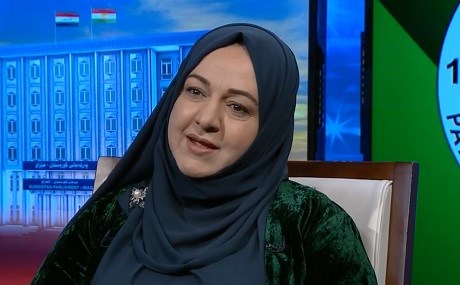
Rewaz Fayaq is expected to be elected Speaker of the Kurdistan Region parliament on July 11. Here she appears on Hiwa Jamal’s Rudawi Ewro program, July 8, 2019. Photo: Rudaw TV
Rewaz Fayaq has served in the Kurdistan regional parliament and on multiple parliamentary committees for many years. On Thursday, the longtime Patriotic Union of Kurdistan (PUK) lawmaker succeeds Vala Farid to become the parliament’s new speaker.
Farid, a member of the Kurdistan Democratic Party (KDP), was elected earlier this year as a placeholder candidate to help push forward the long-delayed process of forming a new government. She and Fayaq are the first women to hold the post of speaker.
Fayaq says the public has a broadly negative perception of parliament – a view she hopes to challenge from the speaker’s chair.
Appearing on Hiwa Jamal’s Rudawi Ewro program on Monday night, Fayaq said she hopes the many political disagreements that have dogged the parliamentary agenda in recent years have been settled, allowing her to focus instead on reform bills and the repayment of salaries during her term in office.
Although political rivalries continue threaten the new government taking shape in Erbil, Fayaq says she will fulfil her duties objectively and without bias toward any given party.
She was handed the post of speaker as part of a power-sharing deal thrashed out between the PUK and the parliament’s other major parties, the KDP and the Change Movement (Gorran), following the September 30, 2018 election.
The presidency and the office of prime minister were both given to the KDP. Other ministries and deputies have been carved up between the top factions to reflect their power inside the parliament and in areas of the Kurdistan Region under their control.
The new governing cabinet will be approved by parliament on Thursday. With a new government at the helm, the Region can focus on rebuilding the economy and its relations with Baghdad.
Interview by Hiwa Jamal
Rudaw: As the first hijabi woman [to become the Speaker], and while you also have a deputy who is also hijabi, how do you feel about becoming Speaker of Kurdistan’s parliament?
 Frankly, being a hijabi or not does not make you feel a particular way when obtaining a position
  Rewaz Fayaq: Frankly, being a hijabi or not does not make you feel a particular way when obtaining a position. My outside appearance is in no way connected to the feeling I have come to feel since becoming the Patriotic Union of Kurdistan’s candidate for the Speaker of the Parliament. Maybe this controversy is over the fact that the PUK is not an Islamist party, so how could the PUK nominate a hijabi woman for one of the most senior positions in the Kurdistan Region? While this might be a hot topic for some people, it is a very normal thing for me.
You have always been seen wearing Kurdish clothes. Will you also keep donning the same clothes while serving as Speaker?
Until the time I go back to my job as a teacher at Sulaimani University or the Polytechnic University, I imagine I will continue wearing Kurdish clothes. Maybe it will not be easy if I travel abroad, but yes I will continue doing so.
What is the process for the current Speaker to leave her post? What are the legal mechanisms?
There are two mechanisms. If she were to present her resignation to the parliament, then the parliament would have to accept it. A day later I would be elected as Speaker by MPs. Another mechanism is the current one. She is a candidate in the new government for a Regional Minister position. According to bylaws, any MP who gets a ministry in the cabinet is automatically considered to have resigned. Whenever we vote and give the individual confidence in the parliament, they will lose their parliament membership directly. And whoever loses their parliament membership, whatever positions they may have in the presidential board, they will lose that too. The position will be considered empty, and the day after, I can become the Speaker of the parliament in an election.
What kind of a Speaker would you like to be?
I will work professionally in my parliamentary job so that there are no rumors about me, and I wish to preserve my neutrality thoroughly
The Speaker, or the head of any other branch of the state, the Executive, will directly come under the duty of looking at all the citizens of the Kurdistan Region the same way, to treat all the areas of Kurdistan in the same way, to rescue themselves from any complexity, any bias towards a political party, person or group. They have to overcome that. I can [do this], and I believe in myself. I can’t not be PUK. I am a PUK [member] at the end of the day. However, I will work professionally in my parliamentary job so that there are no rumors about me, and I wish to preserve my neutrality thoroughly. Why do I want to be objective? This is both a political matter and an ethical commitment. It is also for the institution to progress forth and for my personal success. It is also for me to have 100 percent coordination with the other presidencies in the Kurdistan Region, their Excellences the President of the Kurdistan Region and the new Prime Minister of the Kurdistan Region. I hope I live up to the confidence others have in me to become a successful Speaker of parliament. I promise that if they [the MPs] help me, I will be exactly as they think of me.
Opposition groups in the parliament, such as Komal, New Generation, Kurdistan Islamic Union (KIU) and others may not vote for you. How will you deal with these? Can you preserve your neutrality with them too?
As you know, the bylaws of parliament have already mapped out how the Speaker should do their job, how they manage parliament sessions, what bills they should prioritize, in what manner they allow MPs to speak. Any speaker who implements the bylaws as they are, and if their conduct matches the bylaws, then I am sure no one can accuse that Speaker of bias. I was one of those who rewrote the bylaws. It took us two years with my colleagues to rewrite it. I will try to implement the bylaws as they are so that no one complaints about me.
In previous parliamentary terms, Speakers faced a number of bizarre things. One of them said “sit down” [to an MP], and another said “kick them out”. Do you think you will do this? You get angry at times, and I have seen you leave [TV] shows. Can you put up with the opposition in the parliament?
At that time, I will be the head of the most important institution in the Kurdistan Region. My friends in the [PUK] Leadership Council in a majority vote gave me the confidence for me to obtain that position. I am sure they know me well, and that is why they vested their confidence in me. I have seen the excitement of my friends, my acquaintances, and the people on social media, although I am not active on them. I do however see things on the Facebook accounts of my children, my husband. There are very good expectations and I hope I match them. My getting angry was in a Rudaw TV program because I felt like there was great injustice directed at me. It was a type of stance and I had a purpose.
If you become the Speaker, you will have the power to be unjust, right? Because you are the only one who can be unjust then.
Of course. I can listen to people speak to me for ten hours. MPs, besides speaking, don’t have other rights. They only speak. I can be a good listener.
There are two Islamist parties, the KIU and Komal, who are in the opposition in parliament. You are a hijabi. I would like to know your opinion about Islamic political rule.
I am faced with an election, so speaking about this is a sensitive topic. We have a number of examples for political Islamic rule. We have the extreme version, such as Taliban, and we have had moderate, to an extent, in Egypt. If you were to compare the two examples, one of them was filled with killing and massacres. There may have been some discontent in the other [Egyptian] example. There was some violence, but the evaluation of these examples cannot be a measuring stick if Islamic parties in the Kurdistan Region rule. We haven’t seen them rule, but in the end, they know how to adapt to the circumstances and conditions of the Kurdistan Region.
The parliament and its presidency are now accused of turning whatever their parties say into laws. If the party says no, they say no. This is the image the people have of the parliament. How will you make that image fade?
All the things that have recently come to pass in the parliament are sensitive topics, such as reactivating the presidency law, giving confidence to the parliament, amending the Provincial Law, and extending the term of the Provincial Council. They were all related to the top powers in the Kurdistan Region. The legal dimension of these laws makes the perception the people have about the presidency of the parliament true to an extent. It is the political parties who want the parliamentary presidency to be active in this manner. The parties don’t hide it that these things were their wish, and that they want to organize them through laws. It was the political agreement of parties that pushed us to extend the term of the provincial councils. This is a fact and reality. I imagine that the most political sensitive topics have come to pass now. Maybe I am lucky in this regard.
Do you think that the scenario that befell the previous Speaker, Dr. Yousif Mohammed, may also befall you? KDP and Gorran then had an agreement and had good relations, but it happened nevertheless.
The topics that are directly related to peoples’ lives will come before the parliament, such as the Reforms Bill, Pensions Bill, repaying the saved salaries, reactivating the closed factories in the Kurdistan Region, creating job opportunities and dozens of other projects
No, I don’t expect this to happen. There is a difference between PUK and Gorran, and there is also a difference between that stage and the current stage. For the next four years, which is actually less, the topics that are directly related to peoples’ lives will come before the parliament, such as the Reforms Bill, Pensions Bill, repaying the saved salaries, reactivating the closed factories in the Kurdistan Region, creating job opportunities and dozens of other projects. These are all professional things and are related to a variety of sectors. All the MPs and political forces need to be together, united to find the best solutions. Thus, I don’t think that will happen.
You had a bit of rivalry with Ms. Begard Talabani concerning who would become the Speaker. After the [PUK leadership] meeting [that saw you getting the majority of votes], a picture showing you two hugging each other surfaced. How did you settle this between you?
My friends, and the factions we visited today for Ms. Begard to say goodbye to so that on Wednesday she takes the oath as the Minister of Agriculture, all said that the two of us had one of the most beautiful political competition as two competitors. Even in the Leadership Council meeting of the PUK, the members praised our competition as a beautiful political competition in the time as we never clashed, didn’t badmouth each other and didn’t go head to head against in each other in the media. We were able to handle the process.
So the women presented a more beautiful example of competition than the men?
Yes, based on the example. Even the PUK leadership council led one of the most beautiful processes in how the positions were handed out to all the candidates who are now given the candidacy for the positions in a worthy manner. Even there, during the most sensitive time, we didn’t clash. Ms. Begard gave a description of herself as to why she merited the position. When it was the turn of yours truly, I said I fully support Ms. Begard. Whatever she says about herself is true. We didn’t get to the point for her to speak against [to also express support for me]. She spoke first, then I spoke, but there wasn’t a third time for either of us to speak. The process then went ahead very smoothly. Then we hugged. I told her that I loved her and had nothing personal against her, but that we both had our ambitions. We apologized to each other if we had made each other upset.
One of your deputies is in the leadership of another party, and the other is the head of another party. Can there be full coordination and no clashing together?
I and Ms. Muna [Qahwechi the second deputy] have known each other for four to five years. We worked together in the [parliamentary] legal committee. I am sure there will be no clashing with her. Even before the matter of my candidacy was settled, I and Mr. Hemn [Hawrami the first deputy] have spoken more than once. We have many common points on how to manage the parliament’s presidency. My friends can tell you that I am someone who adapts to fluctuations. I have the same expectation for Mr. Hemn to adapt since he has been working in the relations department. And those who worked in relations departments have diplomatic relations more than other people. We both come from poor families. This is a commonality between us. We usually say that to each other – that we have built ourselves up from the ground. We both have the ambition to succeed in the posts we have because we consider ourselves young. We want to be diligent enough for our parties to take us into consideration for other positions. The place we are at is the place where the people of Kurdistan are represented, it is a place where the elections slogans, which were all beautiful, need to be translated into reality. Hence, we won’t be on the collision course.
Farid, a member of the Kurdistan Democratic Party (KDP), was elected earlier this year as a placeholder candidate to help push forward the long-delayed process of forming a new government. She and Fayaq are the first women to hold the post of speaker.
Fayaq says the public has a broadly negative perception of parliament – a view she hopes to challenge from the speaker’s chair.
Appearing on Hiwa Jamal’s Rudawi Ewro program on Monday night, Fayaq said she hopes the many political disagreements that have dogged the parliamentary agenda in recent years have been settled, allowing her to focus instead on reform bills and the repayment of salaries during her term in office.
Although political rivalries continue threaten the new government taking shape in Erbil, Fayaq says she will fulfil her duties objectively and without bias toward any given party.
She was handed the post of speaker as part of a power-sharing deal thrashed out between the PUK and the parliament’s other major parties, the KDP and the Change Movement (Gorran), following the September 30, 2018 election.
The presidency and the office of prime minister were both given to the KDP. Other ministries and deputies have been carved up between the top factions to reflect their power inside the parliament and in areas of the Kurdistan Region under their control.
The new governing cabinet will be approved by parliament on Thursday. With a new government at the helm, the Region can focus on rebuilding the economy and its relations with Baghdad.
Interview by Hiwa Jamal
Rudaw: As the first hijabi woman [to become the Speaker], and while you also have a deputy who is also hijabi, how do you feel about becoming Speaker of Kurdistan’s parliament?
Frankly, being a hijabi or not does not make you feel a particular way when obtaining a position You have always been seen wearing Kurdish clothes. Will you also keep donning the same clothes while serving as Speaker?
Until the time I go back to my job as a teacher at Sulaimani University or the Polytechnic University, I imagine I will continue wearing Kurdish clothes. Maybe it will not be easy if I travel abroad, but yes I will continue doing so.
What is the process for the current Speaker to leave her post? What are the legal mechanisms?
There are two mechanisms. If she were to present her resignation to the parliament, then the parliament would have to accept it. A day later I would be elected as Speaker by MPs. Another mechanism is the current one. She is a candidate in the new government for a Regional Minister position. According to bylaws, any MP who gets a ministry in the cabinet is automatically considered to have resigned. Whenever we vote and give the individual confidence in the parliament, they will lose their parliament membership directly. And whoever loses their parliament membership, whatever positions they may have in the presidential board, they will lose that too. The position will be considered empty, and the day after, I can become the Speaker of the parliament in an election.
What kind of a Speaker would you like to be?
I will work professionally in my parliamentary job so that there are no rumors about me, and I wish to preserve my neutrality thoroughly Opposition groups in the parliament, such as Komal, New Generation, Kurdistan Islamic Union (KIU) and others may not vote for you. How will you deal with these? Can you preserve your neutrality with them too?
As you know, the bylaws of parliament have already mapped out how the Speaker should do their job, how they manage parliament sessions, what bills they should prioritize, in what manner they allow MPs to speak. Any speaker who implements the bylaws as they are, and if their conduct matches the bylaws, then I am sure no one can accuse that Speaker of bias. I was one of those who rewrote the bylaws. It took us two years with my colleagues to rewrite it. I will try to implement the bylaws as they are so that no one complaints about me.
In previous parliamentary terms, Speakers faced a number of bizarre things. One of them said “sit down” [to an MP], and another said “kick them out”. Do you think you will do this? You get angry at times, and I have seen you leave [TV] shows. Can you put up with the opposition in the parliament?
At that time, I will be the head of the most important institution in the Kurdistan Region. My friends in the [PUK] Leadership Council in a majority vote gave me the confidence for me to obtain that position. I am sure they know me well, and that is why they vested their confidence in me. I have seen the excitement of my friends, my acquaintances, and the people on social media, although I am not active on them. I do however see things on the Facebook accounts of my children, my husband. There are very good expectations and I hope I match them. My getting angry was in a Rudaw TV program because I felt like there was great injustice directed at me. It was a type of stance and I had a purpose.
If you become the Speaker, you will have the power to be unjust, right? Because you are the only one who can be unjust then.
Of course. I can listen to people speak to me for ten hours. MPs, besides speaking, don’t have other rights. They only speak. I can be a good listener.
There are two Islamist parties, the KIU and Komal, who are in the opposition in parliament. You are a hijabi. I would like to know your opinion about Islamic political rule.
I am faced with an election, so speaking about this is a sensitive topic. We have a number of examples for political Islamic rule. We have the extreme version, such as Taliban, and we have had moderate, to an extent, in Egypt. If you were to compare the two examples, one of them was filled with killing and massacres. There may have been some discontent in the other [Egyptian] example. There was some violence, but the evaluation of these examples cannot be a measuring stick if Islamic parties in the Kurdistan Region rule. We haven’t seen them rule, but in the end, they know how to adapt to the circumstances and conditions of the Kurdistan Region.
The parliament and its presidency are now accused of turning whatever their parties say into laws. If the party says no, they say no. This is the image the people have of the parliament. How will you make that image fade?
All the things that have recently come to pass in the parliament are sensitive topics, such as reactivating the presidency law, giving confidence to the parliament, amending the Provincial Law, and extending the term of the Provincial Council. They were all related to the top powers in the Kurdistan Region. The legal dimension of these laws makes the perception the people have about the presidency of the parliament true to an extent. It is the political parties who want the parliamentary presidency to be active in this manner. The parties don’t hide it that these things were their wish, and that they want to organize them through laws. It was the political agreement of parties that pushed us to extend the term of the provincial councils. This is a fact and reality. I imagine that the most political sensitive topics have come to pass now. Maybe I am lucky in this regard.
Do you think that the scenario that befell the previous Speaker, Dr. Yousif Mohammed, may also befall you? KDP and Gorran then had an agreement and had good relations, but it happened nevertheless.
The topics that are directly related to peoples’ lives will come before the parliament, such as the Reforms Bill, Pensions Bill, repaying the saved salaries, reactivating the closed factories in the Kurdistan Region, creating job opportunities and dozens of other projects You had a bit of rivalry with Ms. Begard Talabani concerning who would become the Speaker. After the [PUK leadership] meeting [that saw you getting the majority of votes], a picture showing you two hugging each other surfaced. How did you settle this between you?
My friends, and the factions we visited today for Ms. Begard to say goodbye to so that on Wednesday she takes the oath as the Minister of Agriculture, all said that the two of us had one of the most beautiful political competition as two competitors. Even in the Leadership Council meeting of the PUK, the members praised our competition as a beautiful political competition in the time as we never clashed, didn’t badmouth each other and didn’t go head to head against in each other in the media. We were able to handle the process.
So the women presented a more beautiful example of competition than the men?
Yes, based on the example. Even the PUK leadership council led one of the most beautiful processes in how the positions were handed out to all the candidates who are now given the candidacy for the positions in a worthy manner. Even there, during the most sensitive time, we didn’t clash. Ms. Begard gave a description of herself as to why she merited the position. When it was the turn of yours truly, I said I fully support Ms. Begard. Whatever she says about herself is true. We didn’t get to the point for her to speak against [to also express support for me]. She spoke first, then I spoke, but there wasn’t a third time for either of us to speak. The process then went ahead very smoothly. Then we hugged. I told her that I loved her and had nothing personal against her, but that we both had our ambitions. We apologized to each other if we had made each other upset.
One of your deputies is in the leadership of another party, and the other is the head of another party. Can there be full coordination and no clashing together?
I and Ms. Muna [Qahwechi the second deputy] have known each other for four to five years. We worked together in the [parliamentary] legal committee. I am sure there will be no clashing with her. Even before the matter of my candidacy was settled, I and Mr. Hemn [Hawrami the first deputy] have spoken more than once. We have many common points on how to manage the parliament’s presidency. My friends can tell you that I am someone who adapts to fluctuations. I have the same expectation for Mr. Hemn to adapt since he has been working in the relations department. And those who worked in relations departments have diplomatic relations more than other people. We both come from poor families. This is a commonality between us. We usually say that to each other – that we have built ourselves up from the ground. We both have the ambition to succeed in the posts we have because we consider ourselves young. We want to be diligent enough for our parties to take us into consideration for other positions. The place we are at is the place where the people of Kurdistan are represented, it is a place where the elections slogans, which were all beautiful, need to be translated into reality. Hence, we won’t be on the collision course.
Translation by Mohammed Rwanduzy


Comments
Rudaw moderates all comments submitted on our website. We welcome comments which are relevant to the article and encourage further discussion about the issues that matter to you. We also welcome constructive criticism about Rudaw.
To be approved for publication, however, your comments must meet our community guidelines.
We will not tolerate the following: profanity, threats, personal attacks, vulgarity, abuse (such as sexism, racism, homophobia or xenophobia), or commercial or personal promotion.
Comments that do not meet our guidelines will be rejected. Comments are not edited – they are either approved or rejected.
Post a comment